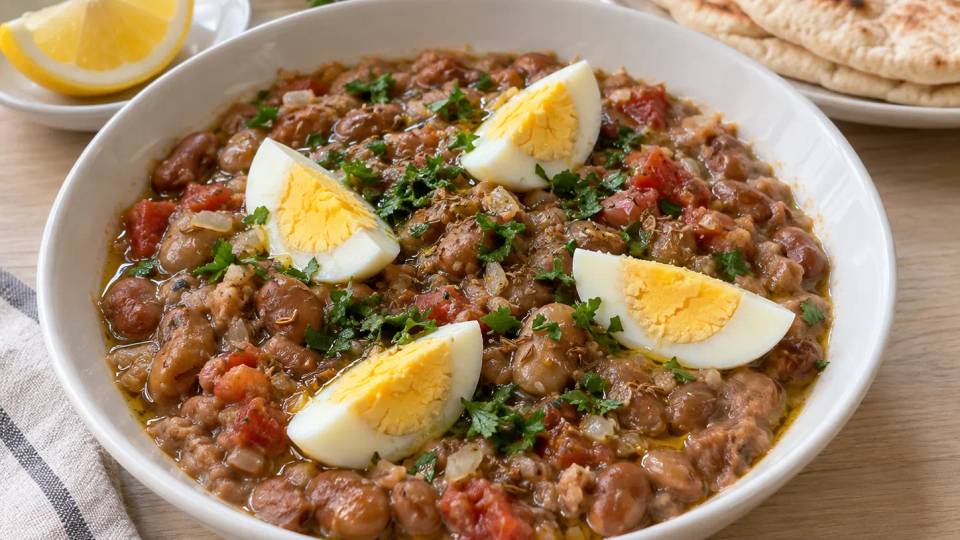
Ful with eggs
🥚 Ful medames enriched with hard-boiled eggs, an iconic Sudanese breakfast dish: tender fava beans, garlic, lemon, cumin, and oil, crowned with quartered hard-boiled eggs, nourishing, flavorful, and rooted in Nilotic tradition.
Ingredients
- 🫘 400 g dried fava beans (soaked overnight) or 2 cans drained fava beans
- 🥚 4 hard-boiled eggs, peeled and quartered
- 🧄 4 cloves garlic, crushed
- 🍋 Juice of 2 lemons
- 🌿 1 tsp ground cumin
- 🌿 1/2 tsp ground coriander
- 🌶️ 1 green or red chili, minced (optional)
- 🧅 1 onion, finely minced
- 🍅 2 ripe tomatoes, crushed
- 🫒 4 tbsp olive or vegetable oil
- 💧 Salt and black pepper
- 🌿 Fresh flat-leaf parsley for garnish
Preparation
🫘 If using dried fava beans, rinse them and soak in cold water overnight. Drain and cook in a large pot of unsalted boiling water for 40 to 50 minutes until very tender.
🥚 Meanwhile, cook the eggs: immerse in boiling water for 10 minutes, cool under cold water, peel, and quarter. Set aside.
🧄 In a large skillet, heat the oil over medium heat. Sauté the minced onion for 5 to 7 minutes until golden.
🍅 Add the crushed garlic, chili, and crushed tomatoes. Sauté for 5 minutes until the sauce thickens.
🫘 Add the cooked and drained fava beans (or canned). Lightly mash about a third of the fava beans with a fork to create a creamy texture.
🌿 Add the cumin, coriander, salt, and pepper. Pour in the lemon juice and mix well.
🔥 Simmer for 10 minutes over low heat, adding a little water if necessary to prevent sticking.
🥚 Arrange the hard-boiled egg quarters on top of the ful. Drizzle with an extra splash of olive oil.
🌿 Garnish with chopped fresh parsley and serve immediately with Sudanese bread (kissra or white bread).
Introduction
🇩🇯 This Sudanese-inspired recipe is offered as an adaptation for a Djiboutian table, rather than as a traditional speciality originating exclusively in Djibouti. Historical, family and religious background below describes its cuisine of origin and should not be read as universal Djiboutian customs. The ingredients, quantities and method define the version proposed here.
🥚 Full Introduction — Ful with Hard-Boiled Eggs. In Sudan, breakfast is a sacred ritual, and ful medames is its undisputed centerpiece. 🌅 This preparation of slowly simmered fava beans, flavored with garlic, cumin, and lemon, is much more than a simple morning meal: it's a cultural act, a living link to centuries of Nilotic culinary tradition, a bridge between the cuisine of ancient Egypt, Sudan, and the entire Horn of Africa. When quartered hard-boiled eggs are added — generously arranged on the tender fava beans and drizzled with golden oil — the dish transforms into a true celebration of Sudanese generosity. 🥚✨
🌍 Historical and Cultural Context. Ful medames is one of the oldest dishes in the world. Traces of its consumption have been found in archaeological sites dating back several millennia BCE in Egypt and Nubia. The word “medames” comes from Coptic Egyptian and means “buried” or “cooked in the earth,” referring to the ancient cooking method of burying a pot of fava beans in embers overnight. 🏺 In Sudan, this tradition has continued with rich local variations: addition of tomatoes, chili, garlic, cumin, sesame, or cheese. Ful with hard-boiled eggs is particularly popular in cities like Khartoum, Omdurman, and Port Sudan, where it is sold on the streets by vendors from dawn. 🌆
☀️ Ful, the Pillar of the Day. In Sudanese households, ful is prepared in large quantities in the morning and eaten for breakfast by the whole family. Children eat it before school, workers take it wrapped in bread for their commute, and elders savor it slowly with spiced milk tea. 🍵 The addition of hard-boiled eggs is not just a matter of taste: it also meets a deep nutritional need, as the fava bean-egg combination offers complete protein and sustained energy. During Ramadan, this dish is often served for suhoor (pre-fast meal) for its ability to keep one full for a long time. 🌙
🧑🍳 Cooking Techniques. The secret to good ful lies in the slow and patient cooking of the fava beans. If using dried fava beans, overnight soaking is essential to soften them and reduce their cooking time. 💧 The traditional method involves cooking the fava beans in an earthenware pot over hot embers, but an ordinary saucepan or pressure cooker works very well. The art of ful also lies in partial mashing: about a third of the fava beans are coarsely mashed to create a creamy base while retaining whole fava beans that provide texture. Hard-boiled eggs, meanwhile, are added last to prevent them from overheating and becoming rubbery.
👨🏾🍳 Chef's Tips. 💡 For an even more flavorful ful, add a spoonful of tahini (sesame paste) at the end of cooking: this very Sudanese touch brings an incomparable creaminess and nutty aroma. A little harissa or dakwa (Sudanese spice blend) can replace or complement the chili. For the eggs, cook them for exactly 10 minutes for a well-cooked but still slightly soft yolk. Use very good quality oil as it finishes the dish by providing shine and richness. Never salt the fava bean cooking water as salt hardens their skin. 🫒
🗺️ Regional Variations. In northern Sudan, in the Nubian regions, chopped dried dates and a pinch of cinnamon are added. In Darfur, ground toasted sesame and hot chili are incorporated. In neighboring Eritrea, ful is served with fermented injera. In Ethiopia, it is flavored with berbere. In the coastal areas of Port Sudan, versions with crumbled dried fish can be found. The Khartoumate version is often milder and creamier, with more tomatoes and less chili. 🌶️
🥗 Pairings and Drinks. Ful with hard-boiled eggs is traditionally served with Sudanese bread — kissra (fermented sorghum flatbread), white bread, or sesame bread — for dipping and scooping up the generous sauce. 🫓 It is accompanied by a salad of fresh sliced tomatoes, onions, cucumber, and a drizzle of lemon. Marinated olives, local white cheese (jibna), or a spoonful of tahini can enrich the platter. As a drink, Sudanese milk tea — strong, spiced with cardamom, and sweetened — is the classic companion. A fresh ginger infusion or fresh water with mint are also perfectly suitable. ☕🍵
Cultural context
🥚 Ful medames is the national dish of Sudan, mainly eaten for breakfast. The addition of hard-boiled eggs is a widespread urban practice in Khartoum and Omdurman. This dish symbolizes Sudanese generosity and conviviality.
Tips
💡 Add 1 tbsp tahini at the end of cooking for an even creamier version.
🥚 Cook eggs for exactly 10 min for a soft yolk.
🧂 Never salt the fava bean cooking water to keep their skin tender.
🫒 Finish with a drizzle of quality olive oil for shine.
🌿 Fresh parsley is essential for the final freshness.
🇸🇩
Variations
🗺️ Tahini at the end of cooking (Khartoum), dried dates and cinnamon (Nubia), toasted sesame and hot chili (Darfur), version with injera (neighboring Eritrea), crumbled dried fish (Port Sudan).
Accompaniments
🫓 Kissra, white bread, sesame bread. 🥗 Tomato-cucumber salad, olives, jibna. 🥤 Sudanese milk tea (cardamom), ginger infusion.
Nutrition notes
Nutrition figures are estimates per serving for the stated ingredients and yield. Bread, rice, sauces or drinks suggested separately are not automatically included. Products used, draining, oil absorption and serving size affect the result. Spices are used for flavour; no therapeutic effect is attributed to this dish.