Xalwo
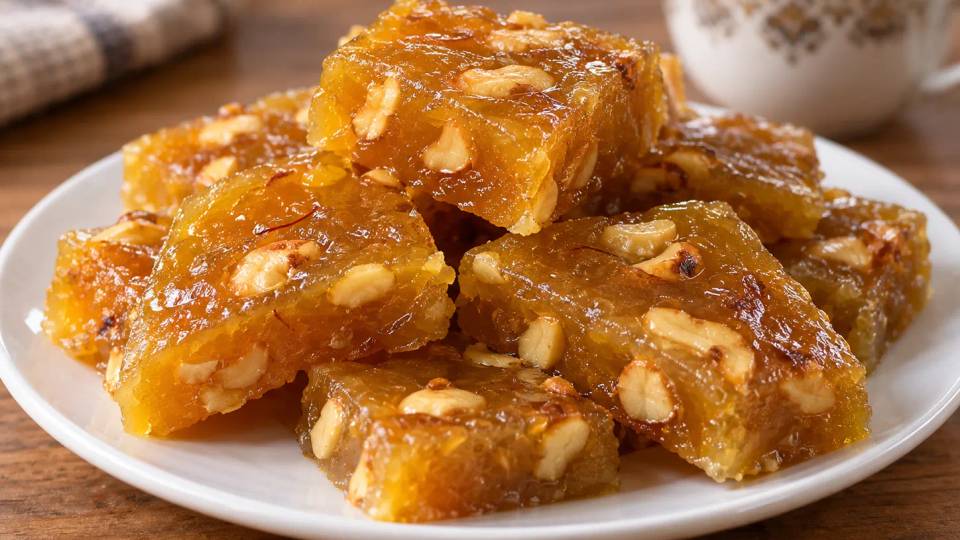
🍬 A dense, shiny confectionery made from sugar, starch, ghee, and spices, traditionally served during celebrations and special gatherings.
Ingredients
- 300 g sugar
- 500 ml water
- 90 g corn or potato starch
- 120 g ghee or clarified butter
- 1 tsp ground cardamom
- 1/4 tsp freshly grated nutmeg
- A few saffron threads infused in 1 tbsp hot water, optional
- 60 g unsalted roasted peanuts, almonds, or cashews
- 1 pinch salt
- A little ghee and starch for the mold and cutting
Preparation
🧈 Grease a small square mold or a shallow dish and sprinkle it very lightly with starch. Mix the starch with 200 ml of cold water until perfectly smooth.
🍯 In a heavy-bottomed saucepan, bring the sugar and the remaining 300 ml of water to a simmer. Stir only until dissolved, then gradually add the dissolved starch while whisking.
🔥 Cook over low to medium heat, stirring constantly with a sturdy spatula. The mixture will thicken then become shiny and elastic. This step requires patience: do not leave the saucepan and do not increase the heat to speed up the process.
✨ Incorporate the ghee in three additions, allowing each addition to be absorbed. Add cardamom, nutmeg, saffron, and nuts. Continue until the mixture partially detaches from the sides and forms a translucent mass.
🍬 Pour immediately into the mold, smooth the surface with an oiled spatula, and let cool for at least 2 hours. The confectionery should firm up without becoming dry.
🔪 Unmold, sprinkle very lightly with starch, and cut into small diamonds or squares with a greased knife. Serve small portions: Xalwo is rich and designed to be savored slowly.
🧼 Caution: hot sugar can cause severe burns. Keep children and pets away, use a tall saucepan, and let the preparation cool completely before tasting.
Introduction
🇩🇯 This version belongs to the culinary exchanges of the Horn of Africa. It retains its Somali heritage: serving it at a Djiboutian table does not make its origin exclusively Djiboutian. The following notes describe that culinary family and its home preparation, with seasonings that may vary between households.
🍬 Xalwo, often transliterated as Halwo, is a dense, shiny, and fragrant Somali confectionery that graces festive tables. Its composition seems simple — sugar, water, starch, ghee, and spices — but its preparation requires slow cooking, a steady hand, and rigorous attention to hot sugar. When successful, Xalwo is supple and slightly elastic, translucent in places, rich without being oily, and infused with the scent of cardamom. Nutmeg, saffron, and nuts can add additional nuances. ✨
This sweet treat belongs to a vast family of confections from the Red Sea, the Arab world, the Indian Ocean, and the Mediterranean, linked by the exchange of ingredients and techniques. In Somalia, however, it has its own customs, spellings, and family preferences. Ghee provides a milky depth; starch creates the texture; cardamom connects the dessert to the aromatic world of shaah and many regional pastries. The color can remain golden, become more amber depending on the cooking, or receive a discreet saffron note.
Xalwo is not a dessert to be consumed in a large bowl. It is a celebratory bite, often cut into small squares or diamonds and placed on a platter to share. It accompanies visits, weddings, family gatherings, and religious holidays, especially when hosting and wishing to offer something precious. This recipe respects this character by offering small portions, an assumed amount of sugar, and safety advice. It does not claim to impose a unique formula: proportions, fragrance, and nuts naturally vary according to families and regions.
Cultural context
🎉 Xalwo is intimately linked to the notion of celebration and hospitality. Preparing a large quantity of confectionery requires time, energy, and ingredients that may be reserved for special occasions; offering it in small portions therefore becomes a gesture of generosity. In Somali homes, a platter of sweets can circulate with tea, fruits, and conversations. The small size of the pieces allows everyone to taste without gluttony overshadowing the shared meal.
Somalia is located at the crossroads of maritime and land routes that have transported spices, sugar, textiles, languages, and culinary ideas. Cardamom, saffron, nuts, and clarified butter tell the story of these circulations without erasing local practices. The names Xalwo and Halwo also show that the same dessert can travel, be pronounced differently, and remain familiar. The important thing is not to freeze these cuisines: a festive recipe lives through the people who prepare it, the accessible ingredients, and the memories it awakens.
🕌 During Eid, weddings, births, or important visits, Xalwo can be offered among other sweets. A family custom should not be presented as a religious obligation: customs vary from place to place and from house to house. The most constant cultural value is hospitality. A bite offered with a glass of shaah, a word of welcome, and a seat at the table expresses an attention that goes beyond the recipe. Cunto wacan! — “Bon appétit!” in Somali.
Tips
🔥 Use a tall saucepan and never leave hot sugar unattended.
🥣 Dissolve the starch in cold water before incorporating it into the syrup.
🧈 Add the ghee little by little to obtain a smooth and shiny texture.
🌿 Use nutmeg sparingly: cardamom should remain the main fragrance.
🔪 Grease the knife and spatula before cutting or smoothing the confectionery.
🌰 Clearly mention the nuts to those serving themselves.
🍬 Cut small pieces: Xalwo is rich and should be enjoyed slowly.
Variations
🌼 Cardamom version: the most direct, with ghee and peanuts. Saffron version: add a small saffron infusion, without coloring. Cashew version: creamier and softer. Almond version: crunchier. Rose version: a very small amount of food-grade rose water can complement the cardamom. Some families prefer a firmer texture, others a more melting one; adapt the cooking time, but never compromise safety around hot sugar.
Accompaniments
🍵 Pairings: Somali shaah, light coffee, fresh fruits, dates, and unsalted roasted nuts. A plate of fruit brings freshness and fiber to balance the intense sweetness. Avoid combining Xalwo, sodas, and other syrups in the same serving; water and lightly sweetened tea better balance a festive service.
Nutrition notes
⚖️ Values are estimates per small 25g piece. Approximately 165 kcal and 27g carbohydrates reflect the very nature of this confectionery: sugar is its structuring ingredient and provides readily available energy, but it should be enjoyed as an occasional treat. The 6g of lipids primarily come from ghee and contribute to the rich texture; they also increase the energy density. Proteins and fibers remain low, although nuts provide small amounts of protein, vitamin E, magnesium, copper, and manganese. 🌰 Cardamom, nutmeg, and saffron provide a remarkable fragrance with very small quantities. They help create an impression of richness without adding even more sugar. The recipe is naturally low in salt — about 0.05g per serving — but it is not light. People with diabetes, nut allergies, or specific dietary needs should adapt their consumption and seek advice if necessary. Removing nuts removes the allergen but does not make the recipe low in sugar. 🍬 The nutritional interest of Xalwo is also social: a small shared bite allows one to participate in the joy of the celebration without seeking a large portion. Serve it after a meal including vegetables, protein, and grains, or with fruit and tea rather than on an empty stomach. Keeping small squares naturally helps moderate the quantity. Respect for tradition can go hand in hand with attention to individual needs: generosity is also seen in the choice to offer water, fruit, and adapted portions. Cunto wacan!