Cardamom rice
🍚 Cinnamon and Cardamom Bariis: soft and fragrant Somali rice, elevated by warm spices, golden onions, and a touch of Horn of Africa hospitality.
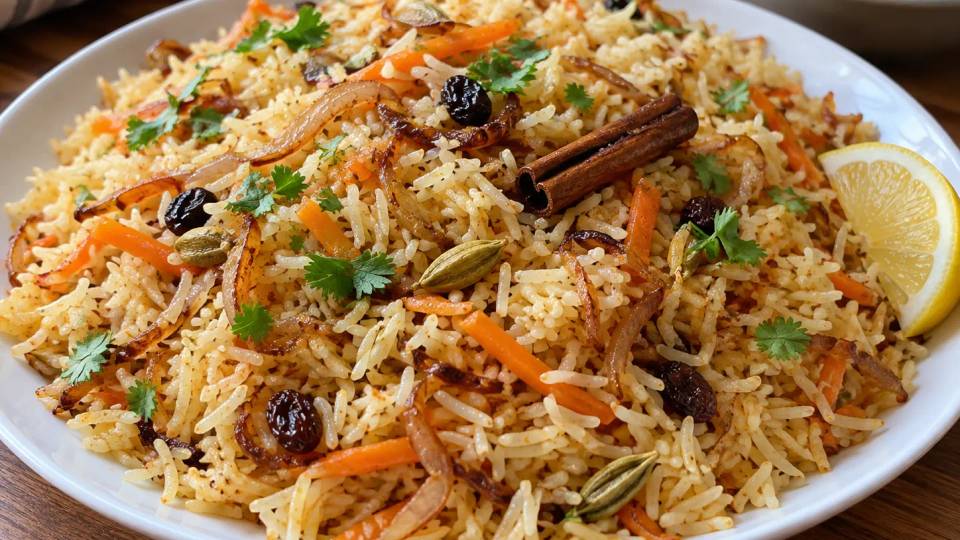
Ingredients
- 🍚 450 g basmati or long-grain rice, rinsed until water is almost clear
- 🧅 2 large onions, thinly sliced
- 🫗 4 tbsp vegetable oil or 2 tbsp oil + 20 g clarified butter
- 🧄 3 cloves garlic, crushed
- 🌿 1 small piece fresh ginger, grated
- 🌰 6 cardamom pods, lightly cracked
- 🌿 1 cinnamon stick
- 🌶️ 4 cloves
- 🌿 1 tsp ground cumin
- 🌿 1 tsp ground coriander
- 🌾 1/2 tsp black pepper
- 🥕 1 carrot, finely julienned
- 🍇 40 g raisins, optional
- 💧 750 ml hot water or light broth
- 🧂 1 to 1.5 tsp salt, depending on the broth
- 🍋 1 lemon, quartered, for serving
- 🌿 Fresh cilantro or parsley for garnish
Preparation
1️⃣ Rinse the rice several times, drain it, and let it rest for 10 minutes so the grains remain separate.
2️⃣ Heat the oil in a heavy-bottomed pot. Sauté the onions until beautifully golden, then add garlic and ginger.
3️⃣ Add cardamom, cinnamon, cloves, cumin, coriander, and pepper. Stir for 30 to 45 seconds to awaken the spices without burning them.
4️⃣ Incorporate the carrot and raisins if using, then add the rice. Gently mix for 2 minutes to coat each grain.
5️⃣ Add hot water and salt, bring to a simmer, cover tightly, and cook over very low heat for 18 to 20 minutes.
6️⃣ Turn off the heat, let it rest for 10 minutes without opening, then fluff with a fork. Sprinkle with fresh herbs.
7️⃣ Serve hot with lemon, a crisp salad, meat, or vegetables, depending on the meal. 🍽️ Cunto wacan! / بالهنا والشفاء !
Introduction
🇩🇯 This version belongs to the culinary exchanges of the Horn of Africa. It retains its Somali heritage: serving it at a Djiboutian table does not make its origin exclusively Djiboutian. The following notes describe that culinary family and its home preparation, with seasonings that may vary between households.
🍚 Full Introduction — Cinnamon and Cardamom Bariis. In many Somali households, the word bariis doesn't just mean cooked rice: it evokes a whole range of fragrant, welcoming, and carefully seasoned meals, capable of nourishing a family, honoring a guest, or giving an ordinary lunch a discreet festive air. This cinnamon and cardamom version highlights two immediately recognizable aromas in the kitchens of the Horn of Africa and the Indian Ocean. 🌍 Cinnamon brings a round, sweet, and deep warmth; cardamom, livelier and almost lemony, lifts the dish and prevents it from becoming heavy. When well-balanced, these spices do not sweeten the rice or confine it to a dessert interpretation; instead, they build a warm, elegant, and savory aromatic architecture.
📜 Historical and Cultural Context. For centuries, Somalia has been at the crossroads of maritime and trade routes connecting the Horn of Africa, the Arabian Peninsula, the Swahili coast, the Red Sea, and the Indian Ocean. Ports, markets, pastoral caravans, and family movements have transported rice, spices, fabrics, tea, sugar, dried fruits, and culinary techniques. Rice itself is therefore not a foreign body in this cuisine: it has been adopted, re-worked, and naturalized by local gestures, by domestic pots, by sharing habits, and by the preferred spices in homes. Cinnamon and cardamom tell this story of circulation, but they are not enough to explain the dish. What makes bariis Somali is also the way onions are browned, water is measured, excess fat is avoided, it's served with lemon, salad, chili sauce, or sometimes banana, and above all, the way the meal is considered a form of relationship.
🕌 Social and Religious Context. In much of Somalia, the family table is part of predominantly Muslim practices, but it would be reductive to turn every plate into an automatic religious symbol. Cinnamon and cardamom bariis can be served on a weeknight, a Friday, during Ramadan after breaking the fast, for Eid, during a visit, or simply because one wants a fragrant and satisfying meal. The same spices can accompany halal meat, fish, vegetables, or a simpler preparation without significant protein. Hospitality is read less in a single rule than in concrete attention: carefully washing the rice, offering chili separately, announcing the presence of broth or clarified butter, adjusting salt for elders, arranging lemon wedges for guests who like more freshness. 🙏
🏠 Home Cooking and Memory. Many cooks learn this type of bariis not from a manual, but by observing a mother, an aunt, a neighbor, or a relative make the right gesture: listening to the crackling of onions, sensing the moment when spices open up, guessing if the lid keeps enough steam, knowing when to let the rice rest off the heat. The dish seems simple, but this simplicity requires precision and patience. Over-stirred bariis becomes pasty; overly wet bariis loses its lightness; overly spiced bariis tires the palate. When successful, each grain remains distinct, carries a film of fragrant oil, absorbs the warm notes of cinnamon and cardamom, and accompanies a full meal as well as a more modest plate.
🔥 Cooking Technique and Logic. Success first relies on the onion. It must be given time to brown thoroughly, as it provides sweetness and depth without requiring much fat. Then come the whole or ground spices, heated just enough to release their essential oils. Cardamom does not tolerate burning well; cinnamon becomes bitter if it blackens; cumin and coriander should bloom briefly. The rinsed rice then joins the pot to be coated: this gesture helps it stay cleaner when cooked. Hot water, not cold, maintains thermal stability. Then begins the most difficult step for impatient cooks: cover and do not open. The steam works in silence. It is what gives bariis its texture. ⏳
🥕 Aromatics, Sweetness, and Balance. Many Somali versions of fragrant rice play on small touches of natural sweetness: finely julienned carrots, a few raisins, sometimes more deeply caramelized onions. This sweetness is not there to make the dish a dessert, but to temper the warmth of the spices, accompany a saltier sauce, or balance an intense meat. In some homes, a ripe banana is even served near the rice, not as a separate dessert, but as a familiar contrast. Again, one must resist generalizations: not all families do it, and no variant cancels out the others. Somalia's culinary truth is plural. 🤝
🍽️ Serving and Table Life. Cinnamon and cardamom bariis can be arranged in a large communal dish or portioned onto plates. It can be offered with a tomato, cucumber, and onion salad, with a chili sauce like basbaas, with sautéed vegetables, a stewed meat, grilled fish, or spiced chickpeas. In a simple reception, the beauty of the dish already lies in its fragrance: when the lid is lifted, guests know that something carefully prepared is arriving at the table. Lemon brings a welcome brightness; fresh herbs lighten the rich sensation. If the meal is larger, this bariis can serve as a base for several garnishes. If it is more intimate, it is often sufficient on its own with a well-seasoned salad and tea served later.
💪 Nutritional Benefits and Contemporary Interpretation. Rice provides a clear and well-tolerated energy base. Spices, without turning the dish into a miracle cure, provide interesting aromatic and antioxidant compounds; carrots and herbs contribute vitamin A, vitamin C, and fiber; if the dish is accompanied by lean protein, it becomes a complete and satisfying meal. The classic points of vigilance are: the salt in the broth, the amount of oil, and portion sizes. Prepared at home with moderation, this bariis remains more controllable than many industrial dishes. It can easily adapt to a daily table by increasing the proportion of vegetables and serving sauces separately.
✨ Conclusion. Cinnamon and cardamom bariis summarizes a great lesson from Somali cuisine: with few ingredients, but with precision, one obtains a dish that is at once simple, noble, and profoundly hospitable. The warm spices do not overpower the rice; they elevate it. The act of covering, waiting, and serving with care becomes as important as the ingredient list itself. This bariis speaks of port history, domestic attention, shared meals, and tastes that have traveled without losing their local roots. Serve it hot, let everyone adjust lemon or chili, and finish with the phrase that connects cuisine and courtesy: Cunto wacan! in Somali, بالهنا والشفاء in Arabic — bon appétit to everyone at the table. 🫶🏽
Cultural context
🇸🇴 Fragrant bariis with warm spices recalls Somalia's maritime and mercantile roots, but above all, the importance of hospitality. It appears in ordinary meals as well as on Fridays, during Ramadan, Eid, visits, and large family gatherings, without any single version being universal.
Tips
🧅 Brown the onions slowly for depth of flavor.
🌰 Lightly crack the cardamom pods to better release their fragrance.
🔥 Heat spices briefly: fragrant yes, burnt no.
💧 Use hot water and keep the lid closed until resting.
🍋 Serve lemon and chili separately for a more flexible table.
🗣️ Cunto wacan! / بالهنا والشفاء — bon appétit!
Variations
🗺️ Some households add raisins, carrots, bell peppers, or a little clarified butter; others prefer a drier, more austere version. On the coast, it can accompany fish and lemon; in festive contexts, it serves as a base for stewed meat. In the diaspora, very fragrant basmati or a mix with long-grain rice is sometimes used.
Accompaniments
🥗 Tomato-cucumber salad, basbaas, plain yogurt, stewed halal meat, grilled fish, or spiced chickpeas. 🥤 Shaah, lemon water, tamarind juice, lightly sweetened ginger drink.
Nutrition notes
💪 Estimated per serving: approximately 430 kcal, 8 g protein, 73 g carbohydrates, 11 g fat, 3 g fiber, 470 mg sodium, and 1.2 g salt. Rice provides energy; carrots, herbs, and lemon provide fiber, vitamin A, vitamin C, and folate; spices contribute to the aroma without requiring more fat.