Millet crêpes
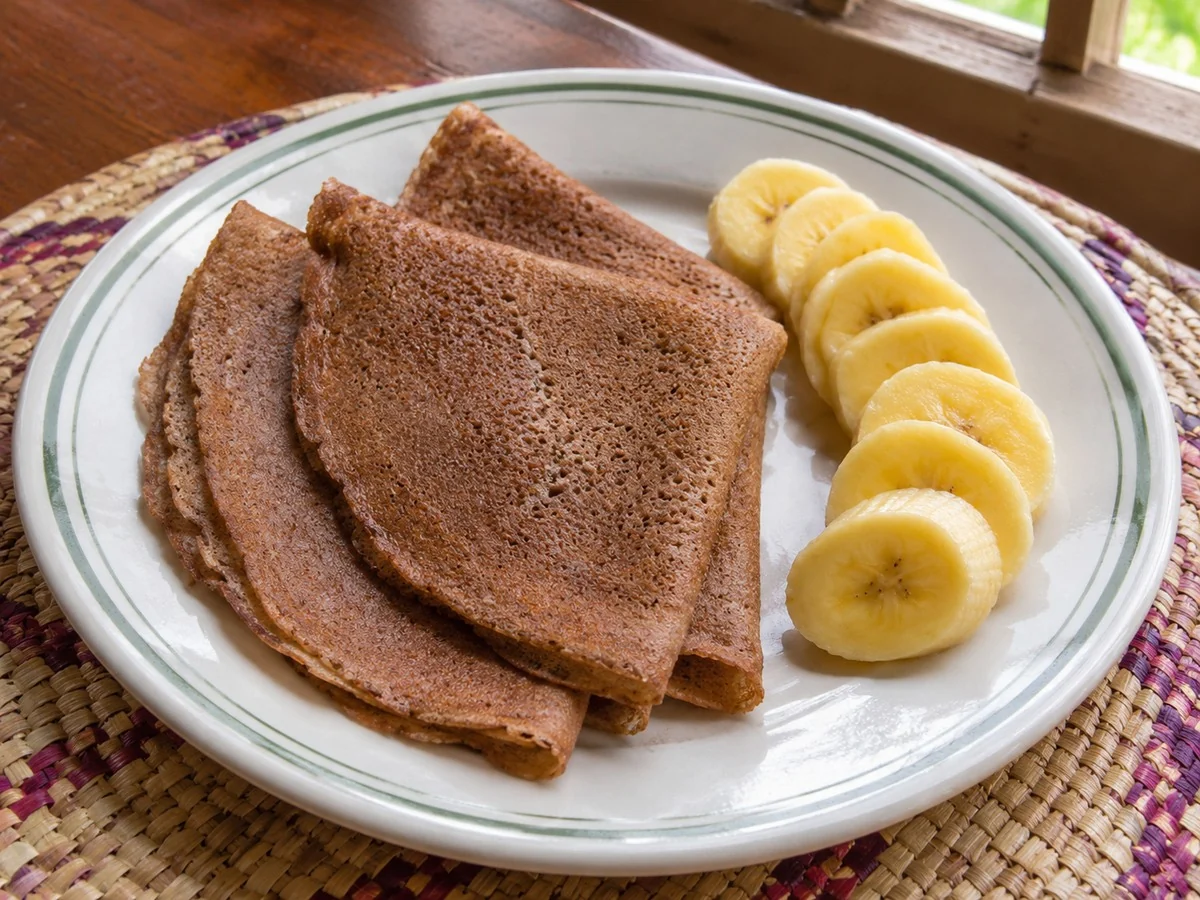
These millet crêpes are thin, lightly browned and pliable enough to fold into quarters. Wheat flour supplements the millet flour, and eggs bind the batter as it cooks. Millet makes up most of the flour, so its flavour comes through. The recipe makes four portions, with ripe banana to serve alongside. The key is how much batter goes into the pan and how hot the pan stays between crêpes. Make a test crêpe before cooking the rest.
Ingredients
- 160 g millet flour
- 60 g wheat flour
- 2 eggs
- 400 ml water
- 20 ml vegetable oil
- ≈2 g fine salt
Preparation
Combine both flours and the salt in the bowl. Make a well and crack in the eggs. Whisk in the centre, gradually drawing in some flour. When the mixture becomes difficult to work, add some water. Keep whisking from the centre outwards so the flour is already moist before you add much liquid.
Add most of the 400 ml of water and scrape across the base of the bowl. The batter should run off the whisk easily without clumps. Rest it for about ten minutes. Stir and add the reserved water if the stream looks too thick. Lift some with the ladle to check. Loosen it before cooking if it falls in large lumps.
Heat the pan over medium heat and wipe it with a film of oil. Pour a small ladleful in the centre, then tilt the pan immediately to spread the batter in a thin layer across the base. If it floods the pan before you finish tilting, use a smaller ladleful next time. If it sets too quickly to spread, lower the heat slightly.
Wait until the edges turn matte and release in places. Slide a spatula under one side and check that the base lifts easily before moving the whole crêpe. Turn it in one motion and finish the second side. The cooked crêpe is supple and matte with no liquid batter in the centre. Transfer it to a plate.
Stir briefly before each ladleful to lift settled millet flour into the batter. Oil the pan again if it sticks. Continue until all the batter is used. Stack the crêpes to keep them pliable for folding. Serve plain or with sliced banana on the side.
Introduction
Ingredients and equipment
Allow 160 g of millet flour, 60 g of wheat flour, two eggs, 400 ml of water, 20 ml of oil and about 2 g of fine salt. A ripe banana can be served separately. Use a mixing bowl, a whisk, a small ladle, a flat-based frying pan and a thin spatula. A pan around twenty centimetres across makes it easy to cook evenly sized crêpes. Allow about fifteen minutes for the batter, ten minutes to rest and twenty-five minutes to cook. Timing depends on the pan diameter and how much batter you use per crêpe.
Finely milled millet flour spreads more readily in the batter. Coarser flour also works, but feels grainier and settles in the bowl between batches. Measure the water in a jug, adding most of it at first and reserving the last few spoonfuls for adjustments after resting. The amount you need also depends on egg size.
Step-by-step preparation
1. Combine both flours and the salt in the bowl. Make a well and crack in the eggs. Whisk in the centre, gradually drawing in some flour. When the mixture becomes difficult to work, add some water. Keep whisking from the centre outwards so the flour is already moist before you add much liquid.
2. Add most of the 400 ml of water and scrape across the base of the bowl. The batter should run off the whisk easily without clumps. Rest it for about ten minutes. Stir and add the reserved water if the stream looks too thick. Lift some with the ladle to check. Loosen it before cooking if it falls in large lumps.
3. Heat the pan over medium heat and wipe it with a film of oil. Pour a small ladleful in the centre, then tilt the pan immediately to spread the batter in a thin layer across the base. If it floods the pan before you finish tilting, use a smaller ladleful next time. If it sets too quickly to spread, lower the heat slightly.
4. Wait until the edges turn matte and release in places. Slide a spatula under one side and check that the base lifts easily before moving the whole crêpe. Turn it in one motion and finish the second side. The cooked crêpe is supple and matte with no liquid batter in the centre. Transfer it to a plate.
5. Stir briefly before each ladleful to lift settled millet flour into the batter. Oil the pan again if it sticks. Continue until all the batter is used. Stack the crêpes to keep them pliable for folding. Serve plain or with sliced banana on the side.
Adjusting after the first crêpe
If the edges crumble when you turn it, let the first side set longer. A wider spatula helps support the centre. If the crêpe is too thick, stir to check for flour at the bottom, then add reserved water a little at a time if needed. In a cold pan, the batter can pool and stay pale. Give the pan time to heat up before cooking the next piece. If patches brown almost immediately, turn the heat down and wait for the surface temperature to settle.
For a half batch, use one egg and halve the flour, water and oil. Use the same ladleful for each crêpe. For a larger table, two pans of similar diameter speed up serving. Divide the batter between two bowls, stirring each before filling the ladle. This makes it easier to compare the yield and adjust the thickness without changing the whole batch.
Serving and nutrition
Fold into halves or quarters. If serving with banana, slice it at the last minute and put it on a small plate. The crêpes contain wheat and eggs. The flours mainly provide carbohydrates. Oil absorption depends on the pan and how much you use to grease it again. Count the crêpes to divide them into four portions, pairing smaller and larger ones if the first batch was uneven. The fruit served separately is outside the weight of the crêpes.
To keep the millet flavour noticeable, taste a plain crêpe first, then add small bites of banana. A ripe banana provides enough sweetness at serving.
To set up while cooking, put the whole bananas beside the plates and have a clean knife ready. Cutting at the last minute keeps the fruit fresh and prevents it from wetting the crêpes as they stand.
Cultural context
This home adaptation uses millet, a grain already found in kalo and porridges in the Ugandan collection. Here, the liquid batter spreads in the pan and needs to turn in one piece. The chapati in the first volume starts with a firm dough rolled out before it goes on the heat. These crêpes take shape directly in the pan. The flour blend and the banana accompaniment are specific to this recipe. Serve plain if they accompany a drink or another sweet dish.
Nutrition notes
Estimated nutrition per serving. Before adjustment for cooking losses · Calcium 20 mg · Iron 3.0 mg · Potassium 166 mg · Vitamin A 30 µg RAE · Vitamin C 0.0 mg