Millet porridge
This millet porridge is served hot in a bowl or wide cup. It is loose enough to pour and thick enough to lightly coat a spoon. Start by mixing the flour with cold water so the particles disperse before they thicken. Serve it plain, with a pinch of salt or with sugar on the side. The four portions are suitable for breakfast or a snack. The final volume depends mostly on how much water evaporates.
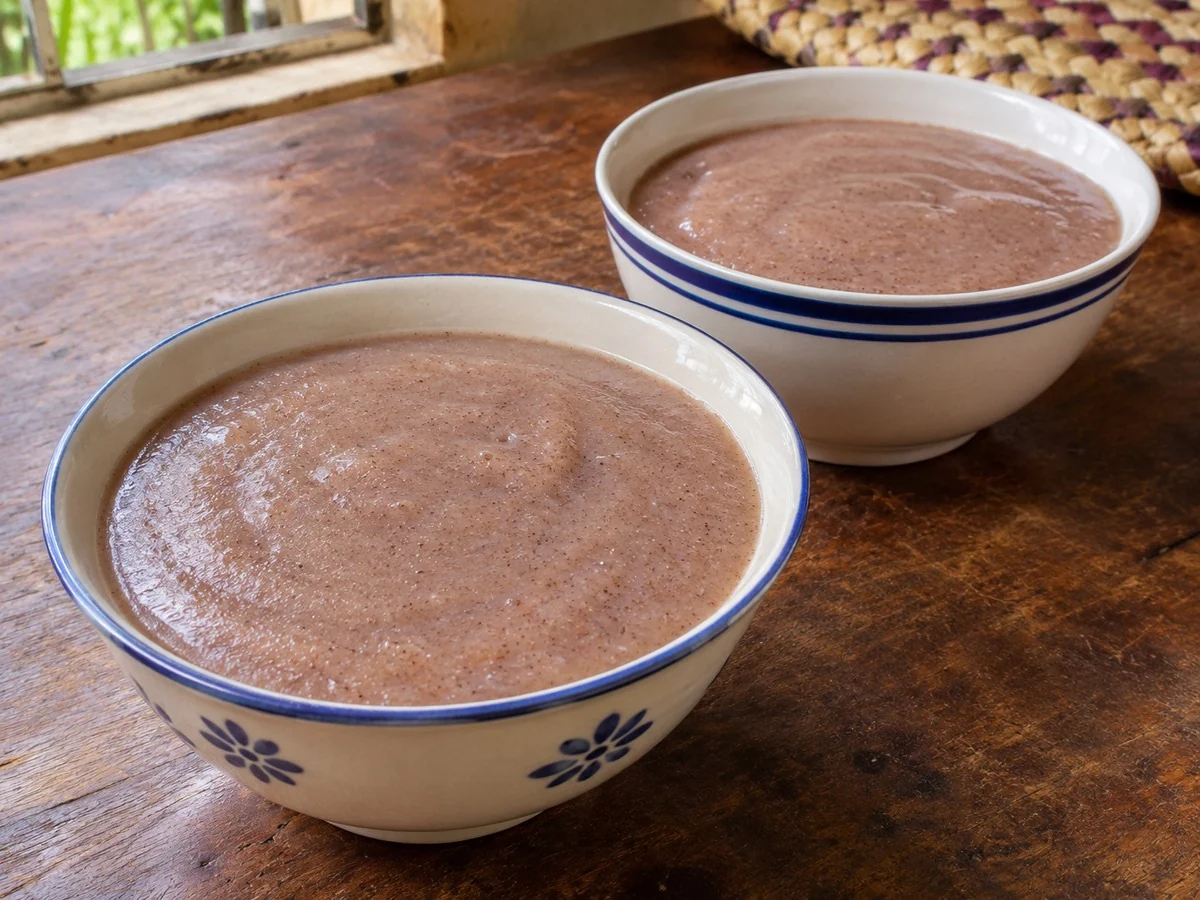
Ingredients
- 95 g millet flour
- 750 ml water
- 1 g fine salt
- ≤15 g sugar, optional
Preparation
Pour 200 ml of cold water into the bowl. Sprinkle in the flour and whisk as you go so all the powder is moistened. Scrape the sides and base. Crush any dry lumps against the bowl with the back of a spoon. The slurry should run off the whisk without large clumps.
Heat the remaining 550 ml in the saucepan. When small bubbles appear around the edge, lower the heat slightly. Whisk the slurry again because some flour may have settled while the water heated. Pour it in slowly, stirring throughout. Scrape the bowl with the spatula to transfer any thick layer at the bottom.
Keep whisking briefly to disperse the slurry throughout the water. When the porridge looks even, switch to the spatula if it reaches the corners more easily. Keep a gentle simmer and scrape the base regularly. Lower the heat if thick bubbles rise and splatter.
Cook for about fifteen to eighteen minutes. Cool a small spoonful and taste it. It should be smooth or a little grainy depending on the flour, with no dry, powdery sensation. If it thickens too much before the end, whisk in a little hot water and let it return to a simmer before checking again.
Add salt to taste. For sweet porridge, stir in some sugar and let it dissolve before deciding whether to use the full amount. Stir once more and divide into four bowls. Serve at a comfortable temperature. The porridge thickens a little as it cools, so remove it from the heat while it still pours easily.
Introduction
Ingredients and equipment
For four small bowls, measure 95 g of edible millet flour, 750 ml of water, 1 g of fine salt and, if desired, up to 15 g of sugar. Reserve 200 ml of the water cold for mixing the flour and heat the remaining 550 ml in the pan. Keep a little extra hot water nearby if you prefer a thinner porridge. Use a bowl wide enough for whisking, a heavy-based saucepan and a whisk. A flat spatula helps reach the whole base and edges. Allow five minutes for preparation and about eighteen minutes of cooking from the time the slurry goes in.
Choose a fine flour and check the packet directions. Millet flour may be beige, grey or browner depending on the grain and milling. Colour alone cannot tell you when it is cooked. A coarse flour feels grainier and may take longer. For a first batch, choose a flour sold for porridge or one milled about as finely as ordinary cereal flour.
Step-by-step preparation
1. Pour 200 ml of cold water into the bowl. Sprinkle in the flour and whisk as you go so all the powder is moistened. Scrape the sides and base. Crush any dry lumps against the bowl with the back of a spoon. The slurry should run off the whisk without large clumps.
2. Heat the remaining 550 ml in the saucepan. When small bubbles appear around the edge, lower the heat slightly. Whisk the slurry again because some flour may have settled while the water heated. Pour it in slowly, stirring throughout. Scrape the bowl with the spatula to transfer any thick layer at the bottom.
3. Keep whisking briefly to disperse the slurry throughout the water. When the porridge looks even, switch to the spatula if it reaches the corners more easily. Keep a gentle simmer and scrape the base regularly. Lower the heat if thick bubbles rise and splatter.
4. Cook for about fifteen to eighteen minutes. Cool a small spoonful and taste it. It should be smooth or a little grainy depending on the flour, with no dry, powdery sensation. If it thickens too much before the end, whisk in a little hot water and let it return to a simmer before checking again.
5. Add salt to taste. For sweet porridge, stir in some sugar and let it dissolve before deciding whether to use the full amount. Stir once more and divide into four bowls. Serve at a comfortable temperature. The porridge thickens a little as it cools, so remove it from the heat while it still pours easily.
Adjusting the texture
If lumps form as you pour, slow down and whisk where the slurry hits the pan. You can also scoop some lumps out, crush them in a little hot liquid and return them. If the porridge is still thin at the end, reduce gently and uncovered, stirring so a thick layer does not form on the base. If it thickens too much, use hot water to loosen it and keep the simmer steady.
Use a smaller pan for a half batch. A pan that is too wide evaporates water quickly and can make a firmer porridge at the same proportions. For a larger batch, check that the whisk can reach across the whole base. Mix the slurry in a bowl large enough to stir without sending flour over the sides. Record the actual cooking time and extra water used if you want to reproduce the texture with the same flour.
Serving and nutrition
Serve in bowls with spoons, or in wide cups for a looser porridge. Set sugar on the table if people want to sweeten their own. Fresh fruit served separately can accompany the porridge without affecting the cooking. Millet flour supplies most of the carbohydrates in the plain version. Account for optional sugar separately in any calculation per serving. The final weight depends on the water actually used and how much evaporates. Weigh and divide the cooked porridge for four equal portions or add a small ladleful to each bowl in turn.
If serving in stages, pour the first portions and stir the remaining porridge before serving again. A spoonful of hot water helps if it has thickened while standing. Taste before adjusting salt or sugar.
Cultural context
Millet already appears in the Ugandan recipes from the first volume, particularly in the firm paste called kalo. This home preparation has a looser texture. Kalo is portioned with a spatula and goes with sauces. Porridge pours and is eaten with a spoon. The amount of flour, the initial slurry and the reduction all reflect this difference. This version is unfermented and uses millet flour and water, with seasonings adjusted at serving.
Nutrition notes
Estimated nutrition per serving. Before adjustment for cooking losses · Calcium 2 mg · Iron 1.3 mg · Potassium 66 mg · Vitamin A 0 µg RAE · Vitamin C 0.0 mg