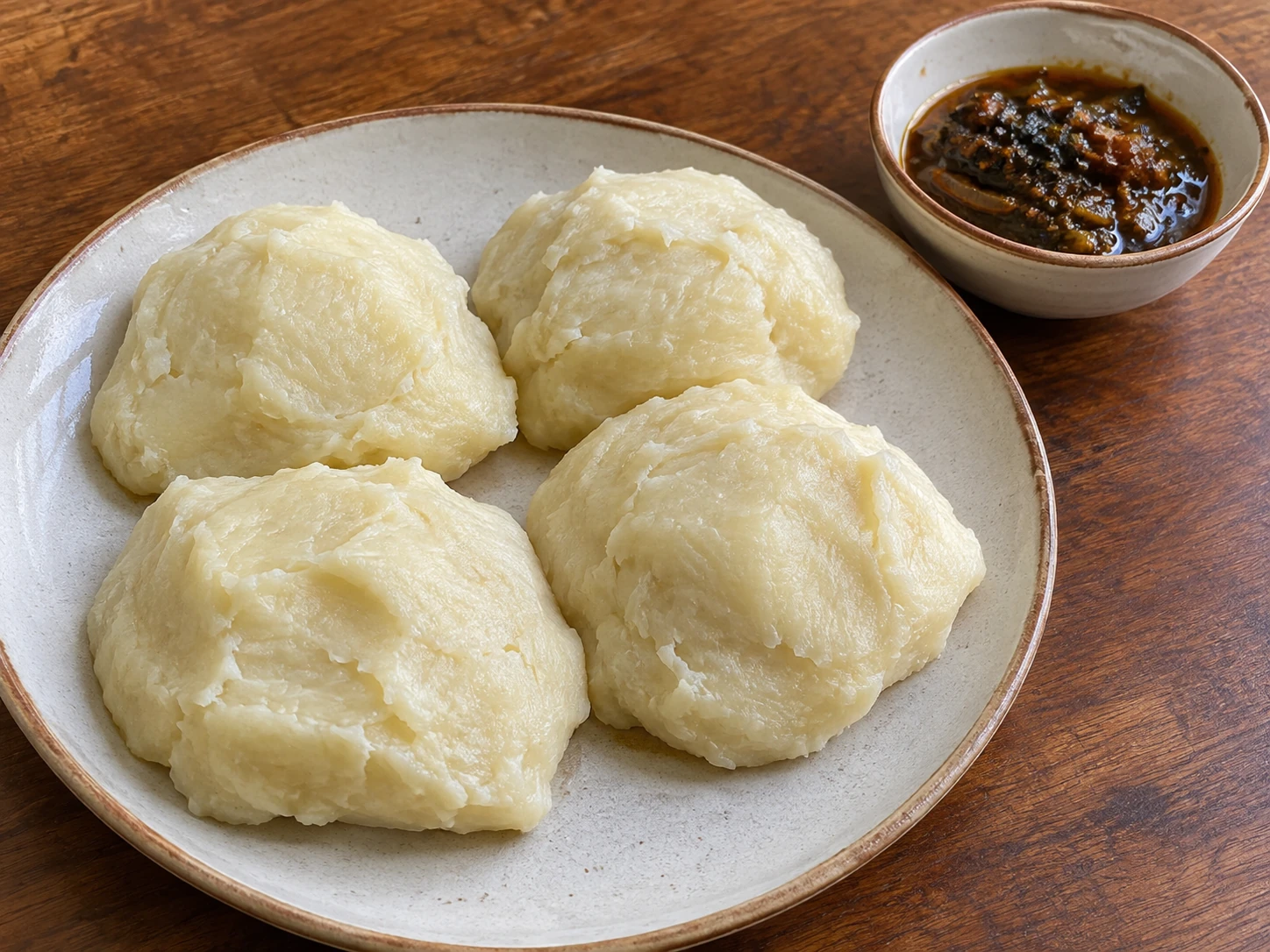
Lituma ya drap pounded cassava
Pound hot cooked cassava and shape it into pale portions to serve with sauce. This home adaptation uses commercially processed sweet cassava that is already fully cooked and explicitly sold ready to eat.
Ingredients
- 700 g fully cooked, ready-to-eat sweet cassava, drained weight
- Up to 40 ml hot water if needed and 2 g salt, optional
Preparation
Drain the cassava and remove the tough central fibre wherever it is visible. Set out a mortar, pestle, spatula and a lightly moistened serving plate before reheating the pieces.
Reheat the cassava according to the label. Start pounding a few pieces while hot, then add the rest a handful at a time. If the mortar is small, work in two batches and keep the second warm. Scrape the paste back towards the centre with the spatula.
If the mass is crumbly or deeply cracked, add a spoonful of hot water and pound again before adding more. Check that the paste will hold its shape when lifted with a spoon.
Divide into four with a damp spatula and shape. Serve straight away, with beans in sauce or a fish dish.
Cultural context
The IITA account describes lituma in Tshopo and the equatorial zone made from sweet cassava that is steamed and pounded. It records cassava-and-plantain mixtures and the name lituma ya drap for the all-cassava version. The RD Congo manuscript’s plantain lituma is a separate preparation. Using a ready-to-eat product here replaces the original processing of the root.
Source https://www.iita.org/wp-content/uploads/2023/03/Manioc.pdf https://doi.org/10.57745/RDMHWY
Nutrition notes
Read the label before buying. This method calls for fully cooked cassava in pieces. Raw cassava, raw frozen cassava and flour need different treatment and are outside the scope of this preparation. If a portion cools before pounding, reheat it separately according to the label. A slightly wet spatula helps shape warm portions without adding too much water to the paste.
Cassava supplies mainly carbohydrate. Choose the sauce and garnishes to round out the meal. Warm the sauce separately and bring it to the table with the freshly shaped portions so they do not cool while waiting.