Molé fried cassava from Kisangani
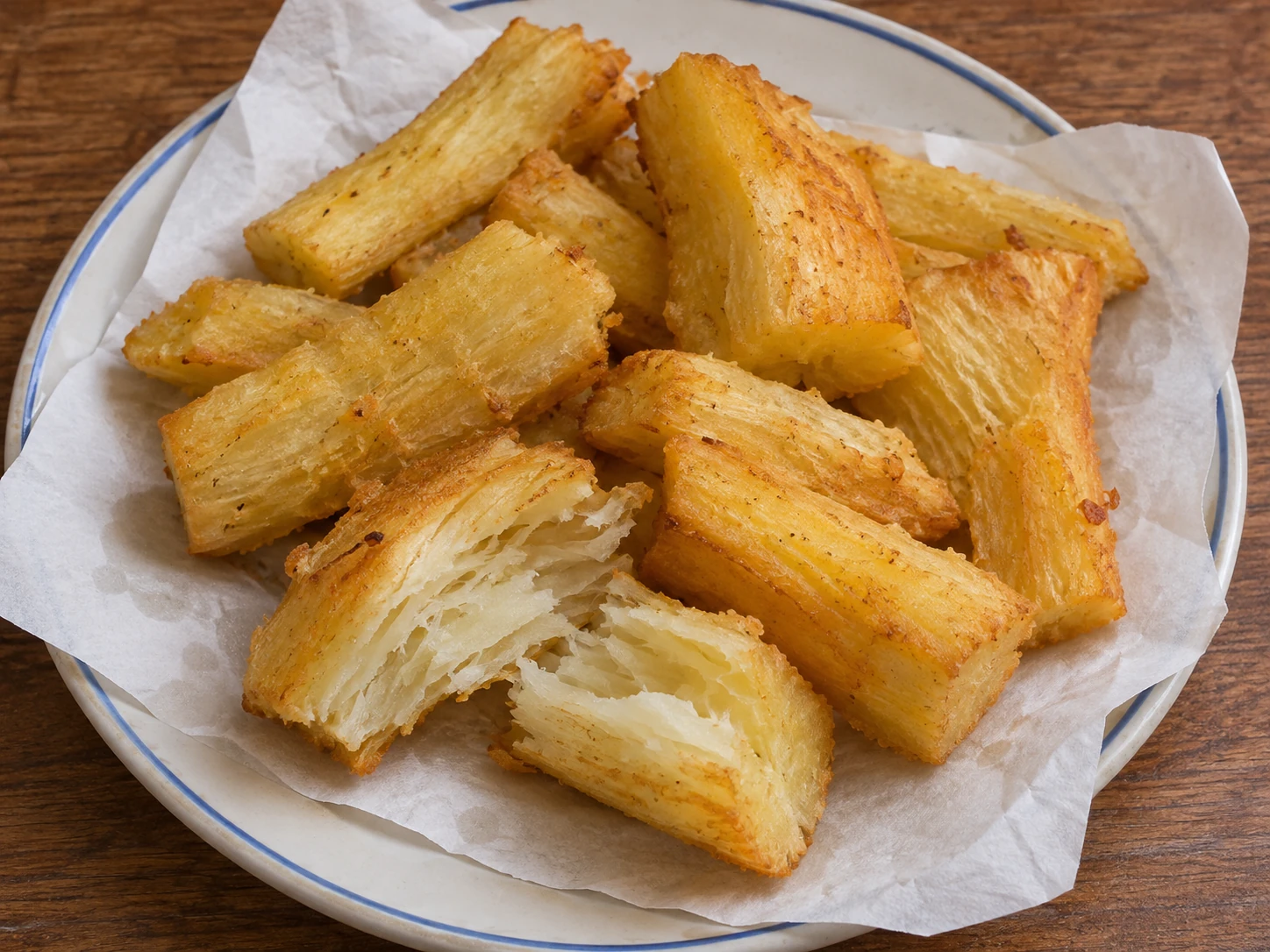
Fry fully cooked cassava until the edges turn golden and the inside stays tender. For this home adaptation use commercially prepared, fully cooked cassava explicitly labelled ready to eat. Keep the pieces dry and fry in small batches so the crust sets without breaking them.
Ingredients
- 650 g commercially processed sweet cassava, fully cooked, explicitly ready to eat and drained
- Food-grade red palm oil suitable for frying, or neutral frying oil for an adapted version
- Up to 2 g fine salt, optional
Preparation
Check the label and follow the manufacturer’s directions. Use the specified ready-to-eat product. Raw cassava or cassava labelled as frozen only is unsuitable for this method.
Cut the cassava into pieces 5–7 cm long and about 2 cm thick. Remove the central fibre if it is visible and tough. Dry both sides thoroughly. If the product has just been reheated, spread the pieces out to let steam escape before drying them.
Fill a deep-sided saucepan no more than one-third full with oil. Heat to about 170 °C. Lower in a small batch and fry for 4–6 minutes, depending on thickness, until the bubbling slows and the edges turn golden.
Lift out with a slotted spoon and drain on a rack. Let the oil return to temperature before adding each batch. Salt lightly, if using, and serve promptly.
Cultural context
The IITA account records the names Molé and Moleki-nzela in Kisangani for fried pieces of cassava. It describes several approaches, including frying cassava that has already been boiled. This adaptation starts with a fully cooked, properly processed product. Browning during frying cannot confirm that raw cassava has been adequately processed.
Source https://www.iita.org/wp-content/uploads/2023/03/Manioc.pdf https://doi.org/10.57745/RDMHWY
Nutrition notes
Follow the natural seams if a piece is already splitting. Fry a few pieces first and use the batch to judge the right size for the remainder. Shorter pieces are easier to lift if the cassava is very tender. Keep finished batches in one layer so that steam can escape. Serve as a snack, with a separate bowl of hot sauce, or beside fish and vegetables.
Cassava supplies mainly carbohydrate. The amount of oil absorbed varies with the surface moisture, size of the pieces and frying conditions. Check the ready-to-eat product and oil labels for allergen information.