Radish and ginger refrigerator pickles
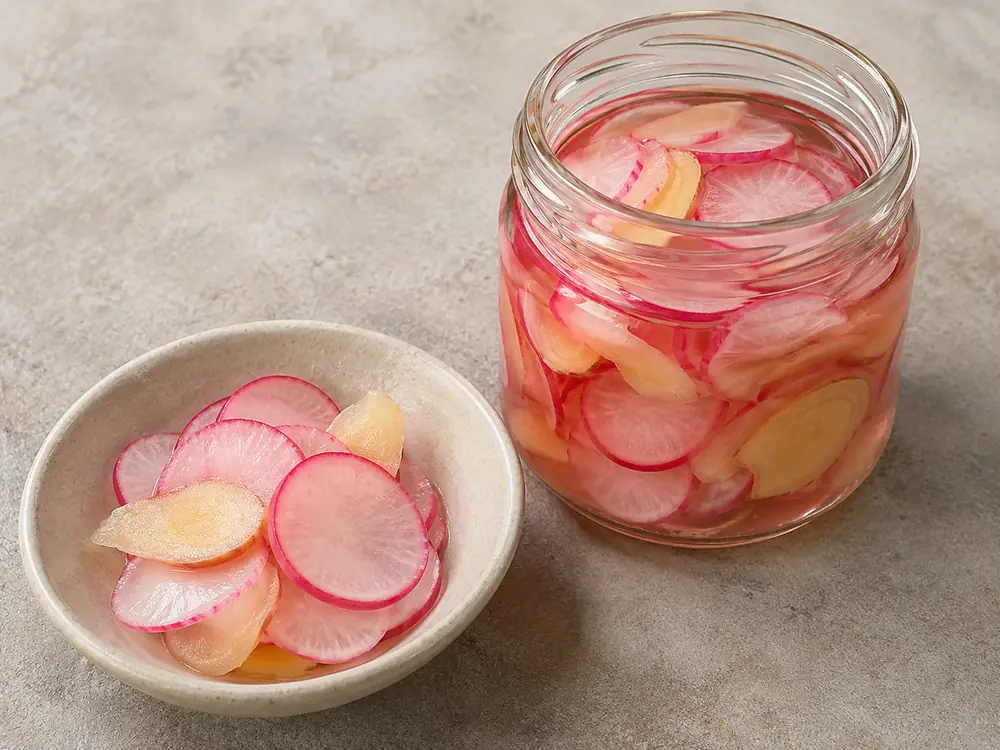
Radishes rest in ginger-scented vinegar liquid, retaining firmness while pink colour may diffuse into marinade. They supply modest crunch and acidity to sandwiches, composed salads or grilled food. Adding 300 g vegetables to roughly 240 ml liquid gives approximately 550–600 g total, not a misleading small 400 g jar. This contemporary formula differs from the first manuscript's pickled onions and carrot achar, without claiming a specific South African tradition. It is neither fermentation nor room-temperature canning.
Ingredients
- 300 g washed trimmed radishes
- 15 g peeled fresh ginger
- 120 ml food vinegar of at least 5% labelled acidity
- 120 ml water
- 25 g sugar
- 4 g salt
Preparation
Method at a glance — Slice radishes and ginger evenly into a suitable clean vessel. Heat water, vinegar, sugar and salt to simmer just until dissolved and pour over. Cool promptly and refrigerate at 4 °C or below at least 4 hours. Serve small drained portions and use the batch within 48 hours of preparation. This is not a shelf-stable preserve.
Slicing with regularity — Wash, remove tops and roots, then weigh 300 g ready radishes. Reject hollow or highly fibrous ones rather than expect resting to repair their texture. Slice a few millimetres thick with a sharp knife; regularity matters more than unsafe extreme thinness. Peel ginger and cut fine slices, trimming tough fibres. It remains identifiable and can be removed from serving portions. Puréeing instead clouds liquid and changes strength distribution.
Suitable vessel and marinade — Wash and rinse vessel and lid, choosing a clean roughly 750 ml container rated for hot liquid. Use two smaller appropriate containers if shape differs rather than discarding marinade to make vegetables fit. Arrange without heavy compacting. Measure labelled-acidity vinegar, water, sugar and salt separately. Heat to a simmer only until dissolved, not reduced to syrup. Pour over vegetables and distribute with a clean utensil for liquid contact. Release strong heat promptly and refrigerate at 4 °C or below. An external cold-water bath may help without entering food. Four-hour resting belongs in the refrigerator, not on a counter overnight. Coloured skins can turn all radish pink; that is expected and does not demand fresh marinade.
Short cold storage — Cold rest distributes flavour, not controlled fermentation. Count it within the 48-hour storage limit. Keep remaining pieces in contact with liquid and do not top up with plain water alone. Do not reuse finished marinade for new raw vegetables or restart the storage clock. A warm-filled clean jar is not a validated cupboard preserve. Uncertain storage, mould or unexpected gas calls for disposal rather than tasting to check. Fresh vinegar or reheating does not reliably rescue deterioration. Keep serving utensils clean and take out only needed portions.
Serving and conclusion — Lift with clean tongs or spoon and drain just before serving, leaving main jar liquid around remaining vegetables. Distribute ginger rather than giving one portion all its heat; remove slices from serving bowls if diners do not want to chew them. This is a condiment, not a large salad bowl. Reduce ginger slightly in a future batch rather than add much sugar to disguise excessive strength. A half-batch divides every ingredient together, not random vinegar-water changes. Even slicing, dissolved marinade and cold resting matter more than prolonged radish cooking. Enjoy your meal! Context retained from the French manuscript, consulted on 22 November 2026: https://extension.umn.edu/food/preparing/cooking-at-home/food-preservation/pickling
Introduction
Radishes rest in ginger-scented vinegar liquid, retaining firmness while pink colour may diffuse into marinade. They supply modest crunch and acidity to sandwiches, composed salads or grilled food. Adding 300 g vegetables to roughly 240 ml liquid gives approximately 550–600 g total, not a misleading small 400 g jar. This contemporary formula differs from the first manuscript's pickled onions and carrot achar, without claiming a specific South African tradition. It is neither fermentation nor room-temperature canning.
Planning
Approximately 550–600 g including liquid; approximately 750 ml vessel; preparation 15 min; heating 5 min; refrigeration at least 4 h.
Enjoy your meal
Enjoy your meal!