Cocoa and vanilla marble loaf
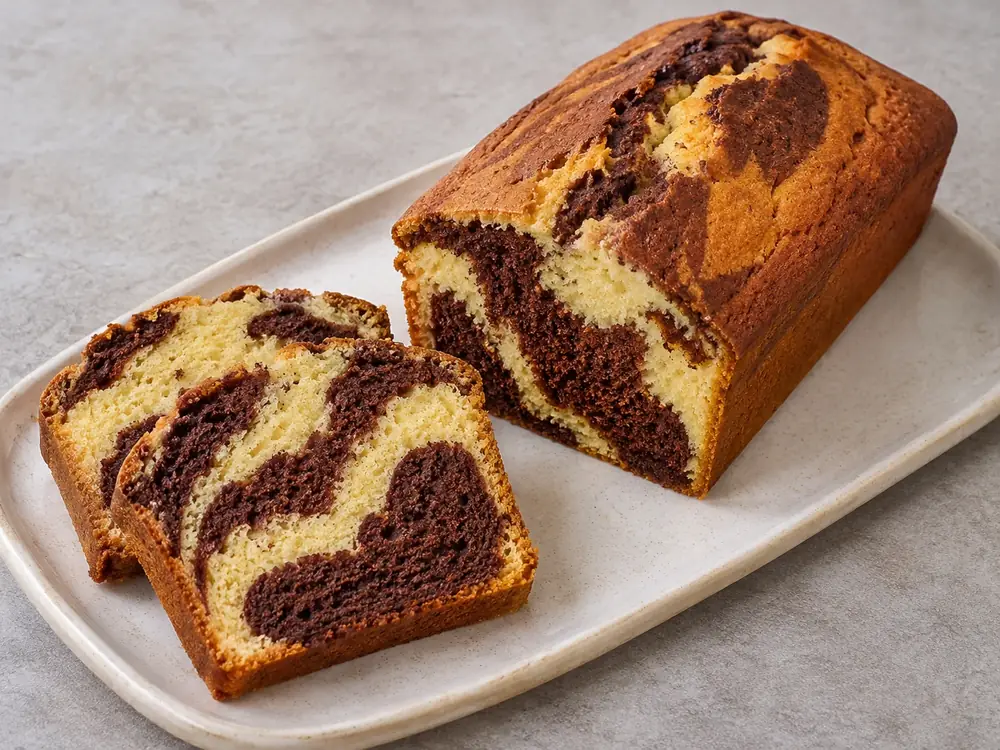
Vanilla butter batter and cocoa batter form distinct colours after alternating without fully combining. A roughly 24 cm tin gives ten tender centrally cooked slices, not a uniform brown loaf. This contemporary family formula claims no particular South African tradition; marbling is widely shared. Use unsweetened cocoa rather than sweetened drinking powder, which changes sugar and solids. Food-grade vanilla powder or extract is adjusted to strength.
Ingredients
- 220 g flour
- 120 g softened butter
- 140 g sugar
- 3 eggs
- 100 ml milk for base batter
- 10 g baking powder
- 20 g unsweetened cocoa
- 20 ml additional milk for cocoa half
- vanilla
- 1 g salt
Preparation
Method at a glance — Cream butter and sugar, add eggs then flour, baking powder, salt and base milk. Divide: flavour one half vanilla, the other cocoa mixed with additional milk. Alternate in a loaf tin and make one gentle swirl with a knife. Bake about 40–50 minutes at 175 °C.
Preparing one base — Preheat to 175 °C and line tin. Work soft, not melted, butter with sugar until lighter and supple. Add eggs individually and scrape sides. Combine flour, baking powder and salt, then incorporate with 100 ml base milk, alternating if easier. Stop once flour distributes instead of seeking elasticity. Divide into two similar weights and vanilla-flavour the first. Sift cocoa and mix with the separate 20 ml milk to a supple paste, then fold into the other half. This milk partly compensates cocoa absorption and does not join the entire batter. Both mixtures should spoon similarly; an unusually stiff cocoa half may need a few recorded milk drops, not an unmeasured cup. Two spoons avoid mixing bowls inadvertently.
Making a simple pattern — Alternate spoonfuls across two or three levels without placing all dark batter in one corner. Draw a knife or small spatula through one flowing path from lower layers towards top. Many rapid circles erase contrast. Level lightly and bake approximately forty to fifty minutes. A central crack is not automatically a defect. Test central crumb in both colours: underdone cocoa batter is less visually obvious than pale batter. Protect top if colour advances before internal cooking.
Mixing a baking powder batter — Weigh ingredients and prepare the tin before wetting flour. Distribute fresh dry-stored baking powder evenly to prevent irregular rising and unpleasant pockets. This is not baker's yeast and requires no long warm fermentation. Once wet ingredients join, mix briefly and bake without unnecessary delay. Scrape bowl edges and base with a spatula. Small irregularities are preferable to prolonged vigorous mixing that develops elasticity unsuited to tender crumb. Distribute fillings without wet clumps and drain canned products before weighing when specified. Respect the stated consistency: pouring batter is different from roll-out dough. Do not add flour merely for a perfectly smooth surface. Unexpected runniness calls for checking missing dry ingredients, measurements or watery products. Record useful corrections rather than progressively changing the formula without a reference. Bake centrally in a preheated oven. Thickness and tin material affect duration. A good crust can conceal wet crumb; probe a crumb area away from cheese or other misleading filling. Protect fast-browning tops and continue moderately. Rest briefly before unmoulding, then rack once stable. Trapped steam wets sides and early slicing compresses crumb. Cool leftovers promptly and refrigerate egg, cheese or meat preparations for use within 48 hours. Reheat portions rather than the entire product repeatedly. Freeze separate wrapped portions promptly for longer storage, dated with preparation day.
Cooling, slicing and conclusion — Let firm briefly, unmould and rack, waiting before slicing. Use a bread knife without crushing layers. Pattern naturally varies among slices and need not reproduce an identical spiral. Serve plain with a drink, without necessary glaze. Keep tin dimensions and cocoa reference consistent next time to compare both pattern and bake. Cool leftovers promptly, refrigerate for use within 48 hours or freeze individual slices promptly. Reheat portions as needed rather than the entire loaf repeatedly. Similar batter consistencies and one considered swirl give clearer marbling than many movements. Enjoy your meal!
Introduction
Vanilla butter batter and cocoa batter form distinct colours after alternating without fully combining. A roughly 24 cm tin gives ten tender centrally cooked slices, not a uniform brown loaf. This contemporary family formula claims no particular South African tradition; marbling is widely shared. Use unsweetened cocoa rather than sweetened drinking powder, which changes sugar and solids. Food-grade vanilla powder or extract is adjusted to strength.
Planning
10 slices; preparation 25 min; baking approximately 40–50 min; cooling before slicing.
Enjoy your meal
Enjoy your meal!