Naartjie sorbet
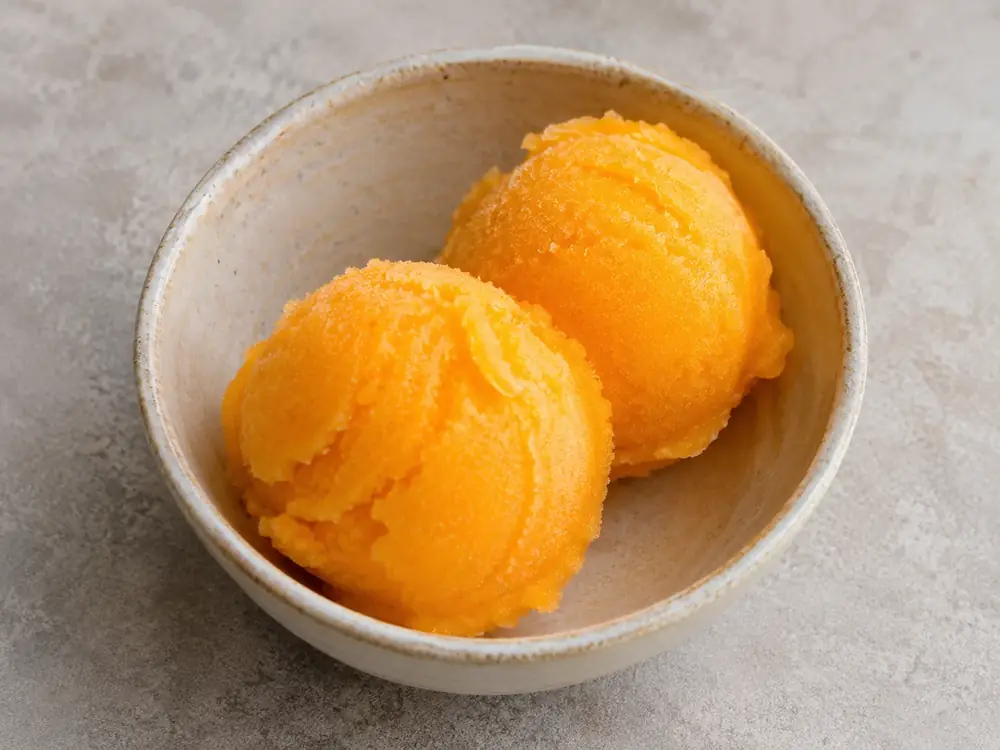
Naartjie is a common South African term for mandarin. This contemporary sorbet highlights its juice with simple syrup and a little lemon, without claiming a particular traditional origin. Six portions depend on machine aeration. There is no milk or egg in the base; accompaniments are separate. Sugar contributes frozen suppleness, not just sweetness; major removal produces harder sorbet and requires a different formula.
Ingredients
- 500 ml strained mandarin juice, fruit quantity according to yield
- 120 g sugar
- 150 ml water
- 20 ml lemon juice
- finely grated zest of 1 washed mandarin
- added salt 0 g
Preparation
Method at a glance — Heat water and sugar to dissolve, add zest and cool. Combine with mandarin and lemon juices, strain and refrigerate 3 hours. Churn, transfer and freeze approximately 1–2 hours to firm. Soften briefly before serving.
Measuring usable juice — Wash mandarins, zest only coloured skin from one, then squeeze and strain until 500 ml juice is obtained. Fruit count varies too much for one guaranteed number. Remove seeds and membranes without forcefully pressing peel that introduces bitterness. Measure 20 ml strained lemon. Taste mandarin juice to understand acidity and sweetness, retaining first-trial proportions before changing several variables. Record variety and maturity for comparisons.
Making clear syrup — Heat 150 ml water with 120 g sugar, stirring until dissolved. Do not caramelise or reduce at length: seek homogeneous syrup close to its initial volume. Add zest and cool off heat. Once cold, combine juices and strain again to remove zest. Refrigerate at least three hours until thoroughly cold. Base can taste slightly sweeter than a table drink because freezing reduces flavour perception, but tasting does not replace weighing.
Preparing equipment and churning — Read machine instructions and prepare freezer bowl sufficiently in advance; a compressor model follows another schedule. Chilled base does not replace a properly prepared bowl. Use clean covered vessels and a clean ready-to-eat spatula, not a spoon used for direct tasting. Warm mixture rapidly reduces frozen-bowl efficiency. Start according to notice, pour cold base and stay below usable capacity because volume expands. Observe even soft sorbet developing, following machine guidance rather than universal timing. Divide batches if needed, keeping remainder refrigerated. Transfer quickly to a clean closed shallow box and firm in freezer one to two hours or longer. Freshly churned sorbet is edible soft but scoops less neatly. Longer exposure to a very cold freezer makes it harder, requiring brief softening before service.
Portioning and freezer management — Small individual boxes reduce repeated exposure of the entire batch. Portion after churning, close and freeze. Take only what is needed at mealtime. Insulated transport maintains existing cold; it does not freeze liquid base. If softened during transit, assess time and temperature rather than appearance alone. Store around stable −18 °C, preferably away from frequently warmed door areas. Prefer use within two weeks for homemade texture. Do not assume freezing repairs long room-temperature storage, and do not refreeze fully melted product that stood out. Use clean scoops and return the main box promptly. Do not correct hard sorbet by long table waits every meal: serving temperature and measured formulation should be checked first.
Serving and conclusion — Present small scoops in chilled bowls. Fresh mandarin segments may join at the last moment, not mixed into the storage box. Avoid very sweet topping that hides acidity. Arbitrary water or sugar additions to frozen sorbet do not neatly repair hardness. Clear juice and measured syrup give more refinement than many extra aromas. Enjoy your meal! Source for the term naartjie consulted on 22 November 2026: Dictionary of South African English — https://www.dsae.co.za/entry/naartjie/e05049
Introduction
Naartjie is a common South African term for mandarin. This contemporary sorbet highlights its juice with simple syrup and a little lemon, without claiming a particular traditional origin. Six portions depend on machine aeration. There is no milk or egg in the base; accompaniments are separate. Sugar contributes frozen suppleness, not just sweetness; major removal produces harder sorbet and requires a different formula.
Planning
6 portions; preparation 20 min; syrup heating 5 min; chilling at least 3 h; churning according to machine; hardening 1–2 h or longer.
Enjoy your meal
Enjoy your meal!