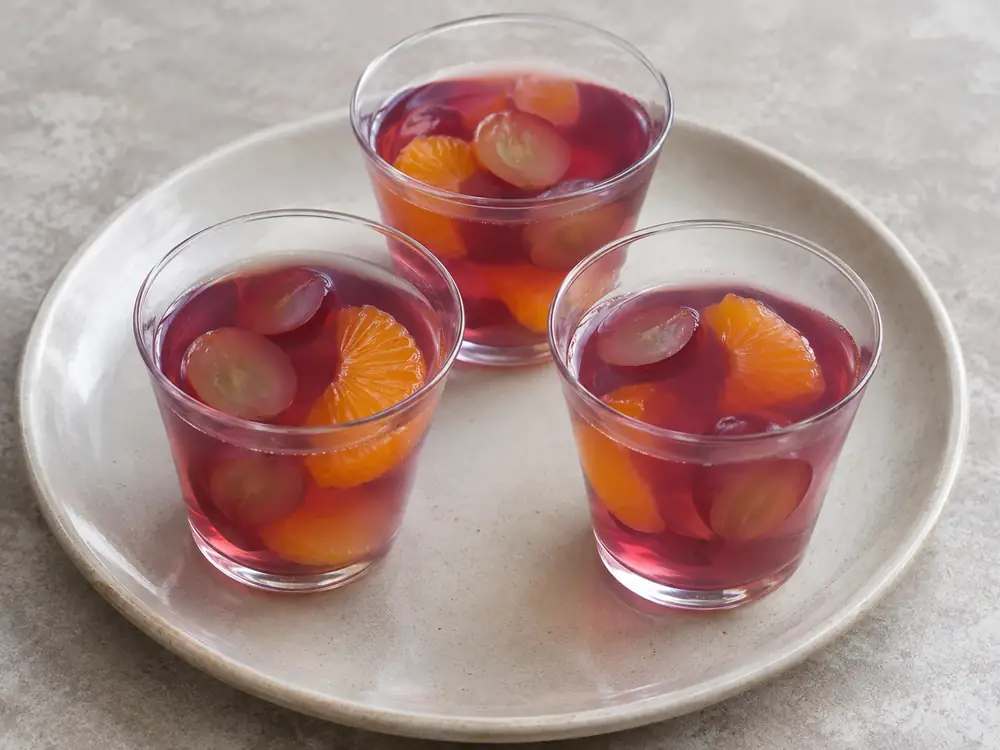
Grape jelly with fresh fruit
Grape juice, fresh grapes and orange form a soft spoonable jelly served in glasses without unmoulding. Fruit remains visible without tightly filling all liquid space. There is no extra sugar where naturally sweet juice suffices. This contemporary fruit dessert claims no specific South African tradition: Cape grape associations do not prove historical origin. Juice is most of the flavour, so gelatin cannot repair bitterness or artificial taste.
Ingredients
- 600 ml grape juice
- 8 g sheet gelatin, checked against packet strength
- cold water for hydrating gelatin
- 250 g ready-to-use seedless grapes
- 1 orange to segment
- 15 ml lemon juice
- added salt 0 g
Preparation
Method at a glance — Soften gelatin in cold water according to packet. Heat 150 ml juice without boiling, dissolve squeezed gelatin off heat and add remaining juice and lemon. Divide cut grapes and orange pieces into six glasses, pour liquid and chill at least 4 hours.
Preparing and sharing fruit — Wash, destem and weigh grapes, halve or quarter large ones and check for seeds despite the variety label. Peel orange, remove thick membranes and cut spoon-friendly pieces. Drain free juice without crushing. Share fruit fairly across six similar roughly 180–200 ml glasses on a stable tray. Long orange segments hinder eating. For young children, adapt grape size further to their needs rather than assuming jelly removes that concern.
Dissolving gelatin — Weigh 8 g rather than counting leaves, since weight and strength vary by maker. Compare packet guidance for total liquid and retain the same reference on a first trial. Separate leaves in sufficient cold water for even hydration, observing stated soaking time. Drain and gently squeeze. Take 150 ml from the total 600 ml juice and heat. Off heat dissolve gelatin completely, stirring and inspecting for fragments, straining if necessary before setting. Gradually add remaining 450 ml cold juice and measured lemon, mixing evenly to avoid gelatin threads from abrupt temperature contrast. Lemon adds acidity, not room-temperature preservation. Prolonged boiling is unnecessary.
Pouring and setting — Let liquid become tepid without beginning a thick set, then pour gently and equally over fruit. Some floating fruit is acceptable. For sharper two-level presentation, partially set a first layer before adding still-fluid remainder, allowing extra preparation time. Do not whisk vigorously to disguise already-setting fragments; gentle reheating is only possible where composition permits. Chill at least four hours, longer with deep or warmer portions. Glass depth and initial temperature matter; four hours is not a guarantee for one large thick mould. Test a portion for a slight wobble without fluidity. Do not increase gelatin merely to accelerate: an excessively hard result may reflect unsuitable strength.
Serving, substitutions and storage — Keep cold until service and do not unmould a jelly formulated for soft glasses. Gelatin is animal-derived; check and identify its origin where relevant to diners. Agar is not a gram-for-gram substitute and needs another heating method and texture formulation. Other juices and fresh fruits may alter acidity and gelling, so substitutions require reconsideration. Cover once cooled and refrigerate for consumption within 48 hours, with setting time included in that period. Serve chilled without long advance exposure. Optional mint is added at the last moment, not required. Good juice, appropriate fruit size and weighed gelatin give refinement without extra sugar or rigid set. Enjoy your meal!
Introduction
Grape juice, fresh grapes and orange form a soft spoonable jelly served in glasses without unmoulding. Fruit remains visible without tightly filling all liquid space. There is no extra sugar where naturally sweet juice suffices. This contemporary fruit dessert claims no specific South African tradition: Cape grape associations do not prove historical origin. Juice is most of the flavour, so gelatin cannot repair bitterness or artificial taste.
Planning
Serves 6; preparation 20 min; heating approximately 5 min; chilling at least 4 h.
Enjoy your meal
Enjoy your meal!