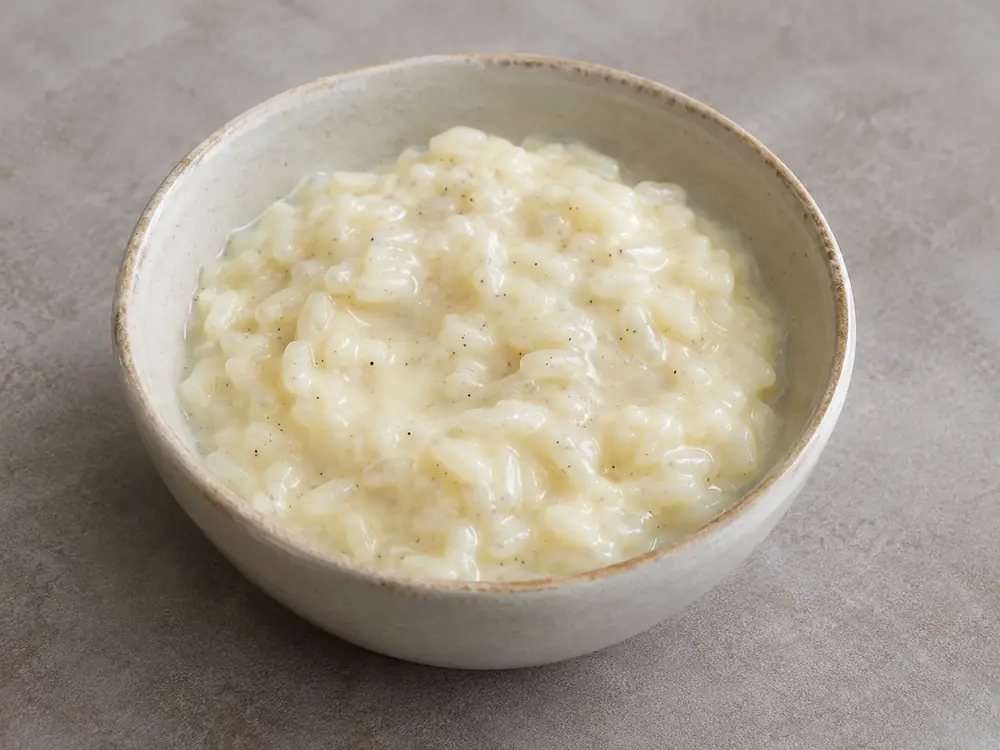
Amasi and vanilla rice pudding
Vanilla sweetness meets amasi's mild acidity, added only after cooking. Grains should remain recognisable in supple cream that firms further under refrigeration. Perfectly thick hot rice can become overly compact when cold. This contemporary dessert claims no named South African tradition. Commercial pasteurised amasi or maas connects an ingredient to the country, without extending rice pudding's storage life through fermentation.
Ingredients
- 150 g dry round-grain pudding rice
- 750 ml milk, with a little extra if cooking requires
- 80 g sugar
- 200 ml commercial amasi made from pasteurised milk
- 1 vanilla pod
- 1 g salt
Preparation
Method at a glance — Heat milk, split vanilla and salt. Add briefly rinsed rice and simmer gently 30–35 minutes or according to product, stirring until grains are tender. Add sugar for the last 5 minutes and measured extra hot milk if required. Remove vanilla and transfer shallowly to release heat promptly. Fold in amasi when rice is warm without reboiling. Divide into six and refrigerate promptly, ideally within 1 hour of rice cooking ending. Serve chilled and consume within 24 hours.
Cooking rice properly — Choose round-grain dessert rice, not long-grain, precooked rice or flakes with different starch release. Rinse briefly if needed without repeatedly removing all starch. Follow packet timing as well as this guide. Split vanilla, scrape seeds and warm seeds, pod, milk and salt in a broad thick-based pan. Watch foaming milk against overflow. Add rice and simmer calmly, stirring often across base and corners with a flexible spatula. Strong boiling evaporates too much milk. Taste several grains; hard centres need more time and adequate liquid. Add sugar during the last five minutes, dissolving fully. If milk runs short while rice stays firm, add a little measured hot milk and record the correction for that product. Do not scrape browned milk through all pudding: transfer unaffected mixture to a clean pan and assess flavour instead.
Adding fermented dairy at the right moment — Remove pod and transfer rice into a shallow dish, stirring with a clean utensil to lose strong heat promptly. Once warm without abundant steam, fold in cold amasi gently without crushing grains. Do not boil again, which can separate acidic dairy. Choose a naturally gentler amasi for subtler acidity rather than large cold sugar additions. Retain first-trial proportions to judge final absorption. Use properly refrigerated commercial product within its date, never questionable dairy disguised in dessert. Plain yoghurt is a declared variation with different texture and acidity. Adding cold amasi helps lower temperature but does not ensure a deep mass cools centrally; small portions are essential.
Cooling and serving — Have six shallow bowls ready before cooking ends. Divide promptly and refrigerate ideally within an hour; an external cold-water bath can help without letting water enter. Do not leave a large pan warm all afternoon. The roughly two-hour chilling estimate depends on container depth; refrigerate until set and appropriately cold, keeping total consumption within 24 hours. Keep optional fruit separate and add at eating, without warm fruit reheating chilled portions or unmeasured juice diluting them. A little cold pasteurised milk can loosen one firm portion immediately before serving. Do not repeatedly dilute the entire batch and return it from table to refrigerator, or reheat all rice to recover initial fluidity. Use clean serving spoons. A broken cold chain is not necessarily corrected by reheating or fresh amasi. Tender grains, off-heat amasi and prompt cooling form one coherent method. Enjoy your meal! Culinary and storage references retained from the French manuscript, consulted on 22 November 2026: https://www.rediscoverdairy.co.za/ask-dairy-maas/ and https://www.gov.uk/government/publications/home-food-fact-checker/home-food-fact-checker
Introduction
Vanilla sweetness meets amasi's mild acidity, added only after cooking. Grains should remain recognisable in supple cream that firms further under refrigeration. Perfectly thick hot rice can become overly compact when cold. This contemporary dessert claims no named South African tradition. Commercial pasteurised amasi or maas connects an ingredient to the country, without extending rice pudding's storage life through fermentation.
Planning
6 portions; preparation 15 min; cooking approximately 30–35 min; prompt cooling ideally within 1 hour, then approximately 2 h chilling according to containers.
Enjoy your meal
Enjoy your meal!