Lemon and condensed milk tart
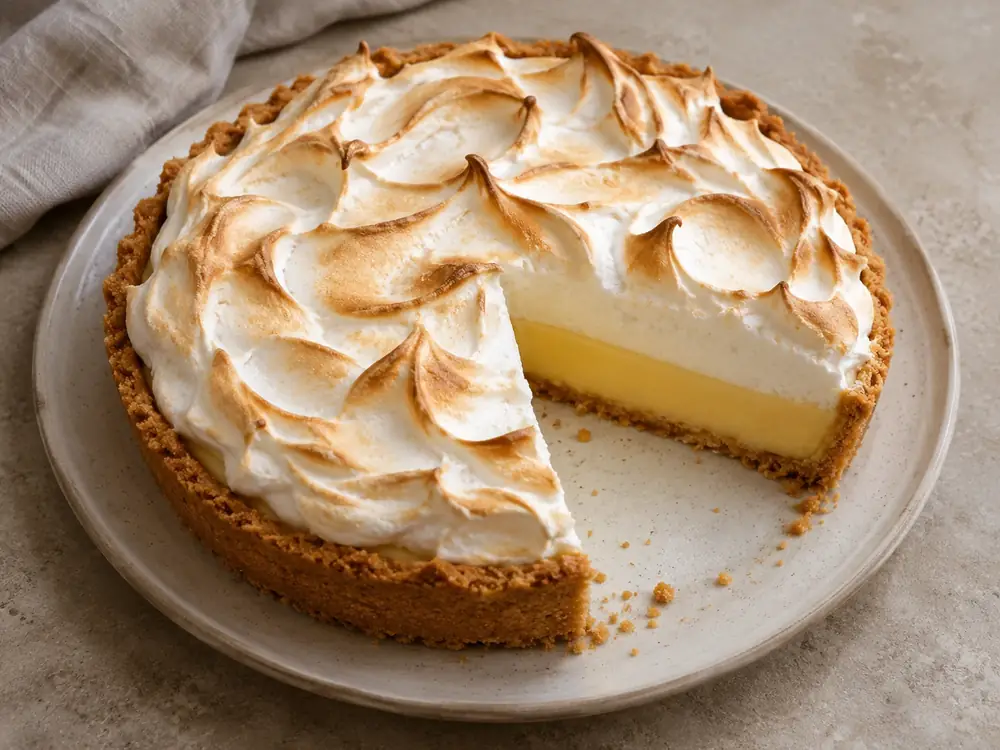
Butter-biscuit base supports lemon condensed-milk filling and cooked meringue. Sweetened condensed milk is essential: unsweetened evaporated milk does not provide equivalent set or balance. Lemon thickens mixture but cannot replace egg cooking. Related tarts occur in South African domestic repertoires, including Clover's. These are the manuscript's proportions and monitored two-stage method, not a copied commercial formula. Avoid filled or iced biscuits; plain or lightly flavoured ones suit.
Ingredients
- 200 g plain dry biscuits
- 80 g melted butter
- 397 g sweetened condensed milk
- 3 separated eggs, yolks for filling and whites for meringue
- 120 ml strained lemon juice
- 80 g sugar for meringue
- added salt 0 g
Preparation
Method at a glance — Crush biscuits, combine butter and press evenly into a 22 cm tin; refrigerate. Combine condensed milk, yolks and lemon, pour into base and bake about 12–15 minutes at 170 °C. Whip whites, gradually add sugar to glossy meringue and spread to edges over hot filling. Bake another approximately 15–20 minutes or longer as checks require until meringue sets and lightly colours. Verify at least 71 °C centrally in egg preparations; colour is insufficient. Cool promptly and chill at least 3 hours.
Making an even base — Crush biscuits finely without large hole-producing chunks. Mix with slightly cooled melted butter until a pressed portion holds. Press across base and low sides with spoon or flat glass, avoiding thick corners. Choose a non-leaking tin on a tray. Refrigerate while preparing filling. Biscuits already sweeten the base; extra sugar is unnecessary. Overthick cold bases are difficult to cut.
First cooking the lemon filling — Separate eggs cleanly, one at a time in a small cup before pooling whites so a broken yolk does not spoil them all. Keep shells away from the ready base. Whites require a clean dry grease-free bowl and whisk. Mix three yolks with condensed milk, then strained lemon juice. Pour into chilled base and level. Bake at 170 °C approximately twelve to fifteen minutes to begin setting while making meringue. This is genuine filling cooking, not merely a later browning of whites; depth and egg size affect duration.
Making and baking meringue — Whip whites until foamy and holding, then add sugar gradually until glossy with a standing peak and no large visible grains. A large early sugar addition slows whipping; stop before dry graininess. Do not taste raw meringue. Use promptly, spreading evenly over still-hot filling right to edges to limit shrinkage. Moderate waves cook more regularly than one tall central peak. Return to oven approximately fifteen to twenty minutes or longer as needed. Meringue must set and lightly colour, with at least 71 °C centrally in egg preparations under the manuscript's reference. Protect a fast-browning surface and continue at controlled heat. Lemon acidity and toasted colour are not adequate checks. A blowtorch alone is not the stated method, since it can brown without sufficient internal heating.
Cooling and slicing — Set on a stable support, release steam, cool promptly and refrigerate at least three hours. Do not seal a hot tart airtight: condensation falls onto meringue. Protect once cold against refrigerator odours. Cold is needed both for set and storage. Remove a loose tin ring only after filling firms, keeping base stable. Cut with a clean wiped blade and broad supporting spatula rather than pulling meringue alone. A small edge break is less harmful than over-compacting base to prevent every crumb. Serve chilled, preferably the day of making after setting, and consume refrigerated within 48 hours. Some liquid may appear with age even after correct preparation. Take out only wanted portions and never return table-served slices to the shared tart. Strained lemon, an even thin base and real cooking of both egg preparations determine balance. Enjoy your meal!
Introduction
Butter-biscuit base supports lemon condensed-milk filling and cooked meringue. Sweetened condensed milk is essential: unsweetened evaporated milk does not provide equivalent set or balance. Lemon thickens mixture but cannot replace egg cooking. Related tarts occur in South African domestic repertoires, including Clover's. These are the manuscript's proportions and monitored two-stage method, not a copied commercial formula. Avoid filled or iced biscuits; plain or lightly flavoured ones suit.
Planning
8 slices; preparation 25 min; total baking approximately 30–40 min in two stages; prompt cooling and at least 3 h chilling.
Enjoy your meal
Enjoy your meal!