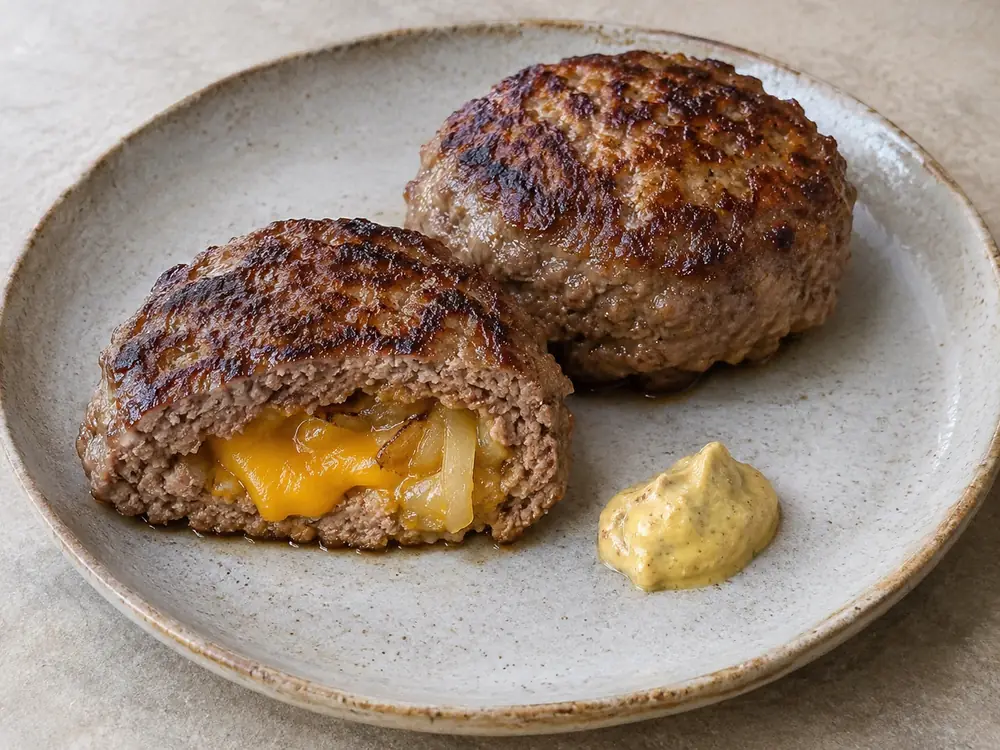
Beef patties stuffed with cheddar and onions
Each patty encloses measured cheddar and softened onion. Divide 600 g beef into eight discs, joined in pairs for four portions. Keep filling away from edges, where cheese would prevent sealing and leak into the pan. These are meat portions; bread and other accompaniments are separate.
Ingredients
- 600 g minced beef
- 100 g cheddar
- 2 onions
- 20 ml oil
- 3 g salt
- pepper
- 10 g mustard
Preparation
Method at a glance — Soften onions in half the oil about 12 minutes and cool. Season beef and form 8 discs. Fill 4 with onion and cheddar, keeping edges clean; cover and seal with remaining 4. Cook in remaining oil at medium heat about 5–7 minutes per side or longer according to thickness. Check at least 71 °C in meat surrounding cheese, not cheese alone. Rest briefly and serve mustard alongside.
Softening onions before assembly — Peel and slice onions, cooking gently in 10 ml oil about twelve minutes. Lower heat if browning precedes tenderness and add a small spoonful of water if needed; evaporate it afterwards. Onions should be supple without abundant juice. Spread on a clean plate to cool promptly. Divide cheddar into four flat portions or four piles of coarse gratings. Large cubes force excessive meat thickness. Season beef with measured salt and pepper, divide into eight 75 g portions and flatten to comparable discs slightly wider than filling. Keep meat cold until actual shaping.
Sealing without thickening the centre — Place onion and cheese on four discs, leaving approximately one centimetre clear at edges. Cover with other discs, expel large air pockets and press edges closed with clean fingers. Do not repair a leak with one very thick meat patch that cooks more slowly than surrounding areas. Refrigerate if the pan is not ready. Heat remaining 10 ml oil moderately. Cook approximately five to seven minutes each side, turning with a broad spatula and controlling heat against burning. Combined cooking is closer to twenty-five to thirty minutes because onion cooking is separate; overlap may shorten elapsed time but does not erase that stage.
Keeping filling reasonable — The 100 g cheddar means 25 g per patty, giving a molten centre without a large cavity. Increasing cheese greatly weakens sealing and may leave dangerously thin meat areas. Share onion beforehand rather than packing leftovers into the final patty. For children, cut after resting and let cheese heat dissipate, without considering opening alone proof of complete cooking.
Shaping evenly and keeping cold — Arrange a raw-meat area and clean cooked-service plate. Remove beef from refrigeration only at assembly. Cook and cool onion first; hot filling softens meat and complicates shaping. If interrupted, cover and refrigerate rather than leaving the bowl on the table. Work briefly with clean hands or spatula to distribute seasoning. Long kneading compacts meat. Divide components before filling and seal without large air pockets or dough-like compression. Drain wet additions because water inside can open patties. Equal portions simplify cooking and give each diner a comparable filling-to-meat ratio.
Checking the meat centre — Molten cheese and browned crust do not establish cooked mince. Use a clean probe for at least 71 °C in the thickest meat around filling, not cheese alone. Check several positions if irregular. Side insertion helps place the sensor in meat without touching the pan. If exterior colours first, reduce heat and continue gently rather than abruptly increasing temperature. Brief rest settles structure but never remedies inadequate cooking. Have accompaniments ready and keep cooked patties off raw-meat boards. Cool leftovers promptly in shallow portions, refrigerate and use within 48 hours. Reheat only needed portions completely centrally, using 74 °C as the manuscript's reference. Check several meat zones because hot cheese can hide a cooler meat ring. Avoid repeated reheating of the same portion.
Checking meat around cheese — Probe from the side into surrounding beef, away from molten cheddar, aiming for at least 71 °C. Check another area if shape varies. If exterior is already coloured but centre insufficient, lower heat and continue without pressing patties flat with a spatula. Rest briefly, serve the measured mustard alongside and warn about hot internal cheese. Separately prepared tomatoes and steamed potatoes suit; bread makes a more substantial sandwich. Cooked dry cooled mushrooms may replace some onions without increasing filling volume. Reasonable filling and regular sealing determine success. Enjoy your meal!
Introduction
Each patty encloses measured cheddar and softened onion. Divide 600 g beef into eight discs, joined in pairs for four portions. Keep filling away from edges, where cheese would prevent sealing and leak into the pan. These are meat portions; bread and other accompaniments are separate.
Cultural context
This contemporary stuffed-patty recipe is not presented as traditional frikkadelle. Flat shaping and individual cooking provide a different structure. Measured filling and regular closure are more dependable than oversized overfilled patties. Consistent meat thickness helps central checking and fair sharing at service.
Planning
Serves 4; preparation 25 min including onion cooling; indicative combined cooking 25–30 min.
Enjoy your meal
Enjoy your meal!