Meatloaf with eggs and chutney
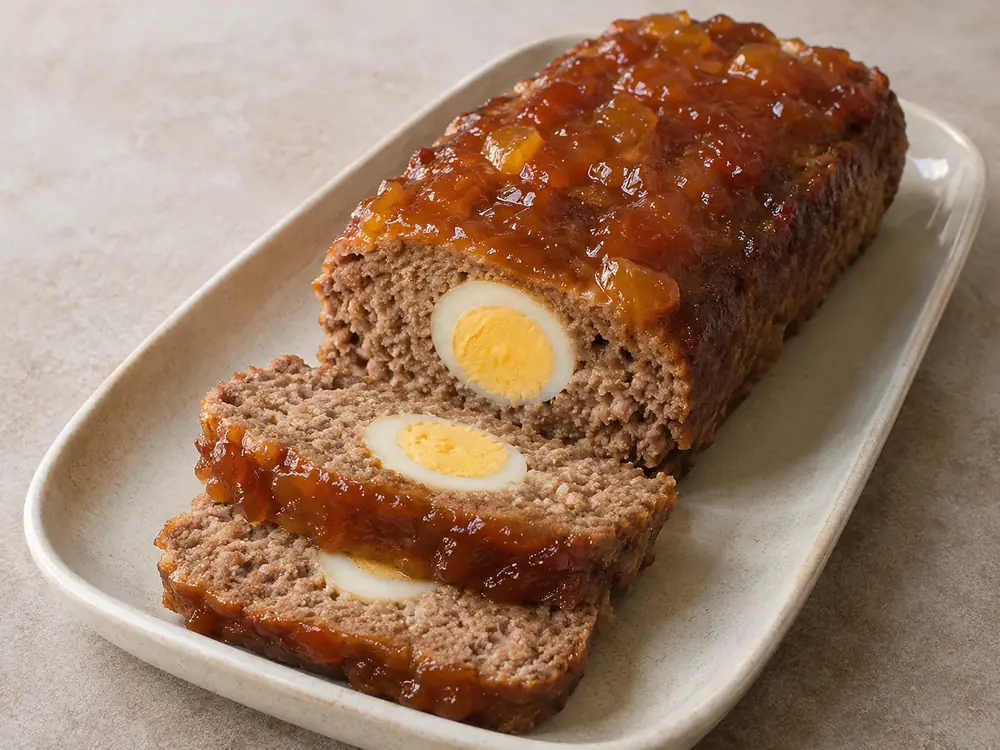
A row of three hard-boiled eggs sits inside beef loaf beneath thin chutney glaze. Beef, a raw binding egg, milk and breadcrumbs make six generous portions. Three eggs must already be cooked, cooled and peeled; only the fourth joins the mixture raw. Keeping this distinction avoids counting the binder twice.
Ingredients
- 700 g raw minced beef
- 4 eggs, including 3 already hard-boiled, cooled and peeled, and 1 raw for binding
- 80 g breadcrumbs
- 1 onion
- 80 g thick chutney
- 50 ml milk
- 4 g salt
- pepper
- 10 ml oil
Preparation
Method at a glance — Moisten breadcrumbs with milk. Mix briefly with beef, raw egg, finely minced onion, salt and pepper. Oil a loaf tin, add half the mixture, align 3 cooked eggs and cover with remaining meat. Seal joins and spread chutney. Bake approximately 55–60 minutes at 180 °C until meat around eggs reaches at least 71 °C. Protect darkening top. Rest 15 minutes before unmoulding and slicing.
Preparing ingredients and tin — Use a loaf tin approximately 24 cm long, wide enough for meat around eggs. Oil with the measured 10 ml. A baking-paper strip may help release without reducing internal space. Preheat to 180 °C. Mince onion very finely so it cooks through without firm pockets. Moisten 80 g crumbs with 50 ml milk and let absorb briefly. Add beef, beaten raw egg, onion, pepper and measured salt. Mix briefly without compacting. Very lean beef gives a firmer loaf; choose mince suited to baking instead of attempting to compensate with excessive milk afterwards.
Forming meat around eggs — Spread approximately half the mixture across base and sides. Align three cooked eggs lengthways, leaving meat at both ends. Cover with remaining mixture and seal joins, particularly alongside eggs. Smooth without compressing excessively. Avoid a large air tunnel around filling that would split slices. Spread 80 g chutney thinly, chopping or lightly crushing large fruit pieces first. Bake about fifty-five to sixty minutes, protecting a fast-colouring glaze. Probe meat away from eggs to at least 71 °C. Measuring the centre of a hard-boiled egg misses the surrounding meat that may cook more slowly.
Adapting tins without losing checks — A shorter tin makes a thicker loaf with a longer heating path. Do not shorten time because the top already looks brown. A low wide vessel cooks faster but makes shorter slices. Keep eggs aligned and surrounded with enough meat in either case. Record tin dimensions for more predictable timing and consistent slicing next time.
Shaping evenly and keeping cold — Organise a raw-mixture zone and a clean plate for cooked loaf. Remove meat from refrigeration only for assembly. Prepare ingredients requiring cooling first; warm filling softens raw mixture and complicates shaping. If interrupted, cover and refrigerate rather than leaving the bowl on the table. Use clean hands or a spatula briefly to distribute binding and seasoning. Prolonged kneading compacts meat. Divide the mixture visually before filling, close joins without large pockets and avoid dough-like compression. Drain wet additions well; accumulated moisture can open the loaf during cooking. This version requires no extra unlisted cheese or binder.
Checking the meat centre — A browned crust does not establish cooked mince. Use a clean probe in the thickest meat around filling, aiming for at least 71 °C, not just inside an egg. Check several positions where thickness varies. Side insertion may help reach the actual centre without touching the tin. If exterior colours first, reduce heat and protect the top without trapping all steam. Extra monitored time is preferable to abruptly increasing heat. Rest afterwards on a clean surface to stabilise structure; resting cannot remedy insufficient cooking. Have accompaniments ready and avoid raw-meat boards. Cool leftovers promptly in shallow portions and refrigerate for use within 48 hours. Reheat only what will be eaten, completely centrally, using 74 °C as the manuscript's reference. Check several meat areas in thick slices because very hot egg can conceal cooler surrounding meat. Avoid repeated reheating cycles.
Resting and slicing — Rest fifteen minutes in the tin. Tilt carefully to remove excessive fatty juices, unmould and slice with a sharp knife without rough sawing. Not every slice reveals equal egg area; distribute central slices and ends fairly. Serve separately prepared salad and roasted vegetables, with optional extra chutney alongside. Chilled leftovers slice more easily for sandwiches but must remain refrigerated until mealtime. Reheat slices under suitable protection with a little juice and verify centres. Egg pattern provides appearance; binding and resting secure the loaf. Enjoy your meal!
Introduction
A row of three hard-boiled eggs sits inside beef loaf beneath thin chutney glaze. Beef, a raw binding egg, milk and breadcrumbs make six generous portions. Three eggs must already be cooked, cooled and peeled; only the fourth joins the mixture raw. Keeping this distinction avoids counting the binder twice.
Cultural context
This contemporary family formula is not named bobotie: shaping, structure and whole-egg filling differ. Chutney is aromatic glaze rather than proof of specific origin. Choose a thick product that stays on top and a chilli strength suitable for diners. Purchase quantities cover the whole loaf, not each layer.
Planning
Serves 6; preparation 25 min; cooking 60 min; resting 15 min.
Enjoy your meal
Enjoy your meal!