Sweet potato and sweetcorn frittata
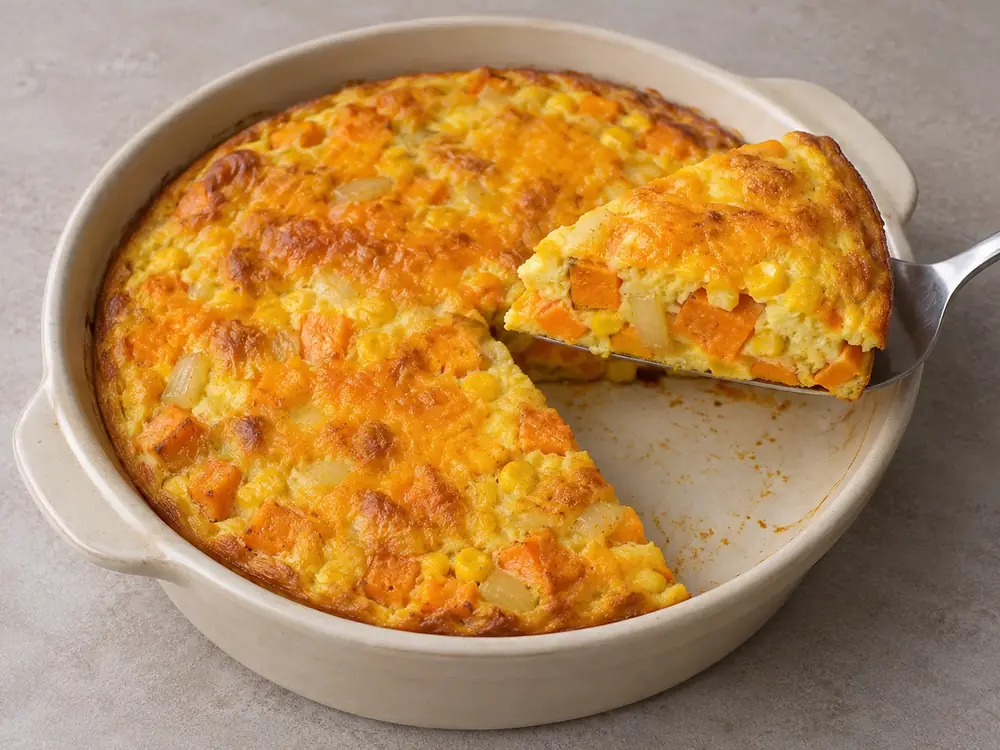
Tender precooked sweet potato, corn and cheddar form an oven-baked egg dish cut into portions without pastry. Seek a set but supple centre with evenly distributed pieces. Raw sweet potato would not necessarily soften in the short egg-setting stage. Baking also creates a different structure from this volume's rolled omelette despite shared ingredients.
Ingredients
- 6 eggs
- 400 g peeled sweet potato
- 150 g cooked drained sweetcorn
- 1 onion
- 60 g cheddar
- 25 ml oil, including 15 ml for vegetables and 10 ml for the dish
- 50 ml water
- 3 g salt
- pepper
Preparation
Method at a glance — Cut sweet potato into 1 cm dice. Cook covered with sliced onion, 15 ml oil and 50 ml water for 15 minutes. Beat eggs, salt and pepper; add corn and cheese. Transfer vegetables to an oiled 22 cm dish, add eggs and bake 18–22 minutes at 180 °C.
Culinary context — This contemporary family meal claims no exclusively South African origin. Frittata names an egg-and-filling preparation from a wider repertoire. Corn and sweet potato connect ingredients across the volume without inventing local history for the combination. Preserve sweet potato rather than ordinary potato and retain precooking; substitutions alter sweetness, moisture and possibly timing.
Preparing sweet potato — Peel before weighing and cut dice approximately one centimetre wide. Small regular pieces cook relatively quickly and distribute through eggs. Large chunks may stay firm or concentrate filling in a few portions. Rinse only if needed and dry. Slice onion finely. Check tenderness with a knife before assembly without requiring the vegetable to become purée.
Cooking dice before eggs — Heat 15 ml oil, add onion, sweet potato and 50 ml water. Cover and cook moderately about fifteen minutes, stirring occasionally. Check against early drying; the lid may require a small hot-water adjustment. Uncover afterwards to evaporate free liquid. Wet filling dilutes eggs. Strong browning is optional because this stage primarily aims to tenderise vegetables.
Preparing corn — Use cooked well-drained sweetcorn. Canned kernels work after checking drained weight and salt. Cook frozen product according to packaging before assembly rather than relying on quickly setting eggs. Retain whole kernels for contrast. Maize flour cannot replace them: it changes binding and liquid requirements. Here corn is distributed filling, not a powdered thickener.
Beating eggs simply — Beat eggs with salt and pepper until homogeneous, without whipping to foam or adding unlisted milk. Fold in corn, grated cheddar and slightly cooled vegetables. Hot filling can coagulate eggs locally before baking; a brief cooling period avoids this. Cheese and salted canned corn contribute seasoning, so judge the measured salt allowance accordingly.
Preparing the dish — Oil base and sides with remaining 10 ml. A suitable paper disc may help a sticky base. Spread mixture evenly, moving dice rather than leaving them all on one side. Uneven thin areas dry before the centre sets. Do not overfill a small vessel. Preheat oven to 180 °C before final mixing so eggs do not wait through oven heating.
Baking until set — Bake approximately eighteen to twenty-two minutes, checking for a set centre without liquid egg pockets but some flexibility. A puffed surface may settle after resting without indicating failure. Excess cooking firms texture and may release water. Protect a fast-colouring top and continue more gently. Fully refrigerated filling differs from freshly cooked warm vegetables and changes timing.
Resting and cutting — Rest five to ten minutes, loosen edges if needed and divide into four. A broad spatula helps keep sweet potato in each portion. Serve hot or warm at mealtime with separately prepared salad or vegetables. Optional sauce is unnecessary for a well-cooked frittata. Warm service does not justify several hours at room temperature; storage requires prompt refrigeration.
Variations and organisation — Some sweet potato can be replaced with a precooked low-moisture vegetable. Other cheese alters salt and melting. These remain variations. Cook vegetables the previous day if useful, cool promptly and refrigerate; warm slightly or adjust oven timing. Add eggs near baking. For groups, two dishes of comparable depth generally cook more evenly than one very deep vessel.
Storage and conclusion — Cool leftovers promptly, refrigerate and use within 48 hours. Cold service is possible after correct cooking and storage. For hot service, reheat completely while protecting edges. Freezing may change egg and vegetable textures; fresh preparation cuts more neatly. Tender dice, suitable corn and simply beaten eggs support success. A properly set centre matters more than a very brown surface. Enjoy your meal!
Introduction
Tender precooked sweet potato, corn and cheddar form an oven-baked egg dish cut into portions without pastry. Seek a set but supple centre with evenly distributed pieces. Raw sweet potato would not necessarily soften in the short egg-setting stage. Baking also creates a different structure from this volume's rolled omelette despite shared ingredients.
Cultural context
Quantities give four light-meal portions. Weigh sweet potato peeled and corn cooked and drained. Similar-sized eggs provide binding. A 22 cm dish gives moderate depth; a wide tin produces a thin layer, while a small deep one needs longer central cooking. The measured water belongs explicitly to the initial vegetable stage.
Planning
Serves 4; preparation 20 min; cooking 35 min.
Enjoy your meal
Enjoy your meal!