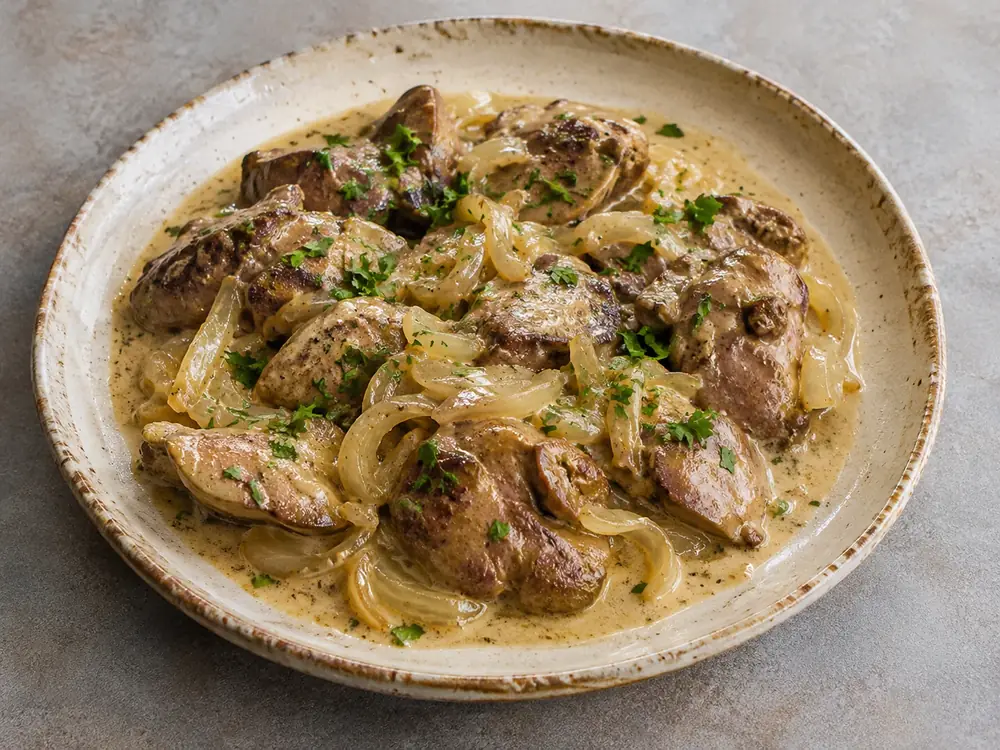
Chicken livers with cream and onions
Chicken livers cook with melting onions before a little cream finishes them. Seek supple pieces cooked throughout, without burnt surfaces or raw centres. Onions need longer and therefore soften first. Sauce follows the main cooking stage rather than hiding poorly controlled texture. Trimming and checking matter particularly when each element remains visible.
Ingredients
- 500 g trimmed chicken livers
- 2 onions
- 150 ml cream
- 20 ml oil
- 10 g butter
- 1 garlic clove
- 3 g salt
- pepper
- parsley
Preparation
Method at a glance — Trim livers and cut evenly. Soften sliced onions in oil and butter about 12 minutes. Add garlic for 30 seconds, then livers. Turn and adjust heat until the centre reaches 70 °C for at least 2 minutes, checked with a probe; pan time is indicative. Add cream, measured salt and pepper, simmer briefly and finish with parsley.
Culinary context and documented cooking — This contemporary family cream version claims no specific South African traditional origin and differs from strongly chilli-seasoned livers elsewhere. Food Standards Australia New Zealand advises cooking poultry liver internally, not merely searing surfaces, with a reference of 70 °C centrally for at least two minutes. This practical guidance does not imply laboratory testing of this recipe or guarantee from a fixed pan duration.
Buying and trimming — Use an identified source within stated refrigeration and date conditions. Keep chilled until preparation. Remove marked connective tissues, damaged areas and abnormal patches, including possible bile staining. Careful trimming improves uniformity. Avoid prolonged tap washing that spreads splashes. Clean equipment after raw liver before preparing parsley or handling serving plates and ready-to-eat accompaniments.
Evening out pieces — Separate lobes and divide large ones into comparable sizes without dicing everything finely. Huge pieces mixed with thin strips complicate control. Pat dry without drying flesh out. Starting temperature and thickness affect central heating time. For groups, cook batches instead of a thick crowded layer. Leave access for turning and probing the largest pieces rather than burying them.
Softening onions — Slice both onions and cook in oil and butter at moderate heat about twelve minutes, stirring until soft, perhaps lightly coloured but never black-edged. High heat burns before tenderising. Add minced garlic only for the final thirty seconds. If cooking livers in several batches, reserve softened onions and return later so they do not burn through repeated searing stages.
Cooking beyond the surface — Add liver and turn to distribute heat. Start at medium to moderately high heat, then moderate it to finish centres without burning. An eight-to-ten-minute window is organisational, not universal proof. Check a thick piece with a clean probe against the stated temperature and holding time. Brown crust with raw centre is not the target. Extend gently without drying every small piece while one oversized lobe finishes.
Adding cream afterwards — Once livers are correctly cooked, add cream and any reserved onions, then salt and pepper progressively. Simmer briefly to bring sauce together without fierce reduction into separated fat. A little hot water loosens thick sauce. Remove ready pieces before reducing an overly thin sauce separately. Add washed, dried and chopped parsley at the end.
Tasting balance — Taste liver, onion and sauce together before correcting salt; 3 g is a whole-dish guide adjusted to product and final volume. Bitterness may come from burnt onion or inadequate trimming, not insufficient cream. More fat cannot remove the cause. Dry texture may reflect excessive cooking, but serving raw next time is never the remedy: even dimensions and precise central checking are.
Serving promptly — Share livers and onions among four plates, then sauce. Bread, simple mash or grain, counted separately, may accompany; fresh salad contrasts with cream. Prolonged hot holding firms pieces and concentrates sauce. Prepare plates and accompaniment before the final stage for timely service. Decoration should not hide texture or replace an even share of livers.
Variations and organisation — A little mustard is a declared variation with salt and allergens considered. Mild spices also vary flavour without creating extra recipes. Trim livers and prepare onions ahead separately, refrigerating raw meat and promptly cooled cooked vegetables. Final liver cooking is best near service. Do not partially cook a large batch and leave it lukewarm for later finishing.
Storage and conclusion — Prefer quantities needed. Cool leftovers promptly, refrigerate and eat the next day after gentle complete reheating. Texture will often be firmer; avoid repeated reheating cycles. Freezing may change cream and liver, making fresh preparation more predictable. Follow starting-product instructions, especially after thawing. Careful trimming, properly softened onions and actual internal verification let cream complement fully cooked liver. Enjoy your meal!
Introduction
Chicken livers cook with melting onions before a little cream finishes them. Seek supple pieces cooked throughout, without burnt surfaces or raw centres. Onions need longer and therefore soften first. Sauce follows the main cooking stage rather than hiding poorly controlled texture. Trimming and checking matter particularly when each element remains visible.
Cultural context
The 500 g is trimmed weight without tough or damaged parts, giving four moderate light-meal portions with separately planned accompaniment. Cream covers the whole dish. Oil and butter are the cooking allowance; additional serving fat changes quantities. Twenty-five minutes remains indicative: thickness and a clean probe matter more than exterior colour or an inflexible timer.
Planning
Serves 4; preparation 20 min; cooking 25 min.
Enjoy your meal
Enjoy your meal!