Fish and courgette timbales
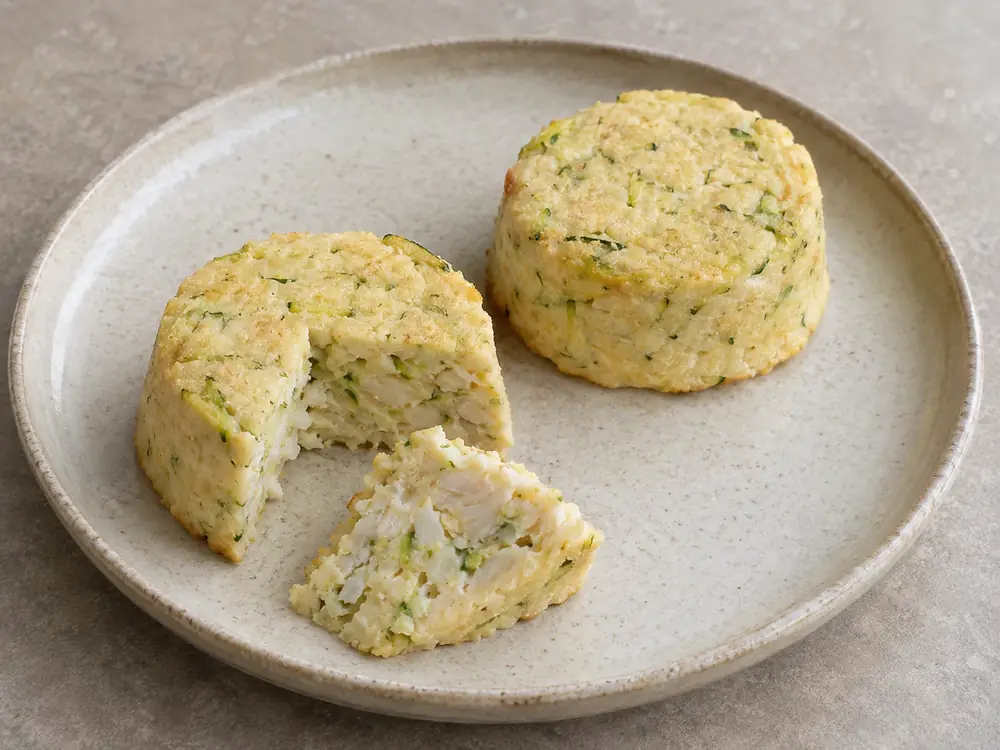
Blended fish, eggs and cream form small moulded starters containing tender courgette strands. A water bath encourages even setting without a dry crust. Seek a tender texture firm enough to unmould, distinct from a spread or pan-fried cake. Breadcrumbs absorb some moisture but cannot replace thorough vegetable draining.
Ingredients
- 400 g boneless white fish
- 250 g courgette
- 2 eggs
- 150 ml cream
- 30 g breadcrumbs
- 2 g salt
- pepper
- 10 g butter
Preparation
Method at a glance — Grate courgette and squeeze firmly. Blend cold fish with eggs, cream, salt and pepper; fold in courgette and breadcrumbs. Butter six ramekins, fill and place in a hot-water bath. Bake 25–30 minutes at 170 °C until fully set and cooked centrally. Rest 5 minutes before unmoulding.
Culinary context — This is a contemporary cooked-fish starter. Timbale shaping and water-bath cooking are widely shared techniques, without a claimed specific South African tradition. Preserve the distinction between raw fish to blend and already-cooked leftovers, which bind differently. This preparation differs from the first volume's snoek pâté and fishcakes through moulding, gentle baking and small servings.
Preparing clean cold flesh — Choose white fish from an identified source and remove bones carefully before cutting. Blending does not make bones reliably disappear; fragments become harder to detect. Thaw frozen fish in the refrigerator according to instructions, then drain. Keep fish and cream chilled. If blending warms the mixture, shorter pulses and better organisation are needed rather than continued processing.
Squeezing courgette — Wash, trim and grate on medium holes. Remove a spongy centre with hard seeds from large vegetables before weighing usable flesh. Squeeze strands in a clean cloth until visible water is removed; do not return that juice. The initial 250 g is not a target to restore after pressing by adding more vegetable. Well-drained strands give better consistency than excessive crumbs compensating for water.
Preparing moulds — Share the 10 g butter among six ramekins, coating bases and sides. A small baking-paper disc may help where suitable. Arrange moulds in a high-sided baking dish before filling. Prepare hot water and preheat oven to 170 °C. Organising equipment first avoids leaving blended raw fish waiting. A stable tray helps move everything without spilling water into the mixture.
Blending without warming — Pulse cold fish with eggs, cream, salt and pepper until smooth. Stop the machine before scraping sides with a clean utensil. Keep mixture cool. Fold squeezed courgette and breadcrumbs in with a spatula, preserving strands. Avoid large air pockets; prolonged beating does not necessarily lighten timbales and can leave cavities after cooking.
Filling evenly — Divide mixture without filling ramekins to the rim. Tap the dish lightly to release large bubbles and smooth tops with a spoon. Pour hot water around moulds to about halfway up, never into the filling. The bath moderates side heat and helps centres set. Starting with cold water changes heating time and is not equivalent to the stated 25–30 minutes.
Checking complete cooking — Start checking after 25 minutes. Both filling and fish must be completely cooked centrally; a firm top can hide a liquid centre. Use a thermometer if needed rather than relying solely on a clean skewer. Deep moulds or very cold ingredients may take longer. Excessive cooking dries texture and releases liquid, so gentle heat still requires active checking.
Unmoulding gently — Protect hands from steam, remove ramekins and rest five minutes. Loosen edges with a thin blade if necessary, cover with a plate and invert while supporting the mould. Do not shake fragile portions violently. Serving in the ramekin is preferable to crushing a reluctant timbale. Serve warm with a separately prepared fresh accompaniment.
Accompaniments and variations — Salad, lemon or a small cold sauce may accompany, with ingredients counted separately. Watery sauce added too early hides texture. Fine herbs are possible, controlling their moisture. Another grated vegetable needs testing rather than promised gram-for-gram equivalence. A different fish requires checks for bones, water content and texture, not merely a title change.
Storage and conclusion — Cool leftovers promptly, refrigerate and consume the next day. Cold service is possible after correct cooking and cooling, explicitly presented as such. For warm service, reheat completely without drying edges. Freezing may release courgette water and reduce delicacy; fresh preparation better suits careful unmoulding. Boneless flesh, a cold mixture and firmly squeezed courgette underpin success. Enjoy your meal!
Introduction
Blended fish, eggs and cream form small moulded starters containing tender courgette strands. A water bath encourages even setting without a dry crust. Seek a tender texture firm enough to unmould, distinct from a spread or pan-fried cake. Breadcrumbs absorb some moisture but cannot replace thorough vegetable draining.
Cultural context
The 400 g is boneless flesh without troublesome skin, divided among six starters. Weigh courgette before grating and squeezing. Use similar-capacity ramekins for even cooking. A large loaf tin needs a different duration, rather than the same timer. Five minutes' resting helps release the portions; it is not complete cooling for storage.
Planning
6 starters; preparation 25 min; cooking 30 min.
Enjoy your meal
Enjoy your meal!