Hake and leek fish pie
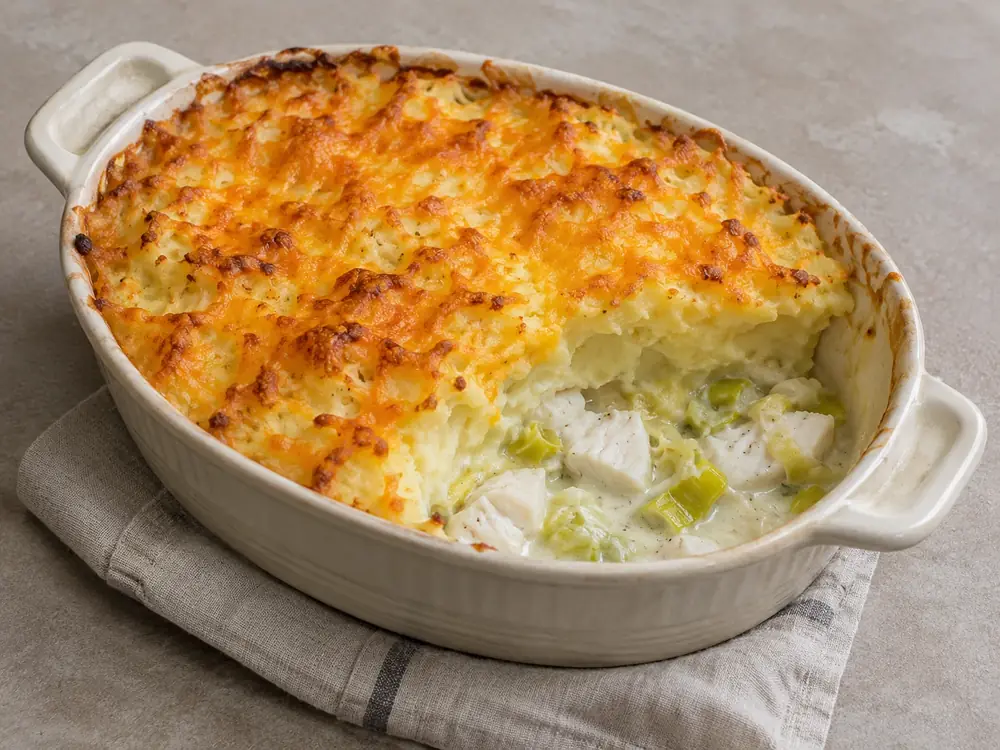
Hake and leek filling sits beneath mashed potato and a little cheddar. Here “pie” means potato-topped rather than pastry-enclosed. White sauce surrounds fish without becoming soup, and mash forms an even layer. Seek a thoroughly hot centre, fully cooked fish and lightly golden top. Potatoes and leeks are precooked; raw hake finishes in the oven.
Ingredients
- 700 g trimmed hake flesh
- 800 g peeled potatoes
- 2 leeks
- 400 ml milk
- 30 g flour
- 40 g butter
- 60 g cheddar
- 4 g salt
- pepper
Preparation
Method at a glance — Boil potatoes around 20 minutes and mash with 100 ml milk and 15 g butter. Soften leeks in 10 g butter 10 minutes. Make a roux with remaining 15 g butter and flour, gradually add remaining 300 ml milk and thicken. Combine sauce, leeks and large raw fish pieces; season. Cover with mash and cheddar and bake 25–30 minutes at 190 °C.
Culinary context — Fish pie belongs to a family repertoire of British heritage present in several countries, including South Africa. This hake and leek formula is the collection's domestic composition, not an exclusively South African claim. Fish and potato cover distinguish it from first-volume meat pies. Extra puff pastry would change balance and is not an invisible finishing step of the same basic version.
Making firm mash — Cook evenly cut potatoes until tender, generally about 20 minutes. Drain carefully and let steam escape 1–2 minutes. Mash with 100 ml warm milk and 15 g butter, retaining enough firmness to cover filling. Runny mash sinks into sauce. Prolonged blending can turn potato gluey; a masher or hand crushing suits better. Season with some total salt.
Preparing leeks — Split and wash between leaves to remove sand, retaining whites and tender greens. Slice finely and soften in 10 g butter about 10 minutes over low heat. If a little starting water prevents catching, evaporate it before assembly. Dripping leeks dilute sauce. Tough fibres do not become pleasant simply beneath mash, so trim and precook sufficiently first.
Making smooth sauce — Melt remaining 15 g butter, stir flour 1–2 minutes, then gradually whisk in remaining 300 ml milk. Stir until thick enough to coat fish and receive juices released during baking. Leave no lumps or raw-flour taste. Add some salt and pepper, allowing for cheddar. Do not simply dump flour into cold milk then leave thickening unattended without appropriate mixing.
Preparing hake — Blot, debone and cut into comparable large pieces. Thaw frozen fish under packaging directions and drain. Tiny flakes disintegrate and may dry; very thick blocks need more centre cooking. Refrigerate until assembly. Fold gently into sauce and leeks without crushing. Sauce should not be so scorching that isolated pieces cook unevenly while the rest of assembly continues.
Layering without mixing — Spread filling in a dish broad enough for moderate depth. Dot small mash spoonfuls across the surface, then gently join them with a spoon's back. One central mound pushes sauce aside and lifts fish. Light fork ridges are optional, then share cheddar evenly. Leave bubbling headroom; a tray beneath catches possible overflow without forcing a too-deep vessel.
Cooking the centre — Bake at 190 °C around 25–30 minutes according to depth and starting temperature. Sauce must simmer and fish cook centrally without raw translucency. Check a thick area, not only a hot edge. Protect fast-browning top and continue gently. The time assumes freshly assembled components; a fully chilled dish often needs longer. A quick grill cannot replace cooking hidden fish through.
Resting and serving — Rest 5–10 minutes, then serve with a large spoon as sauce stabilises and mash holds better. Do not expect rigid cake slices: fish pie remains soft. Share fish and potato across all six instead of giving early diners mash and later diners bottom filling. Salad or greens are separate accompaniments. Potato is included, so another large starch is unnecessary.
Variations and storage — Another white fish needs an adjusted name and duration; herbs can vary sauce. Cool leftovers promptly, refrigerate and consume next day, reheating thoroughly covered to protect mash. Freezing depends on initial product and instructions and may loosen sauce. For advance work prepare mash and leeks separately, then assemble under suitable cold conditions with adapted baking. Do not hold lukewarm for a prolonged wait.
Conclusion — Firm mash, clean low-moisture leeks and smooth sauce that allows for fish juices are the foundations. Oven cooking must reach the centre before a browned top is accepted as readiness. Record dish size and piece thickness for consistent future batches. A simply composed, evenly shared filling leaves fish, vegetables and potato cover recognisable in a clear family meal. Enjoy your meal!
Introduction
Hake and leek filling sits beneath mashed potato and a little cheddar. Here “pie” means potato-topped rather than pastry-enclosed. White sauce surrounds fish without becoming soup, and mash forms an even layer. Seek a thoroughly hot centre, fully cooked fish and lightly golden top. Potatoes and leeks are precooked; raw hake finishes in the oven.
Cultural context
Six family portions use usable fish and peeled potato weights. Leeks should give reasonably consistent whites and tender greens; note net weight when testing. Divide milk between mash and sauce and butter across three uses. Keep those allocations clear in translation to avoid spending the entire quantity on the first component.
Planning
Serves 6; preparation 30 min; cooking approximately 50 min.
Enjoy your meal
Enjoy your meal!