Squash stuffed with lentils and walnuts
Green lentils, tomato, onion and walnuts fill roasted squash. Flesh surrounds a mixture of tender grains and crunchy pieces. Seek moist rather than liquid filling and squash that yields easily under a fork. Cook lentils while squash roasts. Final baking heats everything together; it should not have to complete hard grains or undercooked shells.
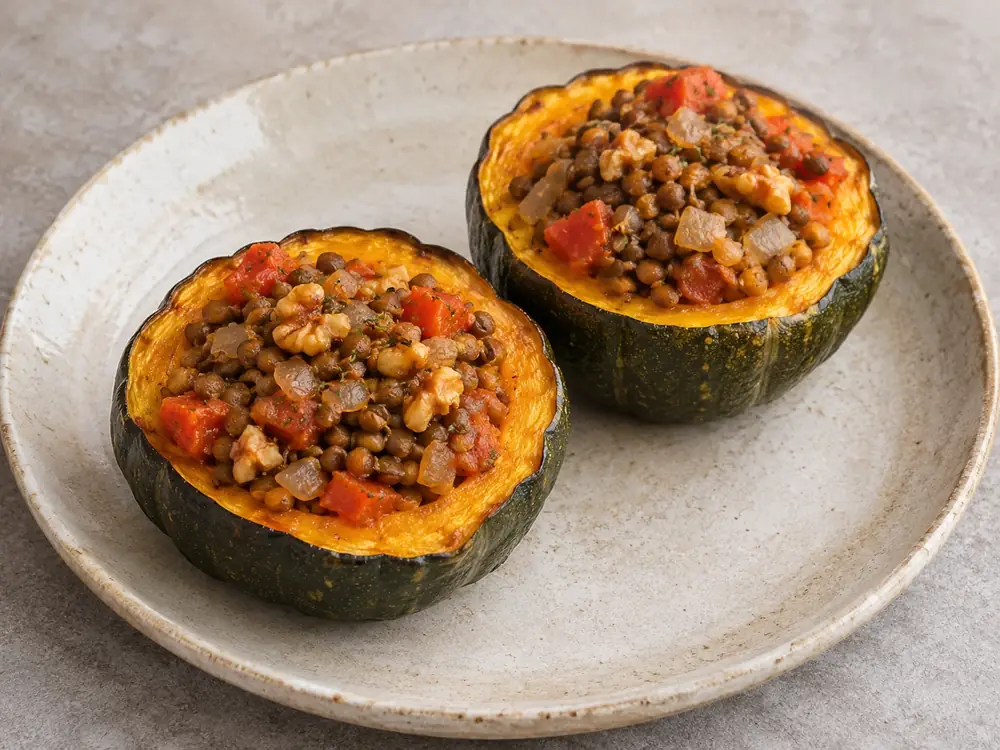
Ingredients
- 2 small gem squash or 1 whole 1 kg butternut
- 180 g dry green lentils
- 1 onion
- 200 g tomatoes
- 40 g walnuts
- 25 ml oil
- 3 g salt
- thyme
Preparation
Method at a glance — Halve squash, remove seeds, oil and roast 40–50 minutes at 190 °C. Cook lentils in water about 25 minutes and drain. Fry onion in remaining oil, add diced tomato and thyme and cook 10 minutes. Mix with lentils and chopped walnuts, salt, fill squash and heat another 10 minutes.
Culinary context — Gem squash appears in South African home cooking, but this lentil and walnut filling is a contemporary creation. It is not presented as an old family recipe or ceremonial dish. A familiar local product supplies context without inventing history for a new combination. Butternut is a practical supply adaptation. Keep the name gem squash with a description of the small round squash to avoid substitution by an unrelated vegetable.
Preparing squash — Wash and cut with a suitable knife on a stable board. Scoop out seeds and central fibres. Lightly oil flesh using part of the measured amount and place in a baking dish. Roast at 190 °C until tender, around 40–50 minutes according to size and variety. Small gem squash may finish before large butternut. Test the thickest area with a knife rather than judging browned surfaces alone.
Cooking lentils — Sort and rinse dry green lentils, then simmer in sufficient water until tender, generally around 25 minutes according to the packet. Drain while soft but still whole. Red split lentils break down and do not make the same filling. An equal weight of already cooked lentils does not replace the stated dry quantity. For cans, use a drained amount corresponding to observed cooking yield and shorten timing.
Building filling — Fry finely sliced onion in remaining oil. Add small tomato dice and a little thyme. Cook about 10 minutes to soften and reduce juices: tomato should moisten, not flood the mixture. Fold in drained lentils and roughly chopped walnuts gently, retaining recognisable grains. Salt after combining. Adjusting weak seasoning is easier before filling hot squash shells.
Handling walnuts — Choose plain kernels without rancid smell and knife-chop into small pieces, not powder. Their textural contrast disappears in a finely ground paste. Brief dry-toasting is a more aromatic adaptation, watched carefully to avoid burning. The 40 g is for all four portions, not a large extra handful on each plate. Identify walnuts clearly to relevant diners, especially on buffets without visible ingredient lists.
Adjusting before assembly — Taste lentils and tomato together, then adjust salt and optional pepper. Loosen dry filling with a little hot water or cooked tomato juice. Reduce excessive moisture in the pan before filling, as liquid stuffing soaks flesh and makes serving untidy. Squash adds sweetness, so tomato acidity does not automatically need sugar. Keep the savoury filling distinct against roasted flesh.
Stuffing and heating — When squash is tender, remove from the oven and share filling without hard packing. For shallow cavities, scoop a little flesh into lentils while retaining a supporting wall. Return about 10 minutes to bring temperatures together. Cold assembled components need longer: cover loosely and verify hot centres. This version contains no cheese, so a cheese-like crust is not a finishing criterion.
Serving according to shape — Present half a gem squash each, or divide large butternut halves with knife and spatula. Very tender shells may stay in individual dishes to avoid repeated transfers. Crunchy salad or green vegetables complement the meal. Lentils and squash are already included, so several rich starchy sides are unnecessary. Count accompaniments separately and use excess filling to balance portions instead of overloading one shell.
Variations and advance preparation — Pumpkin seeds can replace walnuts with different flavour and allergens. Vary herbs, avoiding abundant tough rosemary in a spoonable filling. Variations remain attached to this recipe. For advance work, cook squash, lentils and tomato base, cool promptly and refrigerate. Assemble before final reheating. Leaving the entire dish lukewarm for hours while waiting for guests improves neither texture nor organisation.
Storage and conclusion — Refrigerate remaining portions and use within 48 hours. Reheat covered until hot at the centre, adding a few drops of water if filling has dried. Freezing is possible but squash may soften and release liquid after thawing; fresh preparation better preserves a firm shell. Tender flesh, already cooked lentils and reduced tomato provide coherence, while measured walnuts give contrast rather than hiding insufficient seasoning. Enjoy your meal!
Introduction
Green lentils, tomato, onion and walnuts fill roasted squash. Flesh surrounds a mixture of tender grains and crunchy pieces. Seek moist rather than liquid filling and squash that yields easily under a fork. Cook lentils while squash roasts. Final baking heats everything together; it should not have to complete hard grains or undercooked shells.
Cultural context
Yield is four portions. Two small gem squash provide a half each. With a roughly kilogram whole butternut, share its two larger halves after cooking or cut into four suitable portions. Cavities differ, so some filling may be served alongside. Whole squash weight is not peeled flesh weight: retain that distinction for shopping and later nutritional estimates.
Planning
Serves 4; preparation 20 min; cooking 65 min.
Enjoy your meal
Enjoy your meal!