Bean and vegetable boontjiesop
This meat-free boontjiesop combines white beans and vegetables. Some beans stay whole; a few are mashed to thicken broth. Between clear soup and stew, every spoon should contain liquid and pieces without dryness. Tomatoes give mild acidity but join only after initial bean cooking, allowing tenderness to be controlled before final flavours are built.
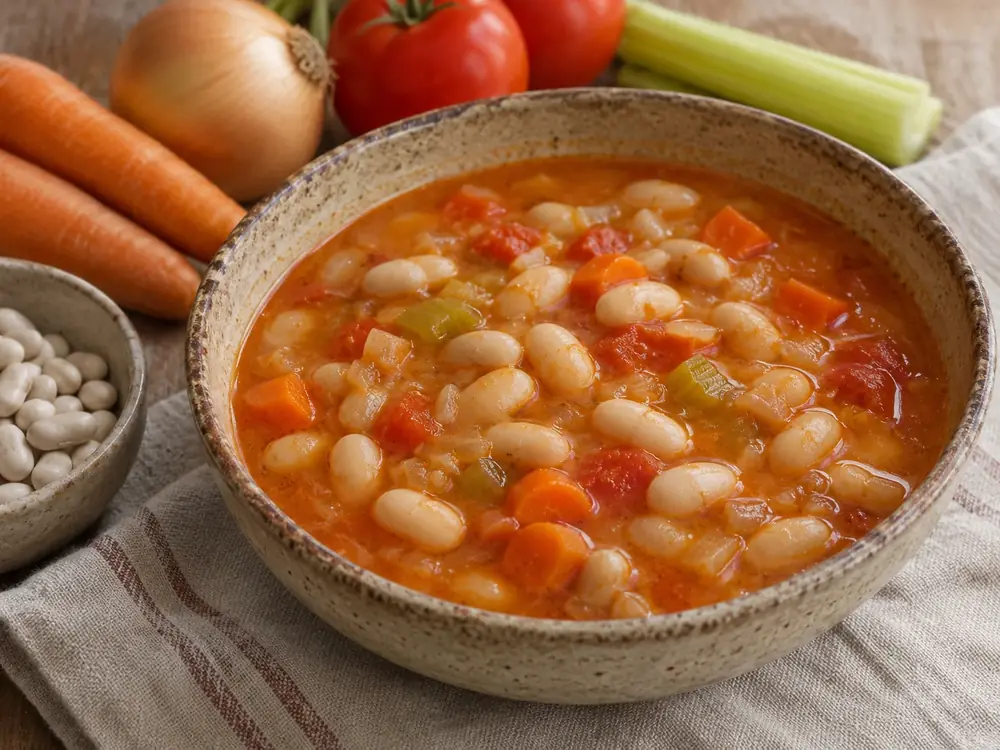
Ingredients
- 300 g dry white beans
- 2 carrots
- 1 onion
- 2 tomatoes
- 1 celery stalk
- 20 ml oil
- 1.6 litres water for the soup, with additional soaking and cooking water as needed
- 1 bay leaf
- 4 g salt
- pepper
Preparation
Method at a glance — Sort and soak beans 12 hours, discard water and rinse. Cover generously with fresh water, boil vigorously for at least 30 minutes, then continue until tender, following product instructions. Add hot water as needed. Sweat vegetables in oil, add tomatoes and bay, then cooked beans and some cooking liquid. Simmer another 20 minutes, adjust salt and consistency and remove bay.
Soaking and rinsing — Sort, rinse and cover beans generously with cold water in a large container. Soak around 12 hours refrigerated or under suitable cool conditions, particularly in warm kitchens. Swelling beans must remain submerged. Discard water, rinse again and transfer to a clean pan. Soaking does not replace cooking: a swollen bean can feel soft outside while retaining a hard centre that must become fully tender. Cover with fresh water. Begin with at least 30 minutes of vigorous boiling, then simmer until tender. The final soup's roughly 1.5–1.6 litres is not a requirement to cook beans dry in exactly that amount: add water to keep them covered. This method does not cook dry beans solely at very low temperature in a slow cooker. Follow more specific manufacturer instructions for the variety as a priority.
Checking beans — From about an hour, sample different-sized beans, cool and taste. Flesh must be tender throughout, without chalkiness. A slightly split skin is acceptable in soup. If hard, continue and add hot water as needed; age and variety may extend timing considerably. Do not add tomatoes to flavour undercooked beans: finish plain cooking first.
Preparing vegetables — Slice onion and finely dice carrots and celery. Chop tomatoes, discarding hard stalk areas. Heat oil in a casserole and sweat onion, carrot and celery about 8 minutes. Add tomatoes and cook briefly until beginning to collapse, then bay. Strong browning is unnecessary: gentle cooked flavour suits soft beans better than blackened vegetables.
Combining while preserving broth — Lift cooked beans with a slotted spoon into vegetables. Gradually add their clean cooking liquid to the desired soup volume, topping with fresh water if necessary. Absorption and evaporation vary; checking consistency is more useful than automatically pouring in excess. Simmer around 20 minutes to tenderise vegetables and unite flavours. Stir gently to keep some beans intact.
Natural thickening — For thicker soup, remove a ladle of beans with little liquid, fork-mash and return. This preserves other pieces and avoids blending bay accidentally. Alternatively press some beans against the pan wall. Do not add raw flour: beans already thicken sufficiently. A little hot water restores soup consistency if too compact without excessively changing beans per serving.
Measured seasoning — Remove bay, salt gradually and pepper. Taste broth with a bean, since seasoned liquid can surround bland grains. Tomato supplies the intended acidity; optional lemon at serving is an adaptation, not a reason to make soup sour. Onion and carrot bring sweetness without sugar. Parsley may be an optional garnish, separately added to exact shopping calculations.
Variations and menu — Speckled beans may replace white with different colour and timing, remaining the same bean soup recipe. For meat, choose an already cooked product and reassess salt. A raw or salted hock requires its own method and cannot simply enter the last 20 minutes. Serve dense sandwich bread or wholemeal bread. A generous bowl can anchor a meal with separately prepared fresh salad.
Storage and conclusion — Beans may be cooked ahead, cooled promptly and refrigerated with some liquid. Refrigerate complete soup and consume within 48 hours, or freeze portions. Reheat stirring to the bottom until hot throughout; add water if beans have absorbed broth. Tender beans cooked before tomato, followed by restrained thickening that preserves recognisable grains and vegetables, are the keys. Enjoy your meal!
Introduction
This meat-free boontjiesop combines white beans and vegetables. Some beans stay whole; a few are mashed to thicken broth. Between clear soup and stew, every spoon should contain liquid and pieces without dryness. Tomatoes give mild acidity but join only after initial bean cooking, allowing tenderness to be controlled before final flavours are built.
The 300 g is dry beans requiring soaking and cooking, giving six portions with optional bread. The same canned weight is insufficient. For a cooked-bean adaptation, determine drained quantity from an observed reference batch and shorten timing accordingly. Following the dry product first establishes actual yield and consistency.
Cultural context
South African home-cooking collections use boontjiesop for bean soup. My Ma se Kombuis publishes a version with vegetables and smoked meat. That reference identifies the dish family; this meat-free composition and its proportions are adaptations for the collection. Families may use different beans. Presenting white beans as the sole permitted pulse or this version as a compulsory traditional formula would mislead.
Planning
Serves 6; preparation 20 min; soaking 12 h; indicative cooking 110–140 min, depending on beans.
Enjoy your meal
Enjoy your meal!