Millet and courgette patties
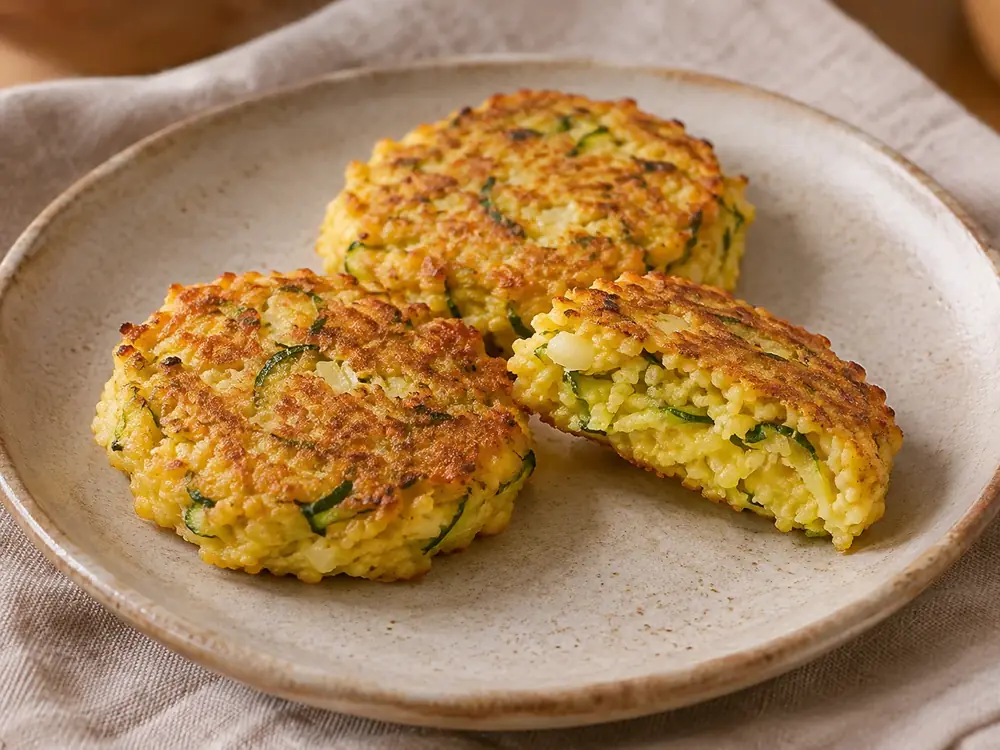
Cooked millet and grated courgette are held together with eggs and a little flour, then pan-fried in small portions to a golden surface and firm centre. Millet retains fine-grain texture unlike potato mash or maize dough. Courgette adds softness but also plenty of water. Squeezing and patty size matter more than abundant oil or fierce heat.
Ingredients
- 150 g dry millet
- 300 g courgettes
- 2 eggs
- 40 g flour
- 1 spring onion
- 30 ml oil
- 3 g salt
- pepper
Preparation
Method at a glance — Cook millet according to its packet, about 15 minutes, and cool to lukewarm. Grate courgettes and squeeze in a clean cloth. Mix millet, courgettes, eggs, flour and sliced onion; season. Form twelve patties and pan-fry over medium heat in the oil, about 4 minutes per side, until firm at the centre.
Culinary context — This is a contemporary grain-and-vegetable creation without attribution to a named South African traditional dish. Millet is used as cooked grain, not flour: purchasing and translation must preserve this, as the products behave differently and require different water amounts. The patties broaden the volume without claiming undocumented local history. Variations belong to this recipe, not additional counts.
Cooking millet — Rinse 150 g dry millet in a fine sieve. Follow packet instructions with measured water suited to the product. Fifteen minutes is guidance for ordinary hulled millet; some grains take longer. Once tender, drain if needed and spread in a dish to release steam. Very hot grain can start cooking eggs during mixing; waterlogged grain makes wet batter. Cool to lukewarm without unnecessary time on the worktop. Fluff gently with a fork to break large clumps; perfectly separate grains are unnecessary, but compact masses produce uneven patties. Do not add uncounted fat while cooking millet: the oil is allocated to the pan. Previously cooked millet works if promptly cooled and properly refrigerated. Measure its equivalent to the original dry weight rather than equating 150 g cooked with 150 g dry.
Preparing courgettes — Wash, trim and grate using medium holes. Very fine grating produces pulp; coarse shreds protrude and impede shaping. Put in a clean cloth and squeeze firmly over sink or bowl, extracting visible liquid. The 300 g is weight before squeezing: do not add more afterwards to restore that weight. For very large courgettes, remove spongy cores and hard seeds before grating and weigh usable flesh. Do not salt for a long drainage without adjusting the measured 3 g: some salt remains. Mechanical squeezing is sufficient for young courgettes in this method. Do not return extracted juice, which would undo the work and require excessive flour.
Binding without heaviness — Mix lukewarm millet, squeezed courgette, eggs, flour and very finely sliced spring onion. Season. Eggs set with heat; flour absorbs some remaining moisture and helps hold. Rest 5–10 minutes to judge before shaping. Mixture should hold on a spoon and flatten under light pressure, not become a dry dough to knead like bread.
A useful test — Cook one small patty before shaping the whole batch. If it breaks when turned, first check that the underside had time to set and the spatula supports its full width. Truly runny batter may need a little extra flour, added gradually and recorded. Do not automatically add a large handful: that makes a doughy centre and hides millet. Draining remains the first adjustment to improve.
Cooking in batches — Heat part of the oil in a heavy pan over medium heat. Add spaced portions and flatten to the intended thickness. Cook about 4 minutes without constant moving, turn with a flexible spatula and cook the other side until golden and set inside. Share 30 ml oil between batches rather than adding all initially. A dry pan can make later patties stick, but deep oil is unnecessary. Colour alone is insufficient for thick patties. Open the first to check a firm interior without liquid egg or raw-flour taste. If crust darkens too quickly, lower heat and continue gently. Set cooked patties on a rack or absorbent paper without immediate stacking to release steam. Brief warm holding is possible; long covered waits soften surfaces. Prepare accompaniments before the last batch for prompt service.
Variations and conclusion — Serve with crunchy salad and optional separately prepared lemon yoghurt. Herbs may replace some spring onion; grated cheese is another adaptation requiring salt review. Cool leftovers promptly, refrigerate and use within 48 hours; reheat thoroughly in a pan or oven. Cooked patties may be frozen, accepting some texture change. Properly cooked millet, squeezed courgette and even thickness are the useful guides. Enjoy your meal!
Introduction
Cooked millet and grated courgette are held together with eggs and a little flour, then pan-fried in small portions to a golden surface and firm centre. Millet retains fine-grain texture unlike potato mash or maize dough. Courgette adds softness but also plenty of water. Squeezing and patty size matter more than abundant oil or fierce heat.
Cultural context
Twelve small patties serve four. Three per person make a light-meal base with salad and an optional separate sauce. Do not increase numbers by thinning until they dry out; very large patties are hard to turn and stay soft inside. About 7 cm diameter and 1 cm thickness make stated times more realistic and portions consistent.
Planning
Serves 4; preparation 20 min; cooking 35 min.
Enjoy your meal
Enjoy your meal!