Macadamia granola
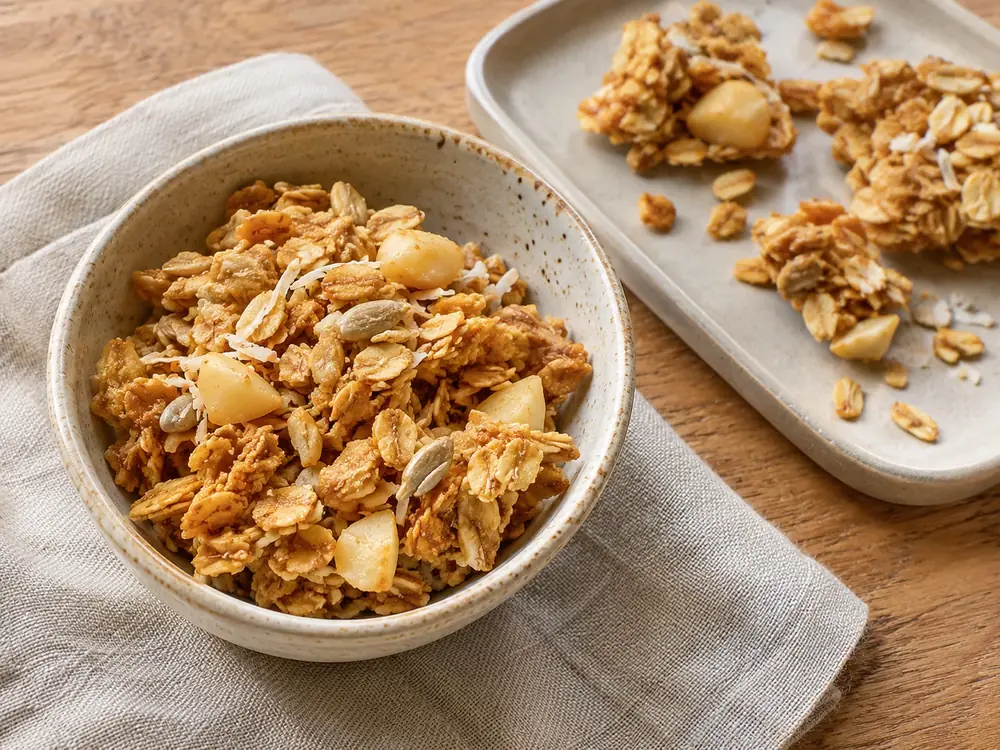
Oats, macadamias, sunflower seeds and coconut are bound with a little oil and honey, then dried in the oven. Aim for golden, crisp ingredients without burnt-tasting nuts. Clusters partly form during cooling; do not judge final texture while the tray is hot. Serve a small quantity over yoghurt, fermented milk or fruit rather than a whole plate of cereal.
Ingredients
- 250 g rolled oats
- 80 g macadamias
- 40 g shelled sunflower seeds
- 30 g unsweetened desiccated coconut
- 60 g honey
- 35 ml oil
- 1 g salt
Preparation
Method at a glance — Mix oats, roughly chopped nuts, seeds and coconut. Add honey, oil and salt. Spread on a baking-paper-lined tray. Bake at 150 °C for about 25 minutes, stirring every 8 minutes. Remove when golden and cool completely before breaking up clusters.
Choosing nuts — Use plain, unsalted macadamias, preferably not already deeply roasted. Large pieces give pleasant texture, but whole nuts brown differently from small fragments. Chop roughly with a stable knife; do not grind to powder. Their high fat content makes them sensitive to storage odours and rancidity. Taste a little first: baking cannot correct rancid flavour. Reseal leftovers according to package instructions. Choose shelled sunflower seeds and unsweetened coconut. Very fine coconut browns faster and can be added after the first 8 minutes rather than initially. This changes timing, not quantity; note it for repeat batches. Oats should be plain, without milk powder or flavourings. Commercial muesli is not a direct substitute because it may already contain sugar, oil and dried fruit.
Understanding the coating — Honey binds flakes and contributes colour; oil coats and encourages crispness after drying. Neutral oil highlights macadamias, while strongly flavoured oil changes the profile. Distribute the 1 g salt throughout without concentrated crystals. Mixing honey and oil separately first helps even distribution. Gently warm very thick honey without boiling. Add liquid to dry ingredients in stages, turning with a large spatula right to the bowl's base. Dry patches make pale, crumbly flakes; pools of honey overbrown. Aim for a light film, not a dripping wet coating. Do not thin honey with water: that extends drying and complicates storage. The homogeneous mixture should be slightly glossy, with pieces still separable under a spoon.
Arranging the tray — Spread moderately thinly on a large lined tray. Packed into a small deep dish, the centre stays damp while edges darken. For twice the quantity, use two trays and swap positions during baking instead of doubling depth. Preheat to 150 °C. Moderate heat allows drying, but hot spots remain possible, hence stirring and watching edges.
Baking and cooling — Bake about 25 minutes, stirring every 8 minutes and exchanging centre and edge ingredients. Watch coconut, often the first to darken. Once oats are lightly golden and nuts aromatic, remove even if still slightly soft. Cool completely uncovered to stabilise crunch. For more clusters, press lightly with a spatula after the last stir, then leave untouched until cold. Very dark colour and acrid smell mean overbaking; extra honey cannot remove bitterness. A pale but crisp batch may simply be less toasted and still pleasant. If soft when cold, return briefly to a moderate oven and cool again. First check that moisture is not from fresh fruit or another post-baking addition: granola containing fresh fruit cannot be stored like a dry mix.
Serving and adaptations — Weigh 40 g to visualise a portion and serve over plain yoghurt with separately prepared fruit. Banana, pear or mandarin belongs in the bowl, not the storage jar. A suitable syrup can replace honey, possibly browning differently; this remains a variation of the same recipe. Another nut may replace macadamia for availability, but adjust the title and agricultural context rather than artificially retaining the identity.
Storage and conclusion — Transfer only completely cold granola to a clean, dry, airtight container. Make a quantity suited to consumption and regularly check aroma and crispness: ambient moisture and nut quality strongly affect keeping. Keep wet spoons out. For longer storage, freeze some in a sealed package and let it return to room temperature without opening prematurely. Even coating and gentle drying, rather than abundant sugar, bring success. Enjoy your meal!
Introduction
Oats, macadamias, sunflower seeds and coconut are bound with a little oil and honey, then dried in the oven. Aim for golden, crisp ingredients without burnt-tasting nuts. Clusters partly form during cooling; do not judge final texture while the tray is hot. Serve a small quantity over yoghurt, fermented milk or fruit rather than a whole plate of cereal.
The mixture weighs about 500 g before small baking losses. Twelve 40 g portions are an estimate to check after cooling: weigh the finished batch and divide by 40. Save a small remainder for another bowl instead of silently enlarging every portion. Cluster size changes the apparent quantity but not total weight. This simple check makes serving reproducible; it is not a detailed nutritional calculation.
Cultural context
South Africa has a well-established macadamia industry and a professional organisation, SAMAC. This agricultural setting supports using the nut here. It does not make granola a traditional South African dish or prove a local origin for this specific combination. This contemporary breakfast creation uses a product grown in the country without inventing a family history, ceremony or community origin unsupported by the consulted sources.
Planning
12 portions of approximately 40 g; preparation 10 min; cooking 25 min.
Enjoy your meal
Enjoy your meal!