Coconut flan
Coconut flan: Alioune's contemporary recipe for four people.
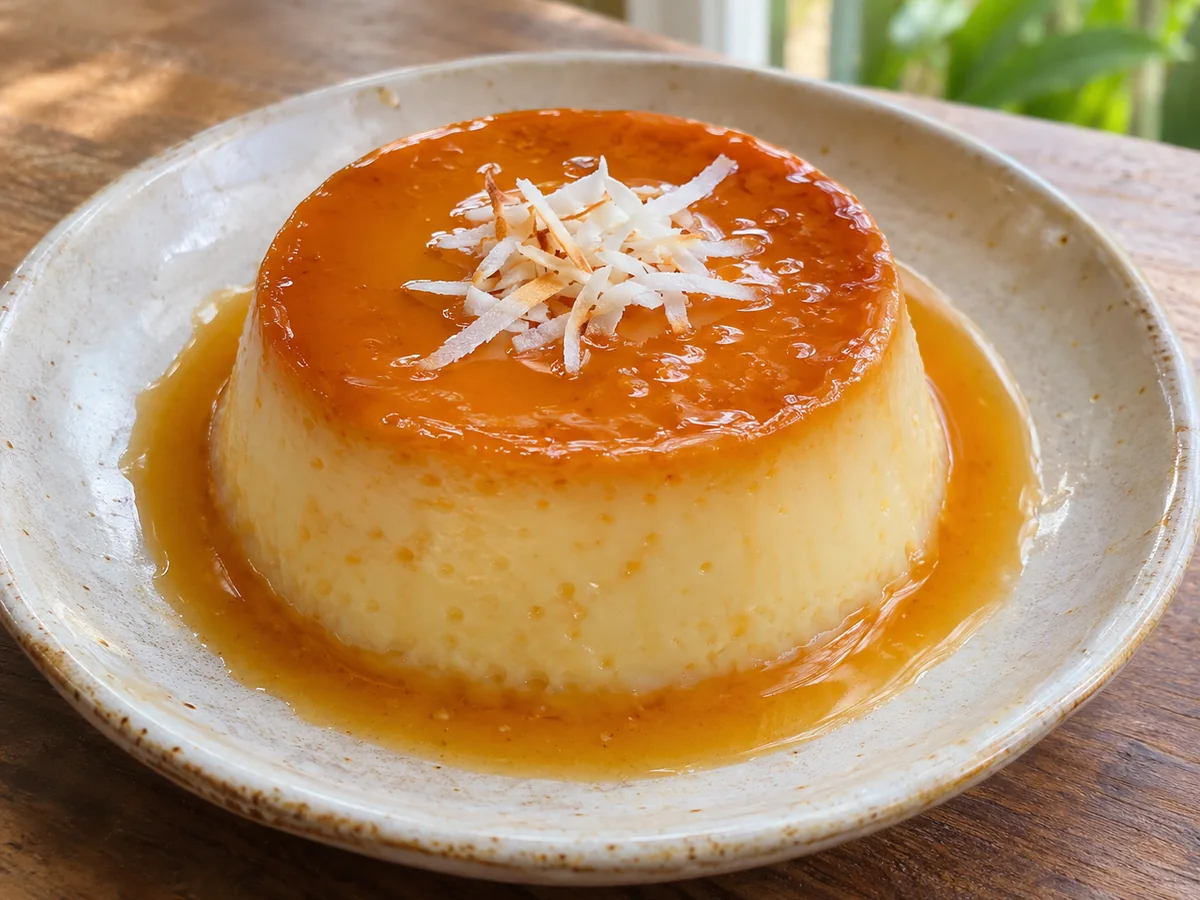
Ingredients
- 400 ml unsweetened coconut milk
- 200 ml pasteurised milk
- 3 eggs
- 90 g sugar
- 30 ml drinking water
Preparation
Preheat the oven to 160°C. Prepare four heatproof ramekins and a dish deep enough to hold them without them touching too much. Heat water for the water bath; this water outside the ramekins will not be used in the final dish.
Place 40g of sugar (taken from the 90g required) in a small saucepan with 30ml of water. Heat without stirring with a spoon until you obtain a light caramel. Gently swirl the pan if the color is uneven.
Immediately divide the caramel among the ramekins, tilting them carefully. Do not touch the hot caramel or try to taste it: it can cause severe burns. Place the ramekins on a stable surface while it hardens.
Beat the three eggs with the remaining 50g of sugar, without creating a large foam. Add the 200ml of milk and the 400ml of previously homogenized coconut milk. Mix until smooth, then allow any large bubbles to subside.
Pour into the ramekins. Arrange them in the large dish and add hot water around them, up to about halfway up the sides. Carefully transfer the whole thing to the oven, or fill the water bath once the dish is placed on the rack to minimize liquid movement.
Bake for approximately 40 to 45 minutes. The edges should be set and the center still slightly wobbly, with no distinctly liquid areas. Rapid boiling of the water bath or a very puffy surface indicates excessive heat; reduce it if necessary.
Carefully remove the ramekins from the water bath. Allow them to cool to room temperature for several hours, then refrigerate for at least three hours. Serve in the ramekins or run a thin knife around the edge before unmolding onto small plates.
Introduction
Coconut flan is a set egg dessert with a smooth texture and a light caramel at the bottom of the ramekins. Coconut milk contributes its aroma and some of the creaminess, while whole milk softens the overall flavor. It's baked in a water bath to avoid excessive heat. The center should be set but still slightly wobbly when removed from the oven, then firm up as it cools.
This recipe is a contemporary adaptation of the Congo-Brazzaville collection. Coconut flans exist in several culinary traditions and cannot be attributed to the Congo solely on the basis of the presence of this ingredient. Our version is a homemade dessert, with precise proportions and serves four. It does not claim any ancient local origin or a traditional name that has not been documented.
Cultural context
Caramel and the bain-marie are part of a widely used pastry technique. Coconut changes the aroma and richness of the dessert, but the structure relies on eggs. It's important to distinguish between unsweetened coconut milk, coconut water, and flavored coconut milk: substituting one for the other would alter the setting and the taste.
Preparation time isn't limited to baking. The flan needs to cool and then chill in the refrigerator for at least three hours before serving. This waiting period is for texture and organization, not additional cooking. For a shared meal, individual ramekins make it easier to distribute the caramel and dessert. A large mold would require more careful monitoring of the center and an adjusted baking time.
Tips
Homogenize the coconut milk before measuring it to distribute its thick part and liquid throughout the appliance.
Keep it a light caramel color: a very dark color brings a bitterness that can mask the coconut flavor.
Do not over-whisk the eggs, as excessive foam promotes a less smooth surface and more bubbles.
The bain-marie is used to moderate the heat; the ramekins should not float or have water inside them.
Control the setting of the center rather than relying solely on the duration, which depends on the size and material of the ramekins.
Do not unmold the dessert while it is still hot: the texture needs to cool down to firm up and the caramel needs to liquefy on contact with the flan.
Keep the flans covered in the refrigerator and take them out shortly before serving; their egg and milk content requires refrigeration.
Variations
A small amount of vanilla can flavor the mixture without changing the technique. For a caramel-free version, divide the mixture directly into the ramekins and reduce the sugar by the amount reserved for the caramel, recalculating the sugar content accordingly. A plant-based milk will not automatically replace regular milk with the same setting time. A large mold is possible, but requires specific cooking control rather than simply increasing the cooking time.
Accompaniments
Serve the flan on its own or with a few pieces of fresh pineapple on the side. A small fruit garnish adds contrast without needing a second sweet sauce. The dessert already contains sugar and fat; there's no need to add whipped cream or syrup. The estimates are based on one ramekin out of four, including the caramel, but excluding any fruit served with it.
Nutrition notes
Eggs and milk provide protein; milk contributes calcium. Coconut milk increases fat, particularly saturated fat, and sugar provides carbohydrates. Caramel remains entirely included in the estimate of one in four ramekins.