Okra with tomatoes
Okra with tomato: Alioune's contemporary recipe for four people.
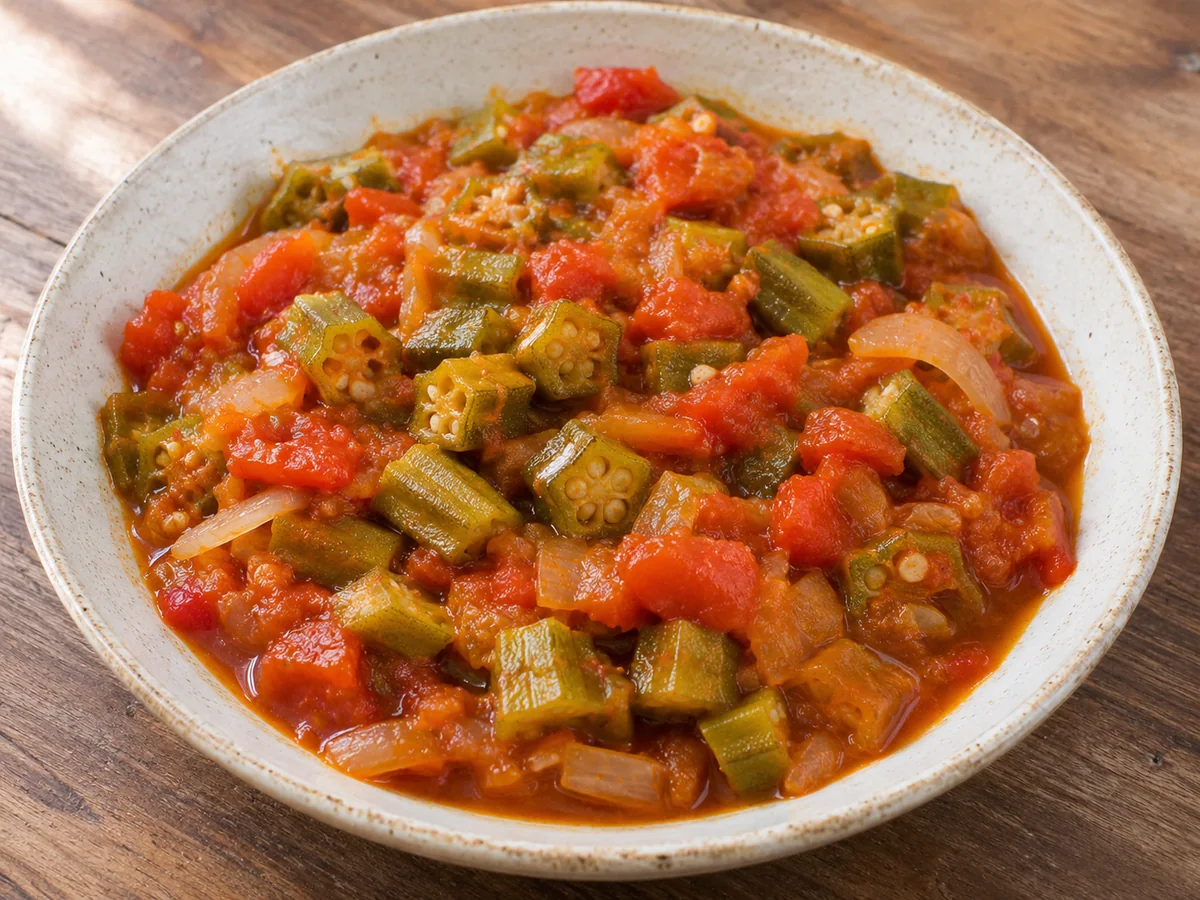
Ingredients
- 700 g sliced okra
- 500 g diced tomatoes
- 120 g sliced onion
- 8 g minced garlic
- 150 ml drinking water
- 20 ml vegetable oil
- 2 g salt to taste
- 1 g ground black pepper
Preparation
Choose firm okra pods without significant soft spots. Wash and dry them thoroughly. Remove the stems without unnecessarily cutting into the entire pod, then slice into even rounds, thick enough to remain visible after cooking.
Wash the tomatoes and dice them. Finely chop the onion and garlic. Prepare a casserole dish or a heavy-bottomed sauté pan: with little water added, an even heating surface makes it easier to control the sauce.
Heat the oil over medium heat and sauté the onion for four minutes. Add the garlic for one minute, then the tomatoes. Stir for a few moments to begin to soften them; they should release their juices without the aromatics sticking to the bottom.
Add the okra slices and 150 milliliters of water. Stir once to distribute the tomato among the vegetables, then partially cover. Cook over low heat for about 15 minutes, at a gentle simmer.
Check the texture of a slice and the juice level. If the okra is still firm, continue cooking for about five minutes. If the sauce dries out too quickly, add a small spoonful of hot water rather than a large amount of liquid, which would require a long reduction.
Gently scrape the bottom of the pan with a spatula as needed, without stirring. Taste before adding salt and pepper. The tomato should be cooked through and the okra tender, while some of the slices should still hold their shape.
Remove from the heat when the consistency is to your liking and divide into four portions. Serve with a wide spoon to keep the vegetables and their juices together. Leaving it on the heat for too long will make the sauce too concentrated and the slices more fragile.
Introduction
Okra with tomato sauce makes the vegetable the star of the dish. The okra slices cook in a base of onion, garlic, and tomato, with just a little water added. The juices thicken naturally and remain concentrated enough to coat the okra. This version contains neither smoked fish nor meat: its flavor relies on the ripeness of the tomatoes, the freshness of the okra, and careful cooking.
Okra is documented in several Congolese-Brazzaville dishes, particularly sauces and vegetable broths. This entry offers a contemporary, plant-based interpretation, as defined by Alioune for this collection. It does not replace the entries dedicated to dongo-dongo and does not claim that all okra dishes share the same name. The tomato-onion combination remains a simple tool for learning how to measure the liquid and recognizing when the okra is tender but not completely mushy.
Cultural context
Okra's stringy texture is part of its culinary identity. It can be desirable, moderate, or more pronounced depending on the size of the slice, the liquid, and the dining experience. Considering it systematically as a flaw would be to overlook its role as a thickening agent in many sauces. Here, fairly thick slices allow the vegetable to maintain a presence on the plate. The dish pairs easily with a starchy side dish prepared separately, whose more neutral flavor complements the tomato juice. The vegetable version can also accompany other dishes, but its portion should not be lost in an indefinite amount of sauce shared without restraint.
Tips
Young okra are generally more pleasant than very large fibrous pods; firmness and surface condition guide the choice.
Drying okra after washing makes the cut cleaner and avoids adding unmeasured water to a recipe that is intentionally not very wet.
The size of the slice influences the texture: thin slices expose more surface area and give a more noticeable bond in the juice.
An unripe tomato sometimes requires a longer initial cooking time before adding okra; do not automatically compensate for its acidity with sugar.
The salt is adjusted at the end, after evaporation: a short sauce concentrates the seasoning more quickly than a large broth.
For a less bound texture, stir only when the bottom requires it and keep the slices thick enough, without trying to remove all the mucilage.
The preserved portions must cool quickly and then be refrigerated; when reheating, handle the okra sparingly to avoid turning it into a puree.
Variations
A spicier version can be served with a chili pepper on the side. A few fresh herbs can enhance the flavor, provided they are mentioned and don't overpower the vegetable. Adding smoked fish would transform the vegetable dish into something else entirely, requiring a different salt content, protein, and cooking method. Unseasoned canned tomatoes can be used, adjusting the liquid to match their juices.
Accompaniments
Plain rice, boiled plantain, or a small portion of cassava paste prepared separately are suitable accompaniments to the sauce. A portion of fish or meat can accompany the meal according to your custom, but it is not included in this recipe. The nutritional estimates describe only the okra, tomato, herbs, and oil divided into four portions; they do not make this vegetable a complete meal based solely on its quantity.
Nutrition notes
Okra and tomato provide a vegetable portion with fiber. The oil represents a significant portion of the energy. This dish alone is low in protein: a legume, fish, or an egg can complete the meal, not included in the calculation shown.