Steamed fish with lime
Steamed fish with lime: a contemporary recipe by Alioune for four people.
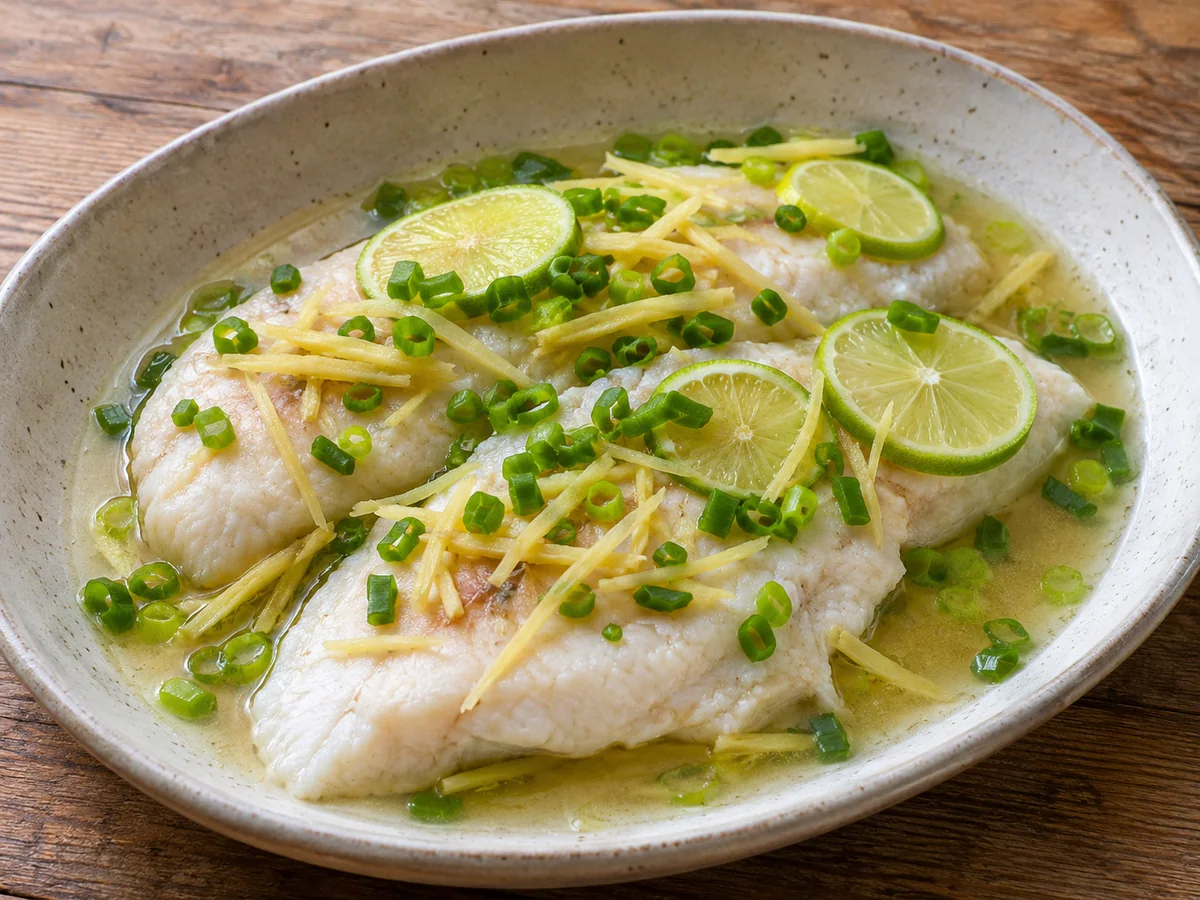
Ingredients
- 700 g boneless white fish fillets
- 40 ml lime juice
- 15 g grated fresh ginger
- 60 g sliced spring onion
- 800 ml drinking water
- 20 ml vegetable oil
- 2 g salt to taste
- 1 g ground black pepper
Preparation
Carefully inspect the fillets and remove any bones. Divide the 700 grams of fish into four portions of as even a thickness as possible. Keep them chilled while you prepare the ginger, scallions, and lime.
Peel the ginger and slice it very thinly, or grate it if you prefer to avoid slices. Finely chop the scallions, squeeze the lime, and measure out 40 milliliters of juice. Cut four sheets of parchment paper large enough to loosely enclose the fish.
Place a portion in the center of each leaf. Distribute the ginger, scallions, lime juice, and oil evenly. Add a small amount of the reserved salt and pepper, then carefully fold the edges to keep the juice inside.
Pour the water into the bottom of the steamer and bring it to a boil. Place the basket inside, ensuring its base does not touch the water. If your appliance specifies a different minimum quantity, follow the instructions: this water is for producing steam, not for making a sauce.
Place the papillotes in the basket, allowing steam to circulate. Cover and cook for approximately twelve to fifteen minutes, depending on the thickness of the fillets and the power of your appliance. Do not constantly lift the lid, as this will slow down the cooking process.
Carefully open the foil packet, keeping your face and hands away from the steam vent. Check that the internal temperature of the thickest part of the meat is at least 63°C; the flesh should be opaque. Reseal the packet and cook for a few more minutes if necessary.
Place each fish parcel on a plate or transfer it with a wide spatula. Pour the juices over the fish, taste, and adjust the seasoning only if necessary. Serve immediately with the prepared side dish.
Introduction
Steamed fish with lime uses parchment paper to retain the juices around the fillets. Ginger and scallions infuse the flesh with flavor during a short cooking time, without frying or reducing sauce. Upon opening, each portion retains a little of the lime-infused liquid, to be poured over the fish when serving. The desired texture is tender and moist, with flakes of flesh that separate easily.
Wrapped cooking methods are well-known in the cuisines of the Congo Basin, particularly with dishes like liboké and maboké. Alioune's version doesn't use the same name: it employs parchment paper, boneless fillets, and a precisely defined lemon-ginger seasoning. It's a contemporary adaptation of this protected cooking method, not a cultural equivalence between a local leaf and paper wrapping. The steam comes from a basket placed over boiling water.
Cultural context
Wrapping food helps retain its juices and flavors, but choosing the right wrapping is part of culinary expertise. Edible or cooking-safe foil requires identification and preparation that aren't necessary with standard food-grade parchment paper. Therefore, this recipe highlights materials readily available in many diaspora kitchens. Individual foil packets facilitate sharing and portion control. They can be opened in front of guests to release the aromas, provided they are warned about the hot steam. Lemon juice is served with fish and should not be forgotten in the foil packet when calculating portion sizes.
Tips
Choose fillets of the same thickness rather than the same length: it is mainly the thickness that determines the steaming time.
Use paper intended for baking and compatible with your equipment; decorative or printed paper is not a food substitute.
Fold the edges upwards to prevent the lime juice from escaping before even placing it in the basket.
Do not pack the foil packets too tightly together. The steam must reach each portion for even cooking.
The very fine ginger adds flavor without imposing large fibers on the taste; remove the particularly woody parts of the root.
Prepare the plates and side dishes before opening the envelopes, as cooked fish cools down quickly once exposed to air.
Always handle the opening of the papillotes like that of a hot container: their papery appearance does not protect against the scalding steam.
Variations
The same method can be used for different types of fish, with cooking times adjusted according to their thickness and a new nutritional assessment if their fat content differs. For a milder flavor, distribute some of the lemon juice after cooking rather than inside the parchment packets. Cooking in a clearly identified vegetable leaf is a different preparation altogether: it's not chosen solely for its resemblance to the outer layer.
Accompaniments
Serve plain rice, a small portion of yam, or steamed vegetables in a separate basket, depending on your equipment. A very strong sauce would overpower the scallions and ginger, so start by tasting the juices from the steamer. The nutritional values include the herbs, lemon, and oil divided among the four portions, but not the water from the reservoir, which is not consumed.
Nutrition notes
White fish provides primarily protein, with few carbohydrates in this preparation. Lime and chives are aromatics, not a significant portion of fruit or vegetable. The water from the steamer is not consumed.