Pork with cabbage and peanuts
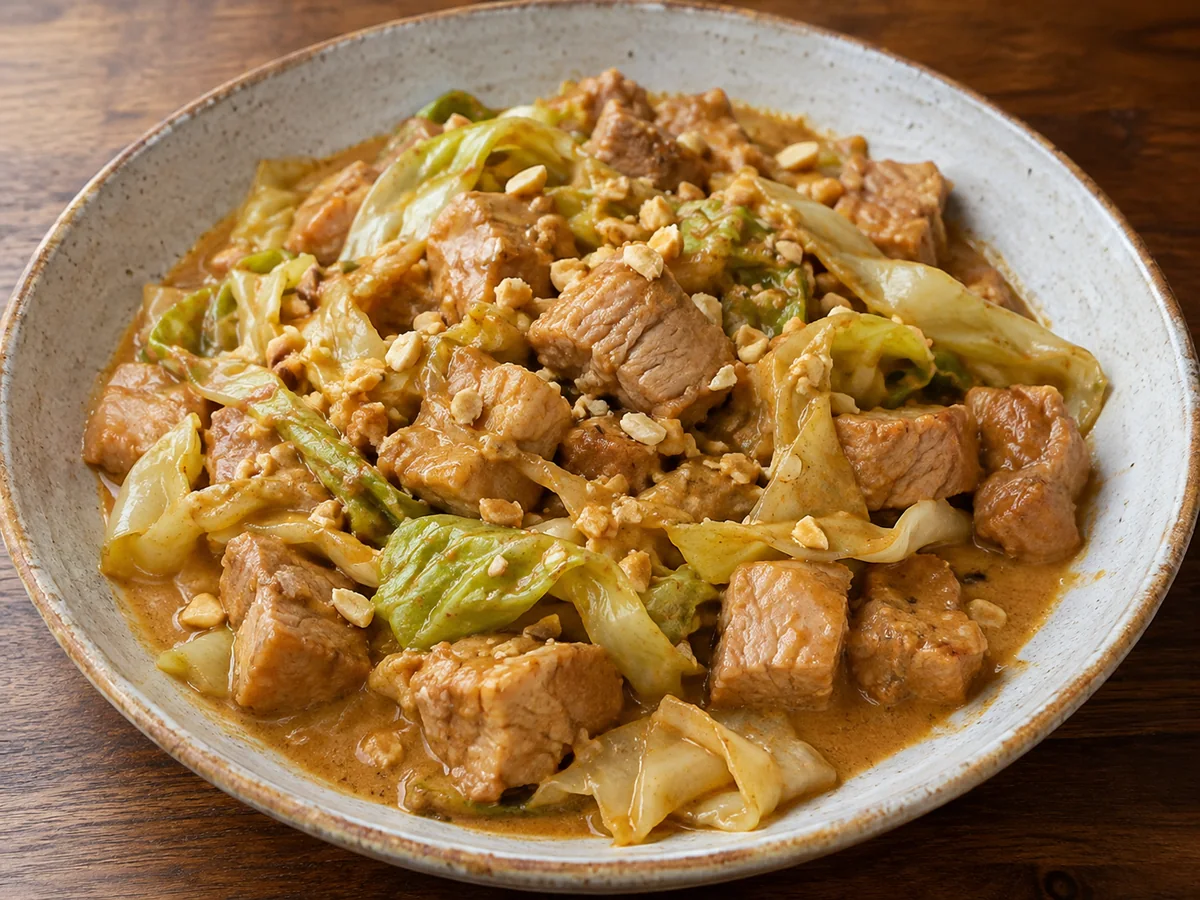
Pork with cabbage and peanuts: Alioune's contemporary recipe for four people.
Ingredients
- 650 g cubed pork
- 500 g shredded white cabbage
- 120 g sliced onion
- 8 g minced garlic
- 80 g unsweetened peanut butter
- 600 ml drinking water
- 20 ml vegetable oil
- 2 g salt to taste
- 1 g ground black pepper
Preparation
Cut the pork into approximately three-centimeter cubes, removing only the pieces of fat you don't want to keep. Finely chop the onion, mince the garlic, and cut the washed cabbage into strips wide enough to remain visible after cooking.
Heat the oil in a heavy-bottomed casserole dish. Brown the pork cubes for five minutes, in batches if necessary. Turn them over to brown several sides, then add the onion and let it soften for four minutes.
Stir in the garlic for another minute, then pour in the 600 milliliters of water. Scrape up any browned bits from the bottom of the pan with a spatula, bring to a simmer, and cover. Adjust the heat to maintain a gentle simmer rather than a rolling boil.
Simmer for thirty-five minutes. Check the resistance of a stock cube with a fork: the meat should have started to tenderize. If the chosen piece is still very firm, continue cooking before adding the cabbage, so as not to unnecessarily prolong the vegetable's cooking time.
Take a small ladleful of hot liquid into a bowl and stir in the eighty grams of peanut paste. Crush any remaining lumps before pouring this mixture back into the pot; the peanuts should be evenly distributed throughout the liquid.
Add the cabbage and stir gently. Partially cover and cook for another twenty minutes. Regularly scrape the bottom of the pan with a spatula, as peanut sauce can stick even when the surface still appears liquid.
Check that the pork is tender and thoroughly cooked, with an internal temperature of at least 71°C. Season gradually with salt and pepper, then adjust the consistency with a little hot water if necessary. Divide the meat, cabbage, and sauce into four equal portions.
Introduction
In this stew, pork, cabbage, and peanuts each play a specific role. The meat provides a firm texture that slowly tenderizes, the cabbage adds volume, and the peanut paste transforms the juices into a smooth sauce. The dish should remain easy to spoon, with distinct pieces of meat and tender strips of cabbage.
This combination is a contemporary suggestion by Alioune for the Congo-Brazzaville collection. Pork and peanut sauces appear in various Central African culinary repertoires, but this does not allow us to present this exact composition as a traditional dish with a local name. The recipe calls for fresh meat, common white cabbage, and pure peanut paste to ensure reproducible proportions. The published version originates from the collection; its culinary similarities lie in the preparation of thickened sauces and simmered meats.
Cultural context
Peanuts aren't just a crunchy garnish: when finely ground, they become a sauce base. They then complement the meat juices and vegetables, with a density quite different from that of a clear broth. The white cabbage used here avoids arbitrarily substituting one wild leaf for another. At the table, the sauce can be enhanced by a lightly seasoned starchy side dish. This version contains pork and peanuts; therefore, it is not suitable for all dietary uses or all diners. Informing the diners before serving is more helpful than offering an impromptu substitution after the meal has finished.
Tips
Choose a cut suitable for slow cooking, such as shoulder: a very lean cut cooked for that long can lose its tenderness.
Peanut butter should be free of added sugar and dessert flavoring; also check its label for the possible presence of salt.
Do not put the peanuts directly in a large block into the pot: separate mixing facilitates a uniform sauce and limits clumping.
Add the cabbage after checking the meat. The time needed to tenderize the pork varies more than the time needed to cook the strips.
If the sauce is splattering a lot, lower the heat rather than moving away: splattering often indicates that it is boiling too vigorously.
Keep the cabbage strips a little wide to prevent them from disappearing into the sauce and to facilitate even distribution.
Quickly refrigerate cooled leftovers in small quantities; thin the sauce slightly when reheating, as peanuts thicken when cooled.
Variations
A pork-free version can be made with poultry or mushrooms, but the cooking time, quantities, and nutritional value will need to be adjusted. To keep the recipe as is while lightening its texture, simply add a little more liquid when serving, without claiming that this reduces the overall energy of the pot. A more tender cabbage will need to be added later than a very firm white cabbage.
Accompaniments
Serve with plain rice, ready-made cassava paste, or steamed plantains. A small portion of separately seasoned raw vegetables can add crunch, but a second peanut sauce would be redundant. Distribute the sauce judiciously: it is part of the calculated portion and should not be considered a negligible condiment. Any added starches should be counted separately.
Nutrition notes
Pork provides protein and fat, peanuts boost energy and contribute magnesium, and cabbage adds fiber. The fat content of the meat and the composition of the dough significantly influence the assessment.