Warm cowpea salad with roasted okra and tomato
Tender whole cowpeas, roasted okra and fresh tomato dressed with lime juice.
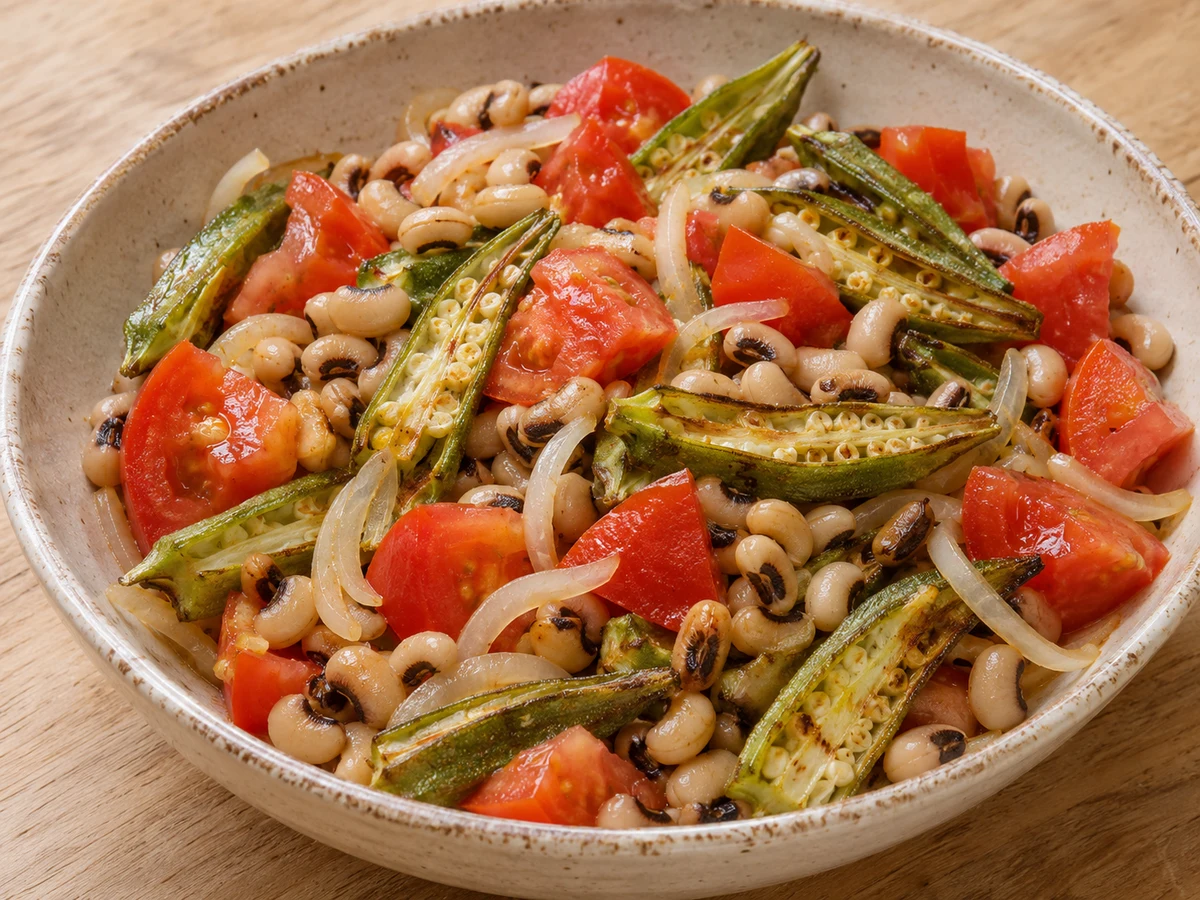
Ingredients
- 200 g dried whole cowpeas
- 400 g trimmed fresh okra, weighed after removing tough stalks
- 300 g washed tomatoes, usable weight
- 80 g peeled yellow onion
- 30 g sunflower oil: 20 g for the okra and 10 g for the dressing
- 30 g lime juice
- 3 g salt: 1 g for the okra and 2 g for the dressing
- 1 litre drinking water for soaking, discarded afterwards
- 1 litre drinking water for cooking the cowpeas, topped up if needed
Preparation
Sort and rinse 200 g cowpeas, then soak in 1 litre water for 8 hours in the refrigerator. Discard the water and rinse.
Cook in 1 litre fresh water: bring to a boil, then simmer for 45–60 minutes until tender at the centre. Add hot water as needed.
Preheat a fan oven to 200 °C. Wash, dry and trim the okra, weigh 400 g and split lengthways.
Toss the okra with 20 g oil and 1 g salt. Spread in one layer and roast for 20–25 minutes, turning halfway through.
Prepare 300 g tomato pieces and finely slice 80 g onion. Briefly drain very juicy tomatoes.
Drain the beans and cool slightly for 5–10 minutes. Mix 30 g lime juice, 10 g oil and 2 g salt.
Coat the beans in dressing, add onion and tomato, then gently incorporate the roasted okra. Divide immediately into four portions.
Introduction
This salad plays on three textures: the cowpeas should remain whole but tender, the okra browns in the oven and the tomato supplies fresh pieces. Lime seasons everything without turning the bottom of the dish into a pool of marinade. Unlike an okra sauce, the vegetables do not simmer together. They are prepared separately and combined just before serving, making their different textures more apparent. Serve warm, with the contrast of tomatoes at serving temperature.
This is a contemporary creation for the second volume, without claiming a traditional Beninese name. Cowpeas and okra are ingredients here, not evidence that the formula is ancient. The quantities make four starter or side portions. Fish, meat, rice or a cereal paste would change the meal’s composition and are not included in the calculation. Start the cowpeas the day before; the other elements can be prepared while they cook.
Cultural context
The FAO’s 2011 nutritional profile of Benin describes regional differences in eating patterns and the place of pulses in the South. It provides general context, without documenting this specific combination or a practice of roasted-okra salad. This formula is a contemporary editorial creation. Separate cooking, roasting and warm assembly distinguish it from the first volume’s bean stews and okra sauces. Context source: https://www.fao.org/4/ap830f/ap830f.pdf
Tips
Dry the okra thoroughly before oiling.
Leave space between the pieces on the tray.
Stop cooking the beans as soon as tender to keep them whole.
Set aside the ten grams of dressing oil before preparing the tray.
Mix gently and serve without prolonged marinating.
Planning
Spread the two hundred grams of cowpeas on a plate and sort them. Rinse, place in a large container with a litre of drinking water and soak for eight hours in the refrigerator. Discard the soaking water and rinse again. This stage is separate from cooking: the old water is used neither in the dressing nor to loosen the salad. Use a saucepan large enough to accommodate the initial boil without overflowing.
Pour the litre of cooking water over the beans and bring to a boil. Reduce to a steady simmer and allow forty-five to sixty minutes, depending on the batch. Keep the beans covered with water, adding a little hot water if necessary. Begin testing after forty minutes. A bean should crush under a spoon yet keep its shape when lifted gently. If its centre remains hard, continue; if the seeds start splitting, stop as soon as they are tender.
Meanwhile, preheat a fan oven to 200 °C. Wash the okra whole, then dry thoroughly with a clean cloth. Remove tough stalks and weigh four hundred grams of usable okra. Split lengthways. A lengthwise cut provides a wide contact surface; small rounds cook differently and do not give the same presentation. Quarter particularly large pods lengthways to make their thicknesses more similar.
Toss the okra with twenty grams of oil and one gram of salt in a bowl. Spread on a baking-paper-lined tray in one layer, with cut sides against the tray where possible. Roast for twenty to twenty-five minutes, turning once halfway through. Look for lightly golden edges and cooked flesh, not dried-out pods. Okra naturally retains some thickening quality inside; roasting reduces surface moisture without promising to eliminate its mucilaginous character completely.
Wash the tomatoes before cutting, remove hard parts and weigh the planned three hundred grams. Cut into pieces about two centimetres across. If very juicy, leave in a sieve for five minutes and retain the flesh without squeezing it. This short draining prevents the dressing from becoming flooded. Slice the eighty grams of onion very finely. For a milder result, rinse briefly in cold drinking water, then drain and dry; do not soak it in the bean cooking water.
Drain the tender cowpeas in a sieve and allow steam to escape for five to ten minutes. They should remain warm but no longer be scalding against a spoon. Mix the lime juice, remaining ten grams of oil and two grams of salt in a large bowl. Add the beans and turn gently to coat. Incorporate the onion and tomato, then add roasted okra last. Lift with two spoons instead of stirring for a long time: crushed beans and broken tomatoes would make the salad pasty.
Serving
Serve on a wide platter so the okra is not buried under a mound of beans. Share the tomato and cowpeas evenly, then place several okra pieces on each portion. No extra garnish is needed to identify the salad. Chilli can be offered alongside, but is not part of the formula. To increase quantities, use two trays rather than piling okra onto one; space between pieces determines how well they roast.
Storage
This salad is best immediately after assembly. To prepare ahead, cool the cooked beans promptly in a shallow container and refrigerate at 4 °C or below before two hours at room temperature have elapsed. Keep cooked vegetables, tomatoes and dressing in separate containers and assemble within twenty-four hours. An already mixed salad can be refrigerated for no more than twenty-four hours, with a softer texture. Do not extend room-temperature storage because lime is present: its acidity does not replace refrigeration.
Variations
For less raw-onion flavour, sauté the onion in a small part of the ten grams of dressing oil, then allow to cool slightly; do not add a fresh quantity of oil. Different tomato sizes are fine if the usable weight remains the same. Replacing cowpeas with chickpeas makes another salad and requires revised cooking and nutritional figures. Do not replace fresh okra with an equal weight of dried okra: water content, texture and method would change completely.
Nutrition notes
The values cover one quarter of the complete preparation. Cowpeas are weighed dry, okra and tomatoes as usable portions, and all oil and salt are included. Soaking water is discarded. Losses in cooking water and any drained tomato juice are not measured; the ingredient-based calculation remains approximate. Oven drying mainly changes the final weight. These estimates are neither an analysis of the served dish nor a promise of health effects.
Conclusion
Tender but whole cowpeas, an uncrowded tray and gentle assembly are the useful markers for this salad. Tomato and lime enter after cooking, while okra goes in last to preserve its shape. This creation is offered as a formula to cook, without claiming that kitchen trials have already been performed. Enjoy your meal!
Enjoy your meal
Enjoy your meal!