Sweet potato cream with orange
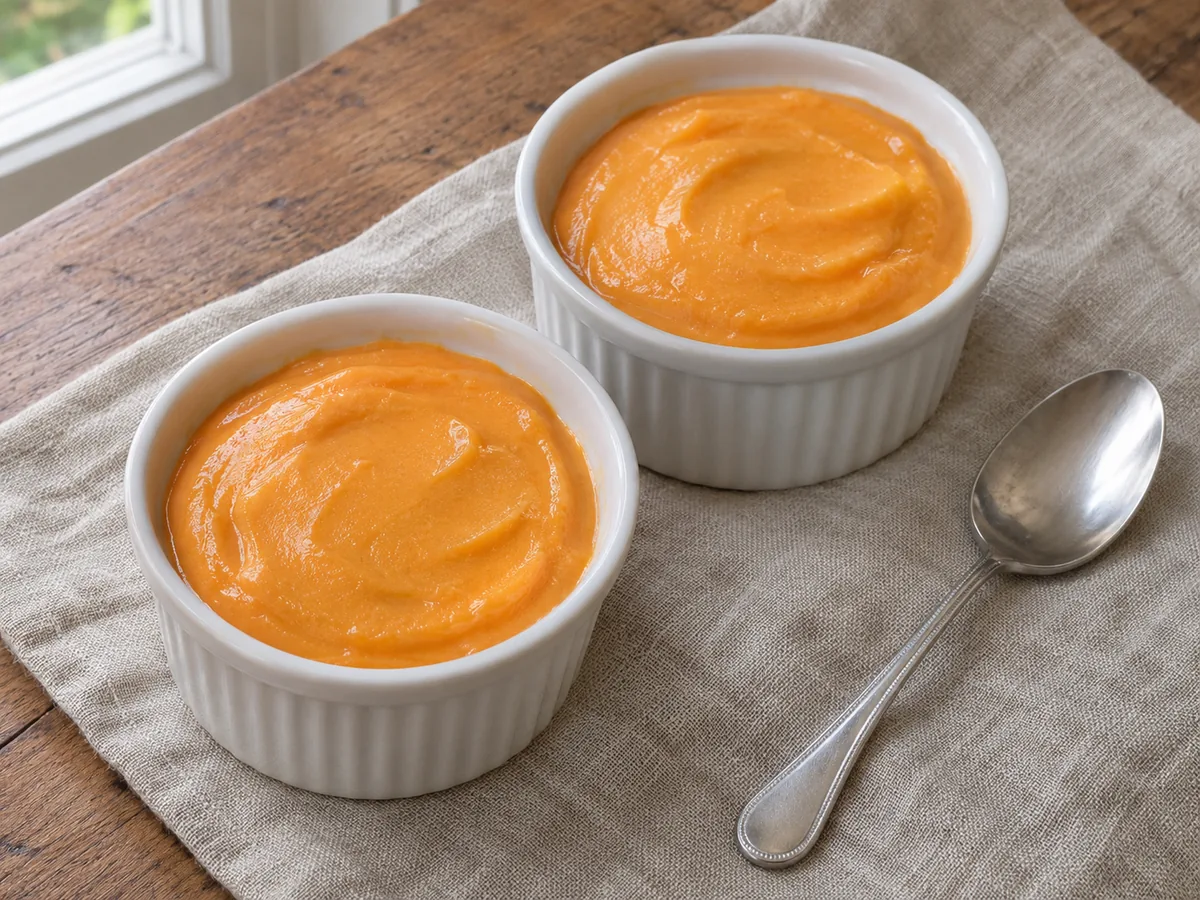
A cold, thick cream of steamed sweet potato, coconut milk and freshly squeezed orange juice. A contemporary creation for four small desserts.
Ingredients
- 400 g raw peeled sweet potato, edible weight
- 200 g unsweetened coconut milk, thoroughly mixed
- 120 g freshly squeezed and strained orange juice
- 20 g white sugar
- 0.5 g salt
- Drinking water for steaming, without contact with the food
Preparation
Peel and weigh 400 g raw sweet potato; cut into 2 cm cubes.
Steam for about 20 minutes until completely tender; extend in 3-minute stages if necessary.
Squeeze, strain and weigh 120 g orange juice; keep chilled.
Mix then weigh 200 g coconut milk; heat gently for 3 minutes with 20 g sugar and 0.5 g salt.
Blend the hot sweet potato with the warm coconut milk, then incorporate the orange juice off the heat and make smooth.
Divide among four shallow ramekins, let steam escape for 15 minutes, then refrigerate promptly.
Allow at least 120 minutes in the refrigerator before serving; plan 180 minutes overall, longer if the sweet potato needs extra cooking.
Introduction
Sweet potato provides the main body here: once cooked through, its flesh becomes a purée fine enough to take coconut milk and orange juice. The result is a spoonable cream, dense yet supple, without eggs, gelatine or added starch. It does not aim for the wobble of a set custard or the texture of a pouring cream. Chilling firms the mixture and makes the meeting of the tuber’s sweetness and the fruit’s acidity clearer.
This combination is a contemporary creation for Angola à table. It is not presented as a historical Angolan speciality or a family recipe collected locally. If possible, choose an orange-fleshed sweet potato, whose colour remains attractive after mixing. The four portions are modest and served alone: biscuits, whipped cream, orange segments and coconut shavings are outside the formula.
Cultural context
This cream’s place in a collection about Angola reflects a contemporary editorial choice. Combining sweet potato, orange and coconut is not enough to establish a precise origin, an associated celebration or a regional name. None of these details is invented here.
FAO offers institutional context on agriculture and food in Angola: https://www.fao.org/angola. This reference illuminates the collection’s general setting without authenticating this particular recipe. The preparation remains a proposal for a home dessert, with explicit quantities and a reproducible method.
Tips
Weigh the sweet potato raw and peeled, rather than weighing the cooked purée.
Measure exactly 120 g strained juice rather than counting oranges.
Mix the coconut milk before weighing to distribute its fat.
Check the largest cubes for tenderness before blending.
Use small containers to cool faster and keep the whole preparation refrigerated.
Planning
Wash the sweet potatoes before peeling, remove the ends and damaged areas, then weigh exactly 400 g of raw flesh. Cut into even cubes about two centimetres across. This weight does not mean an already cooked purée: the calculation starts with the raw tuber actually used. There is no need to weigh the sweet potato again after steaming to bring it artificially back to four hundred grams, since its water content changes during cooking.
Place the pieces in a steamer basket above simmering water, without immersing them. Cover and allow about twenty minutes from the point at which steam circulates steadily. Test several larger cubes with a knife tip: it should pass through without marked resistance, right to the centre. If any pieces remain firm, continue in three-minute stages. Undercooked flesh will not produce a smooth cream, even with prolonged blending.
While it cooks, wash the outside of the oranges, then squeeze them. Strain the juice through a fine sieve to remove seeds and large membranes, then weigh exactly 120 g. The weight of whole oranges and the volume of a glass do not replace this measurement. Keep the juice covered in the refrigerator. No zest or fruit segments enter this version; adding them would change the flavour, appearance and, slightly, the calculated composition.
Stir the contents of the coconut milk container before taking 200 g, so the watery and fatty phases are reunited if they have separated. Use an unsweetened cooking product, rather than a very diluted drink. In a small saucepan, gently heat this milk with the twenty grams of sugar and half gram of salt for about three minutes, just to dissolve the grains. Do not try to reduce it or bring it to a vigorous boil. This can be done during the final minutes of steaming.
Transfer the still-hot flesh to a tall container suitable for a stick blender. Add the warm coconut milk and blend in short pulses, then more steadily until no small grains can be felt. Keep the blender head submerged to limit splashes and incorporated air. With a jug blender, respect its capacity and instructions for hot food, without sealing a scalding mixture airtight. Scrape the sides with a clean utensil to retain all the planned ingredients.
Off the heat, incorporate the 120 g of cold orange juice. Blend briefly again or stir thoroughly until the colour is uniform. Taste with a small clean spoon: the sugar should have dissolved, the salt should be unnoticeable and the orange present without dominating. Do not spontaneously add milk or water to copy the texture of pastry cream. The intended consistency is a soft, smooth purée that holds on the spoon; it will thicken further when cold.
Immediately divide among four shallow ramekins, weighing portions if possible to make them even. Final weight depends on evaporation and scraping and is therefore not guaranteed to the gram. Let the strong steam subside for fifteen minutes, then refrigerate without waiting for complete cooling on the worktop. Cover with clean lids as soon as possible and refrigerate for at least two hours before serving. The three-hour schedule includes twenty minutes of preparation, twenty-five minutes allowed for cooking and blending, fifteen minutes of initial cooling and two hours refrigerated; any cooking extension is additional.
Serving
Serve chilled, directly in the ramekins. A simply smoothed surface is enough: no additional decoration is needed to understand the dessert. If the cream seems very firm straight from the refrigerator, leave it on the table for five minutes while arranging service, without repeated long waits. It should remain thick enough to spoon up without flowing like a drink. Slight colour differences between batches may come from the sweet potato or orange variety and do not call for colouring.
Storage
Refrigerate promptly after the fifteen minutes allowed for steam to escape, ideally within an hour of preparation, and always before two hours at room temperature. Keep covered at no more than 4 °C and consume within twenty-four hours. Use a clean spoon for each serving and avoid repeated journeys between table and refrigerator. Orange juice does not replace the cold chain. Freezing is not preferred: separation of water and fat may leave a grainy texture after thawing.
Variations
A white-fleshed sweet potato can work if it becomes fully tender, but its dry matter and colour will produce a different result. For a less sweet cream, reduce the sugar in another batch rather than diluting this one after chilling; the nutritional formula would then need adjustment. A plant-based drink does not replace culinary coconut milk gram for gram. Changing this base would require reviewing the liquid ratio and expected richness, without promising an identical result.
Nutrition notes
The sweet potato and juice contribute carbohydrates; coconut milk supplies a substantial share of this formula’s fat. All added sugar and salt are counted. The calculation uses raw sweet potato and the juice actually weighed, rather than whole fruit. The Ciqual reference “coconut milk or coconut cream” remains an approximation for the chosen product, whose label may differ. Values per quarter are food estimates and make no health promise.
Conclusion
A good result depends mainly on three actions: cooking the flesh fully, measuring the liquid and allowing the cream to set in the cold. This gives a dense, soft, uniform texture without adding a gelling agent. Cooling time is part of the recipe and should be arranged before the meal. This editorial formula is not claimed to have been kitchen-tested.
Enjoy your meal
Enjoy your meal!