Soft millet-flour cookies with banana and coconut
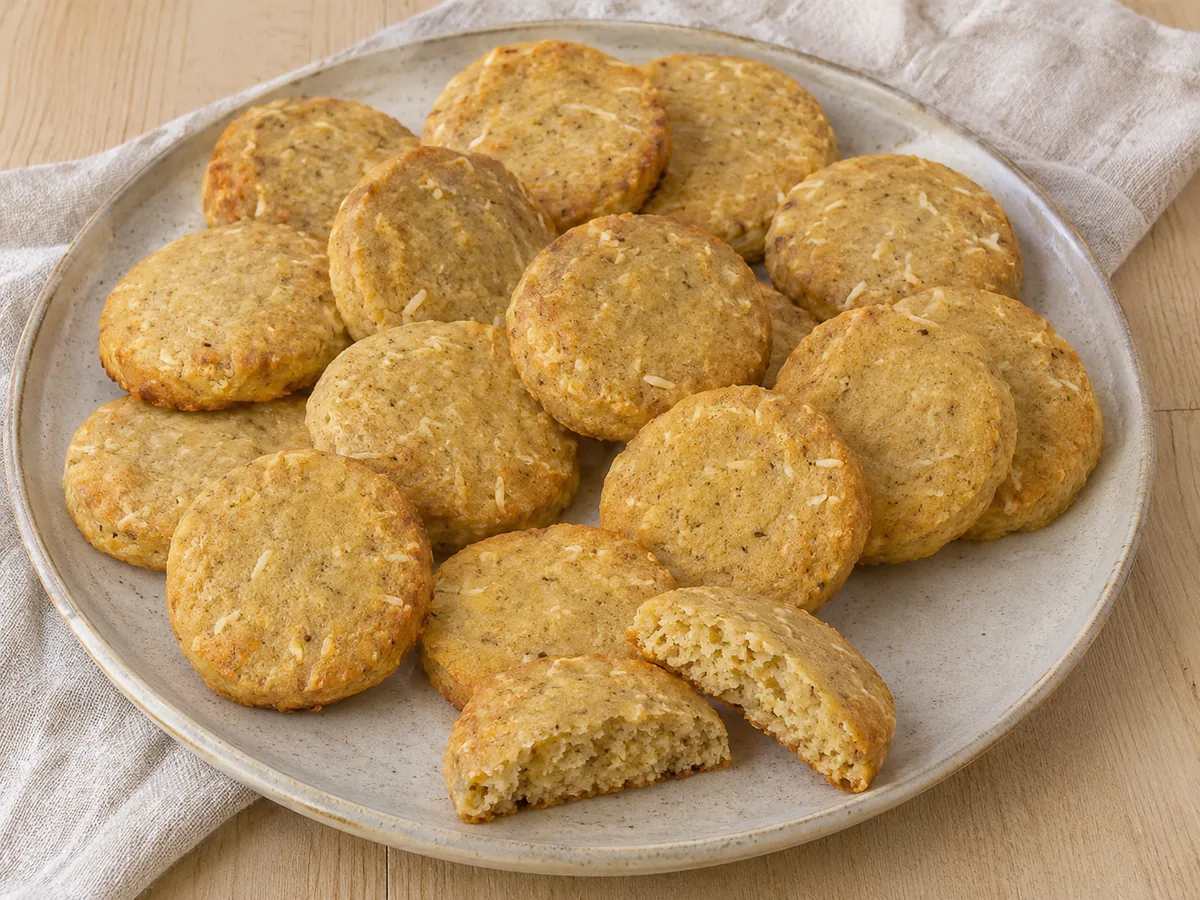
Flattened cookies made from millet flour, ripe banana and dried coconut, bound with egg and oven-baked. A contemporary creation for Angola à table.
Ingredients
- 140 g food-grade millet flour
- 200 g raw ripe banana flesh without peel
- 40 g unsweetened dried shredded coconut
- 50 g raw whole egg without shell, approximately 1 egg to verify by weighing
- 20 g olive oil
- 20 g white sugar
- 1 g salt
Preparation
Peel and weigh 200 g ripe banana flesh, then mash with a fork without adding liquid.
Separately combine 140 g millet flour and 40 g unsweetened dried shredded coconut.
Beat and weigh 50 g egg without shell; fold into banana with 20 g sugar, 1 g salt and 20 g oil.
Add dry ingredients, scrape the bowl and rest for 15 minutes while oven preheats to 180 °C.
Divide all dough into 16 mounds on a paper-lined tray. Flatten to approximately 6 cm diameter and 1 cm thickness.
Bake approximately 20 minutes. Check set tops and at least 74 °C at the centre of a thick cookie; extend if necessary.
Cool for 5 minutes on the tray then 15 minutes on a rack. Count 4 cookies per portion.
Introduction
These cookies are intentionally soft and fairly dense. Banana supplies moisture and fruit, coconut small fragments and millet flour the dough's base. The aim is neither flaky butter shortbread nor the volume of a risen cake. Flattening helps the centre cook before edges become overly coloured. A brief wait after baking lets the cookies be moved without breaking.
The recipe explicitly uses millet flour, not already cooked whole millet. The products cannot be substituted at the same weight using this method. It is a contemporary creation for Angola à table without claiming an ancient Angolan tradition. Quantities yield sixteen cookies, four per portion in the nutritional calculation. No drink, cream or other accompaniment is included.
Cultural context
Millets are a cereal group and the flour used here is a cooking ingredient, not proof of a traditional biscuit origin. FAO presents their diversity at https://www.fao.org/millets-2023/en. In this recipe, choosing millet, banana and coconut is contemporary creation.
The collection concerns Angola, whose agricultural and food context can be explored at https://www.fao.org/angola. These institutional references illuminate ingredients and a setting; they do not certify the formula. The title therefore clearly identifies flour and intended texture without an invented heritage name.
Tips
Weigh banana after peeling and egg without shell.
Allow the fifteen-minute rest before deciding dough is too soft.
Keep the same thickness across cookies to limit cooking differences.
Move cookies after their initial tray rest, not immediately from the oven.
Do not promise crisp texture: fruit and formulation here aim for soft cookies.
Planning
Choose ripe bananas with possibly spotted skin but sound flesh, without mould or fermented smell. Peel and weigh 200 g usable flesh. Mash with a fork in a large bowl until fairly even, with only small fragments. Do not add water or milk to make mashing easier: extra moisture makes dough harder to control and changes the formula.
Check the two dry ingredient packages. Flour must be genuine food-grade millet flour, not cracked grains or sweetened instant mix. Coconut must be dried, shredded and unsweetened, not fresh flesh or candied flakes. Weigh 140 g flour and 40 g coconut, then combine in a clean container to distribute fragments before incorporation.
Crack egg into a small bowl, beat and weigh 50 g without shell. Eggs differ in size, so the indicated number does not replace weighing. Fold egg into banana with 20 g sugar and one gram of salt. Stir in 20 g oil. There is no need to whisk for a long time to introduce air: structure comes from cooking dough and egg, not fragile foam.
Pour flour-coconut mixture into the wet bowl and stir with a spatula until dry pockets disappear. Scrape bottom and sides. Rest for fifteen minutes at kitchen temperature while a conventional oven preheats to 180 °C. This lets dry ingredients absorb some banana moisture. The dough should remain soft and spoonable; do not seek a firm dough that can be rolled out.
Line a large tray with baking paper. Divide the entire dough into sixteen comparable mounds using two spoons or a scale if needed. Flatten each to approximately six centimetres diameter and one centimetre thickness using a lightly dampened spoon back. Space cookies for airflow. Do not add tray oil or unmeasured shaping flour; paper and damp utensil suffice for this method.
Bake in the middle of the oven for approximately twenty minutes. Edges should be lightly golden and tops set without seeking dark colour everywhere. The centre remains soft but must not contain raw egg dough or an uncooked wet pocket. Check a thick piece with a clean probe, aiming for at least 74 °C in the centre; extend in short intervals if needed. Banana ripeness and oven settings can change useful cooking time.
Leave cookies on the tray out of the oven for five minutes, then gently transfer to a rack for fifteen more minutes. These twenty minutes of cooling are included in total time. Wait until they stop steaming before storage to avoid condensation. Expected texture remains soft after cooling; longer baking does not guarantee crisp shortbread and may simply dry edges.
Serving
Serve four cookies per person to match the reference portion. Present cold or barely lukewarm after planned cooling without icing or sprinkled sugar. They may be eaten by hand once stable but remain softer than commercial dry biscuits. A drink or accompaniment may be offered separately; it is outside calculated values.
Storage
These cookies contain appreciable banana and remain soft: do not treat them as dry shortbread intended for weeks in a tin. Once cool, place in a closed container in the refrigerator at no more than 4 °C and consume within forty-eight hours. Do not seal while still steaming. Take out only for serving and use clean hands or utensils; never taste dough containing raw egg.
Variations
Riper banana naturally changes aroma and sweetness without changing its planned weight. For subtler coconut texture, choose fine shreds rather than randomly reducing the quantity, better preserving the reference formula. Another flour may absorb and bind differently; automatic substitution is not guaranteed. An egg-free version needs a new binding formulation. Thicker cookies require reassessing centre cooking.
Nutrition notes
The calculation uses millet flour reference data, not whole-grain data. Banana is weighed raw without peel, coconut dried and unsweetened, and egg without shell. All sugar and oil are counted; natural fruit sweetness does not cancel their contribution. Values represent four cookies out of sixteen without accompaniment and remain composition estimates. Disclose egg according to diners' allergies.
Conclusion
Weighed banana, correctly identified flour and observed hydration time provide a more regular method. Flattened shape and centre checks are more useful than strong browning. Dividing all dough and allowing cooling helps obtain sixteen comparable units. This editorial formula is not declared kitchen-tested.
Enjoy your meal
Enjoy your meal!