Banana custards with cocoa and coconut
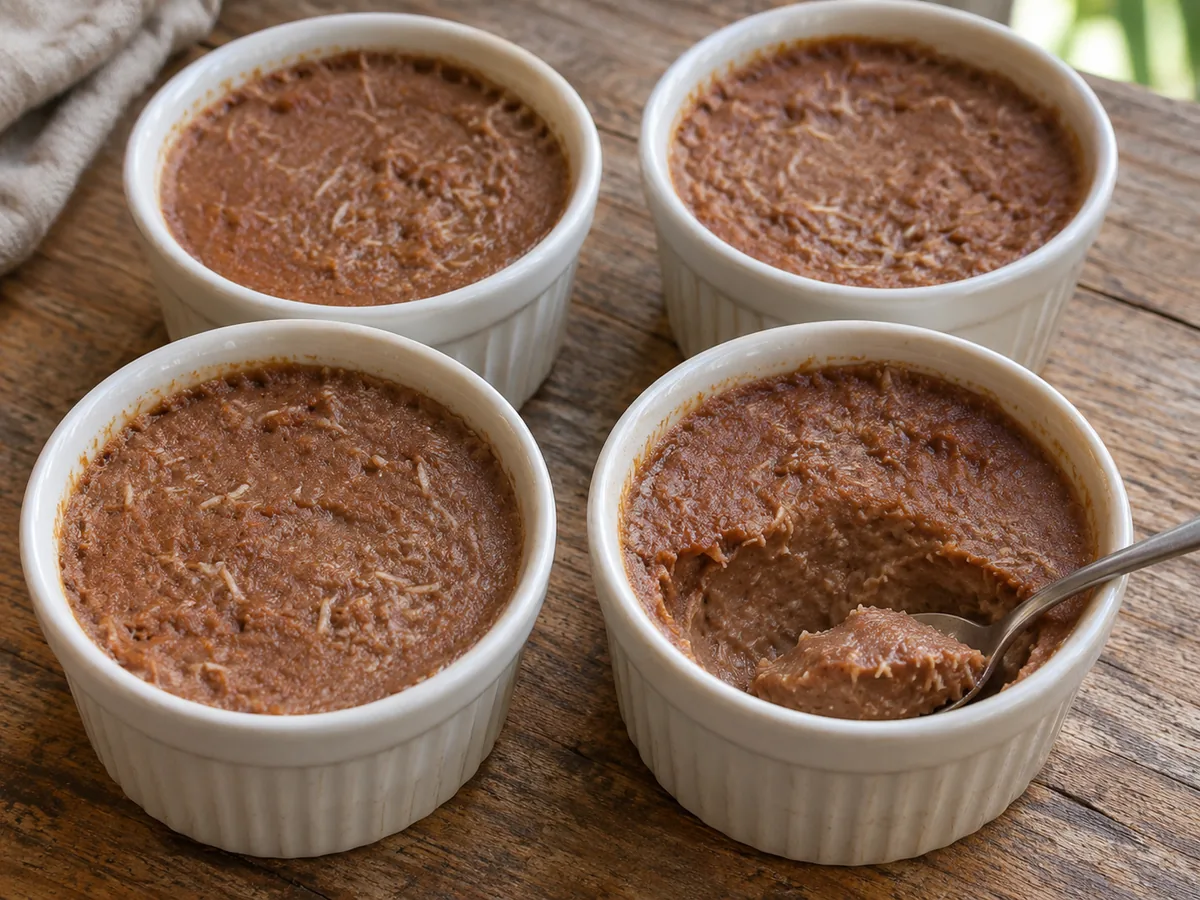
Four spoonable egg-set custards with ripe banana, unsweetened cocoa, coconut milk and grated coconut. Gentle water-bath baking and cold serving.
Ingredients
- 300 g raw ripe dessert banana flesh, without peel, not plantain
- 150 g raw whole egg without shell, approximately three eggs, weighed after mixing
- 300 g unsweetened coconut milk, homogenised
- 20 g unsweetened cocoa powder
- 20 g white sugar
- 20 g unsweetened dry grated coconut
- 0.5 g salt
- Hot water for the water bath, entering neither custards nor nutritional calculation
Preparation
Provide four 250 ml ramekins and a water bath; preheat a conventional oven to 160 °C.
Weigh 300 g peeled dessert banana and purée it; mix and weigh 150 g shell-free egg.
Blend 20 g cocoa with part of the 300 g coconut milk; add the remainder, 20 g sugar and 0.5 g salt.
Fold in banana, eggs and 20 g dry grated coconut without excessive whisking; divide between four ramekins.
Pour hot water halfway up around ramekins and bake 35–45 minutes until set and approximately 80 °C at the centres of several custards; extend if needed.
Remove from the water bath, cool 20 minutes on a rack then refrigerate at no more than 4 °C for at least 120 minutes, until completely cold.
Serve cold in containers. Minimum total: 205 minutes, including both cooling stages; extend chilling if needed.
Introduction
These custards are served in their ramekins with a spoon. Banana gives body and fruity sweetness, while eggs provide effective setting during cooking. Cocoa is unsweetened powder; it replaces neither eggs nor a gelling agent. Coconut milk and a little dry grated coconut share a flavour but contribute different textures. The intended result is tender and uniform, lightly dotted with fibres, without any promise of perfect unmoulding.
This is a contemporary Angola à table proposal, rather than a transcription of an ancient or ritual dessert. Four individual containers allow more even heating than a thick large dish. The stated minimum total is two hundred and five minutes: twenty preparation, forty-five baking, twenty initial cooling and two hours in the refrigerator. If custards are not cold after that period, serving must wait longer.
Cultural context
Banana, cocoa and coconut are assembled in a contemporary egg-set dessert. A water bath describes the chosen cooking technique without arbitrarily assigning the preparation to an Angolan cultural group. The national reference supplies editorial context rather than evidence of an ancient combination.
FAO in Angola offers resources on agricultural and food context: https://www.fao.org/angola. General egg handling, cooking and storage recommendations are available from the FDA: https://www.fda.gov/food/buy-store-serve-safe-food/what-you-need-know-about-egg-safety. They do not attest that this particular creation was kitchen-tested.
Tips
Use four comparable containers to avoid one overcooked custard alongside another still liquid.
Weigh eggs without shells rather than relying only on their number.
Blend cocoa before combining everything to avoid dry lumps.
Check centres with a clean probe rather than judging colour alone.
Remove ramekins from hot water and include complete cooling in your organisation.
Planning
Choose four ovenproof ramekins of approximately 250 ml each, with comparable shape and depth. Provide a high-sided baking dish holding them without crowding and a cooling rack. Greasing is unnecessary because dessert remains in its container. Ramekins should be at room temperature to limit thermal shock when hot water is added. Clear the route between oven and worktop before handling a scalding water bath.
Preheat a conventional oven to 160 °C. Wash banana skins before peeling and weigh exactly 300 g flesh. Use ripe fruits with sound flesh even if skins are spotted; reject mouldy or fermented areas. Mash thoroughly with a fork or briefly blend to reduce large pieces. Dessert banana suits this recipe: plantain, even ripe, is not equivalent in this formula.
Crack eggs into a separate container, mix whites and yolks and weigh 150 g. Three eggs are an approximate guide; if sizes differ, adjust the amount taken by weight. Keep eggs and perishable mixtures chilled until use, then work without delay. Wash hands after touching shells and clean soiled equipment. Do not taste raw mixture even if banana and cocoa smell appealing.
Homogenise coconut milk before taking 300 g. Blend sifted cocoa with a few spoonfuls of this milk, taken from the weighed amount, to form a lump-free paste. Add remaining milk, sugar and the half gram of salt. Fold in banana then eggs, mixing gently without beating in much air. Add twenty grams grated coconut. Scrape the bowl bottom where cocoa may settle.
Divide mixture between four ramekins, stirring gently between pours to distribute coconut. Fill to comparable heights, leaving a little headspace. Place the dish on the slightly extended oven shelf, put ramekins in it, then carefully pour hot water around them to halfway up their sides. Water must not enter the mixture. Slide the shelf back without shaking the dish and close the oven.
Bake approximately thirty-five to forty-five minutes. Edges should be set and the centre wobble gently as one mass, without a liquid wave. Use a clean probe to check approximately 80 °C at the centres of several ramekins without touching the bottom; this cooking choice exceeds the FDA’s recommended minimum of 71 °C for egg dishes. Extend if centres remain liquid or insufficiently hot. The bath should simmer gently rather than boil vigorously enough to splash custards.
Remove ramekins from the water bath using suitable protection and place separately on a rack; do not leave them cooling in hot water. Let strong heat dissipate for only twenty minutes, then refrigerate at no more than 4 °C, spaced apart and lightly covered. Once cold, close containers. Allow at least two hours chilled, longer if centres are not yet cold. Cooling takes place in these small containers rather than a large deep bowl.
Serve directly in ramekins after complete cooling. Grated coconut remains perceptible: do not expect the surface and cut of a perfectly smooth industrial custard. A little moisture at the edge may accompany cooling; a widely separated grainy texture instead suggests excessive heat. Timings remain indicative according to equipment. Do not shorten chilling to force the stated total.
Serving
One ramekin is one serving. Serve four custards cold without caramel, cream or biscuit added to the calculation. A small spoon suits better than attempted unmoulding that could break this tender set. Take out only needed portions, especially in warm weather. Tell diners about eggs and check packaging for other possible allergens. Cocoa remains a flavour ingredient without promised medical benefit.
Storage
Keep custards covered at no more than 4 °C and eat within forty-eight hours after baking. Twenty minutes on a rack do not justify additional hours of waiting: refrigerate promptly, always within two hours after cooking, or one hour if surroundings exceed 32 °C. Do not return a long-exposed or largely eaten portion to storage. These custards are intended cold; freezing may damage texture and is not used here.
Variations
A less ripe banana gives a different perception of sweetness and may leave firmer pieces. A very diluted coconut drink does not have coconut milk’s composition and would alter setting. Removing eggs would require another formula with an appropriate binder, absent from this sheet. Sweetened chocolate drink powder is not the chosen cocoa; any substitution requires reviewing quantities and calculation.
Nutrition notes
The calculation includes raw banana flesh, shell-free eggs, homogenised coconut milk, unsweetened cocoa, sugar, all dry coconut and added salt. External bath water is not consumed and remains excluded. A serving is one quarter of the mixture without garnish. Generic references, particularly coconut milk, may differ from brands; figures remain estimates and justify no health claims.
Conclusion
Eggs, checked gentle cooking and complete cooling structure these banana custards. Cocoa and coconut add flavour without concealing the storage requirements of a moist dessert. The recipe remains a proposed creation without claiming a specific tradition or a completed cooking trial.
Enjoy your meal
Enjoy your meal!