Cabbage gratin with white beans and coconut
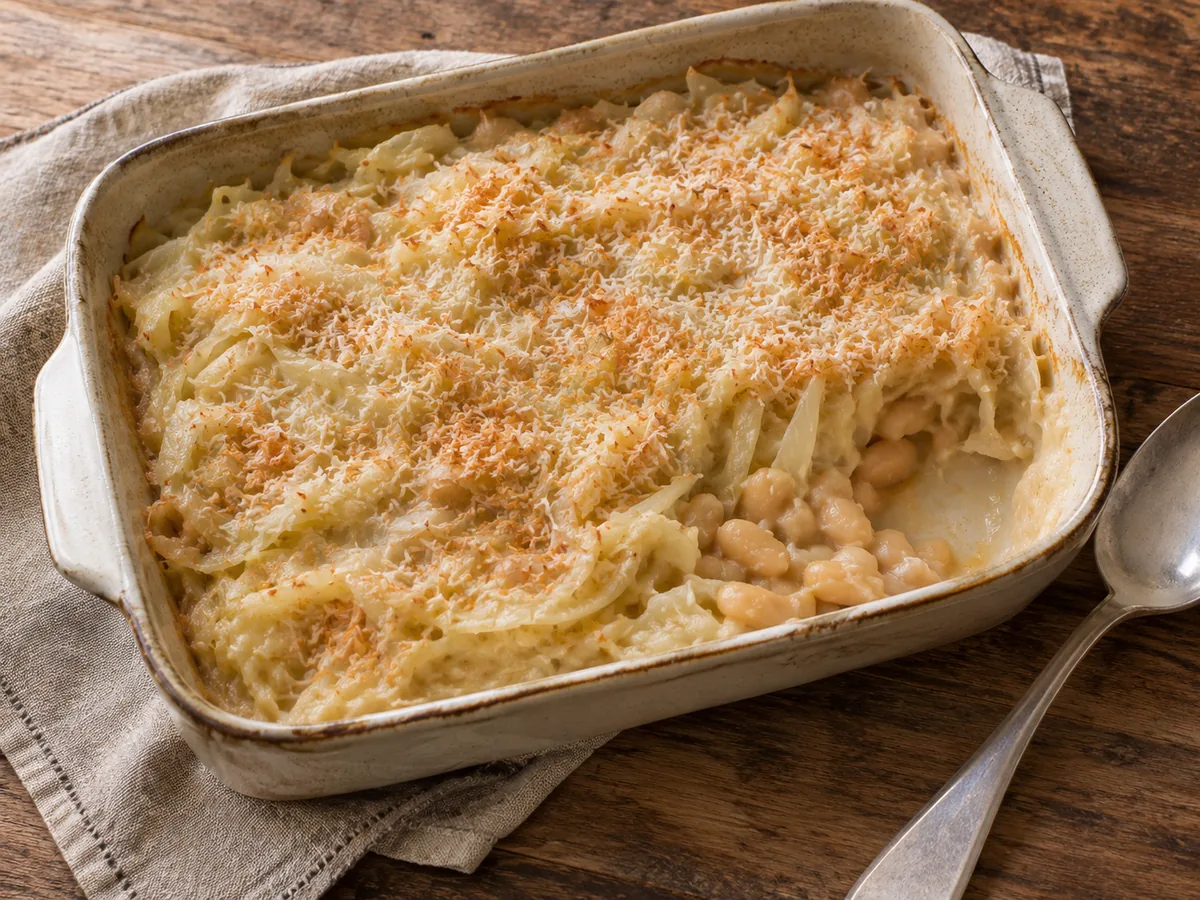
A contemporary gratin without cheese or eggs, in which mashed cooked white beans bind cabbage with coconut milk. Grated coconut forms a thin golden surface for four portions.
Ingredients
- 600 g white beans already boiled without salt and drained, cooked edible weight
- 600 g raw white cabbage, weight after removing the hard core
- 150 g peeled raw onion
- 6 g peeled raw garlic
- 200 g unsweetened coconut milk, not a diluted coconut drink
- 25 g unsweetened dried grated coconut
- 20 g olive oil
- 100 ml drinking water
- 3 g salt
Preparation
Weigh 600 g white beans already boiled without salt and drained. Divide into two 300 g batches; preliminary bean cooking is excluded from the times.
Prepare 600 g net white cabbage in ribbons, 150 g onion and 6 g garlic. Preheat the oven to 200 °C.
Soften the onion in 20 g oil for 7 minutes. Add the garlic for 30 seconds, then the cabbage, 100 ml water and 3 g salt.
Cook covered for 10 minutes, turning once, then uncovered for 5 minutes to soften the cabbage and evaporate free water.
Mash 300 g beans with 200 g coconut milk. Fold into the cabbage with the 300 g whole beans and heat for 2 minutes.
Transfer to a dish about 24 × 18 cm and bake for 12 minutes at 200 °C. Add 25 g dried grated coconut and bake for another 8 minutes.
Check that the centre is thoroughly hot, at least 74 °C when reheating, then serve in four portions.
Introduction
This gratin relies on two textures of white beans: one half is mashed to thicken the coconut milk, while the other half stays whole between ribbons of cabbage. The cabbage softens in a pan before going into the oven. This produces a cohesive mixture that is easy to spoon out, without relying on cheese or an egg mixture to hold it together. Only a small quantity of dried coconut goes on top, added towards the end of baking to limit browning.
This is a contemporary creation for Angola à table, without attribution to an old speciality or a particular region. The six hundred grams of beans are weighed already boiled without salt, tender and drained. This detail determines both the method and the composition figures. If starting with dried beans, their preliminary cooking is excluded from the stated time: it must be completely finished before weighing. Do not confuse this quantity with six hundred grams of dried beans.
Cultural context
This combination of cabbage, white beans and coconut is presented as a contemporary creation. It is given neither an invented regional name nor an assumed age. Here, gratin describes oven finishing with a lightly golden surface, without requiring cheese. FAO resources on Angola can provide national food context: https://www.fao.org/angola. They do not endorse this particular recipe. The American reference for white beans cooked, boiled without salt, is FoodData Central 175203: https://fdc.nal.usda.gov/food-details/175203/nutrients ; it describes a food state without claiming to define an Angolan variety.
Tips
Drain the cooked beans before weighing.
Remove the core before weighing the edible cabbage.
Evaporate the pan water before adding the binding mixture.
Reserve the grated coconut for the last eight minutes.
Share the whole depth of the dish across four portions.
Planning
Start with fully cooked white beans, without salt and thoroughly drained. They should crush easily under a fork. Weigh six hundred grams at this stage, then divide into two batches of three hundred grams. A bean that is still firm will not become creamy merely through baking. If the preparation begins with dried beans, complete the appropriate preliminary cooking for the product, then drain and weigh the cooked quantity; soaking and preliminary cooking are not included in the stated seventy minutes. The method is particularly straightforward when the beans have just been cooked and remain in one continuous hot preparation.
Remove damaged leaves and the hard cabbage core. Rinse the retained leaves, drain and weigh six hundred grams net. Slice into ribbons about five millimetres wide, shortening very long strips to make portioning easier. Peel and weigh the onion and garlic. Finely slice the onion and chop the garlic separately: it is added later to avoid burning during the initial cooking. Preheat a conventional oven to 200 °C and prepare a dish about twenty-four by eighteen centimetres, with a capacity of at least one and a half litres.
Heat all the oil in a large sauté pan over medium heat. Add the onion and soften for seven minutes, stirring without strong browning. Stir in the garlic for thirty seconds, then the cabbage, one hundred millilitres of water and three grams of salt. Cover and cook for ten minutes, turning the cabbage once so the top ribbons reach the bottom. Remove the lid and cook for another five minutes, until the cabbage is tender and free water has evaporated. If some ribbons remain too firm, continue briefly while watching; the oven should not have to cook a layer of raw cabbage beneath a thick sauce.
Meanwhile, mash one three-hundred-gram batch of beans with the two hundred grams of coconut milk. Use a fork or potato masher to produce a thick cream; a few small pieces are acceptable. Do not add extra liquid to make a pourable sauce: the purée should coat the vegetables. Choose unsweetened culinary coconut milk, rather than a light breakfast drink. Fat content varies between brands; the calculation uses the composition reference identified in the formula, rather than assuming every carton has the same values.
Fold the purée and the remaining three hundred grams of whole beans into the hot cabbage. Mix gently and heat for another two minutes to distribute the heat. Scrape in the oil and onions from the pan as well: they belong in both the dish and the calculation. Transfer to the baking dish without adding grease to coat it. Spread to an even depth. The mixture should hold on a spoon while remaining soft, with no large puddle underneath. Avoid packing it down hard, which would crush the whole beans and make serving less pleasant.
Bake at 200 °C for twenty minutes in total. After twelve minutes, carefully place the hot dish on a heatproof surface, scatter the twenty-five grams of dried coconut across the top and return to the oven for the remaining eight minutes. This should be a thin, lightly golden layer rather than a dark brown crust. Use a clean probe to check that the centre is thoroughly hot, aiming for at least 74 °C when reheating the cooked beans. There is no egg to set. Serve immediately in four comparable portions, without extending baking to imitate a cheese crust.
Serving
Spoon out the gratin through its full depth to share the cabbage, whole beans and thin coconut topping. Mashed beans provide the binding and remain soft; the absence of neat slices is no defect. Bread, rice or other accompaniments are not included in the formula. Adding them at the table changes the nutritional portion. The coconut aroma should remain gentle alongside the vegetables and beans, without a thick layer masking their texture.
Storage
Prefer continuous preparation using freshly cooked beans. For leftovers from this first service, divide promptly into small shallow containers and refrigerate at no more than 4 °C, never exceeding two hours at room temperature. Eat within twenty-four hours and reheat once only until the centre is very hot. If the beans had already been cooled and reheated before assembly, do not plan another reheating after baking: prepare the amount that will be eaten at the meal. Do not let the thick dish cool all evening or repeatedly move it between cold and hot.
Variations
The width of the ribbons can be adjusted without changing the six hundred grams of net cabbage. A smoother bean purée gives a more even coating; keep half the beans whole to preserve the described texture. Replacing the cooked beans with the same weight of dried beans would be a different recipe. Salted canned beans change the sodium assumption and do not match the source used. A diluted coconut drink does not replace culinary milk gram for gram. Cheese, breadcrumbs and eggs are not included in this version and would require recalculation.
Nutrition notes
The six hundred grams of beans are counted cooked and drained, while cabbage, onion and garlic are weighed raw after preparation. The two forms of coconut have different compositions: milk provides a fatty liquid phase and dried shreds are concentrated. All the oil and salt are included; added water supplies no energy. The generic coconut milk reference remains a documented approximation of the actual product, whose label may differ. Estimates refer to one quarter of the dish without accompaniments and make no medical promises.
Conclusion
The proposal depends on beans that are already tender, precooked cabbage without excess water and a purée thick enough to bind the ribbons. Dried coconut goes on only near the end of baking for light colour. Serve four comparable portions, respect the cooked state of the beans and arrange cooling without repeated reheating. This editorial recipe is not claimed to have been kitchen-tested.
Enjoy your meal
Enjoy your meal!