Baked millet with tomato and eggs
Precooked millet grains are mixed with reduced tomato and beaten eggs, then baked as four portions. A contemporary creation for Angola à table.
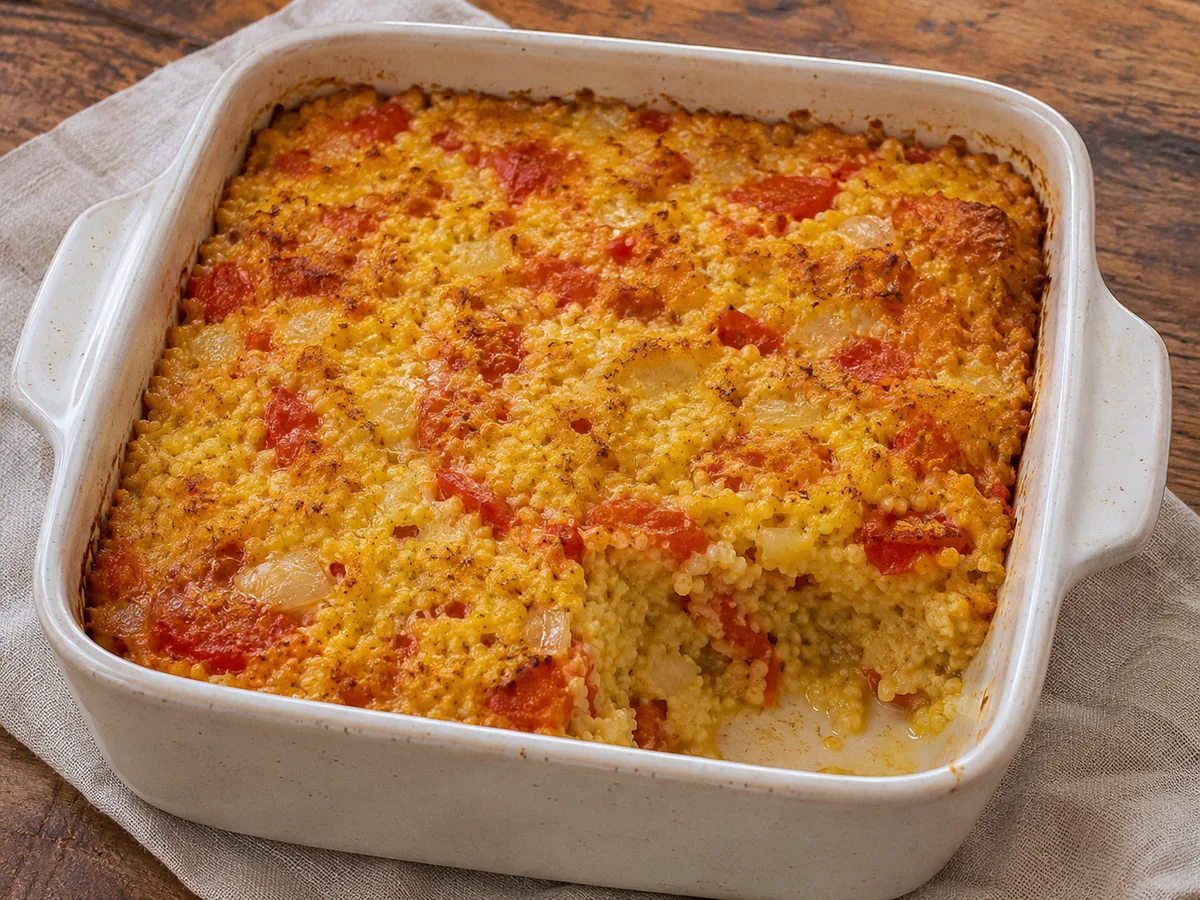
Ingredients
- 180 g dried hulled millet for cooking as grains
- 450 ml drinking water for millet, with a little hot reserve if needed
- 400 g raw tomatoes with their juice
- 100 g peeled raw onion
- 200 g raw whole eggs without shells, approximately 4 eggs confirmed by weighing
- 20 g olive oil
- 3 g salt
Preparation
Rinse 180 g dried millet. Gently cook covered in 450 ml water for 15–20 minutes until tender, with a little additional hot water if needed.
Rest covered for 5 minutes, separate grains and spread to become lukewarm for approximately 10 minutes, without prolonged room-temperature waiting.
While grains cook, soften 100 g onion in 20 g oil for 6 minutes; add 400 g tomatoes and juice with 1 g salt, then reduce for 10 minutes. Cool to lukewarm.
Preheat oven to 180 °C and prepare an approximately 20 cm square dish of at least 1.5 litres.
Beat 200 g eggs without shells with remaining 2 g salt. Mix with all lukewarm millet and tomato base.
Immediately pour into the dish, spread evenly and bake for 25–35 minutes.
Check at least 74 °C at the centre with a clean probe and absence of liquid egg, then divide into four portions and serve.
Introduction
Millet is not cooked from dry grains directly inside the eggs. It is first cooked in water until tender, then combined with a tomato-and-onion base. Beaten eggs subsequently give a soft binding in the oven. The preparation remains recognisably a grain dish: it seeks neither soufflé volume nor a cheese-gratin surface. Each spoonful should contain tender millet, tomato and fully cooked egg binding.
This contemporary recipe makes four portions from one hundred and eighty grams of dried millet. Cooked weight depends on absorbed water and does not replace dry weight in the calculation. Use food-grade hulled millet sold for cooking as grains, not flour or an instant porridge preparation. This combination is an editorial choice for Angola à table, without claiming to reproduce a documented traditional speciality or identify commercial millet as a specific local variety.
Cultural context
Millet, tomato and egg are combined here in a contemporary creation with a deliberately explicit method. The dish receives no invented regional name and does not claim to represent every form of millet cooking in Angola. The commercial product is millet grain; its variety is not assumed local without evidence.
FAO offers institutional resources on millet diversity: https://www.fao.org/millets-2023. For national food context, see https://www.fao.org/angola. These links illuminate an ingredient and context without certifying the recipe or its age.
Tips
Check millet tenderness before combining with egg.
Reduce tomato sufficiently to avoid excessively watery binding.
Briefly cool both bases to lukewarm without a long worktop wait.
Weigh eggs without shells and evenly distribute the mixture.
Check the dish centre, not just an edge that cooks faster.
Planning
Rinse millet in a fine sieve and drain. Bring four hundred and fifty millilitres of water to the boil in a heavy-based saucepan. Add grains, cover and reduce heat to cook gently for fifteen to twenty minutes, also following package instructions. Check a grain cooled on a clean spoon: its centre must no longer be hard. If liquid is absorbed before tenderness, add a little hot water and continue in short stages. Baking inside egg will not rescue grains that remain dry.
Turn off heat and rest covered for five minutes. Separate grains with a fork, then spread in a thin layer on a clean dish to become lukewarm for approximately ten minutes. Do not leave waiting for hours. They should no longer be piping hot when meeting the eggs, to avoid coagulated strands before baking. If meal organisation requires a wait, rapidly cool and refrigerate rather than holding a large lukewarm mass on the table; this change requires reconsidering the reheating cycle and leftovers.
While millet cooks, wash tomatoes and cut into small dice, retaining juice. Peel and weigh onion, then finely chop. Heat twenty grams of oil in a frying pan over medium heat and soften onion for six minutes without strong colouring. Add tomatoes with their juice and one gram of salt. Cook for ten minutes, stirring, until the base is reduced but still soft. There should not be a large pool of water that would dilute the eggs. Cool this base to lukewarm on a clean plate while the grains cool.
Preheat a conventional oven to 180 °C. Prepare a square dish approximately twenty centimetres across, with a capacity of at least one and a half litres. Oil contained in the preparation is sufficient; no additional grease for the dish is planned. Crack eggs into a separate container and weigh two hundred grams without shells. Briefly beat with the remaining two grams of salt without aiming for a voluminous foam. Use scales rather than infer mass from egg count, since sizes differ.
Mix all lukewarm millet with all tomato-and-onion base, including oil. Fold in beaten eggs and immediately pour into the dish. Spread to an even thickness and smooth without firmly compacting grains. Bake for twenty-five to thirty-five minutes. The top may lightly brown, but colour is insufficient: insert a clean probe into the centre of the thickest part and check at least 74 °C. No free liquid egg should remain when a few central grains are gently moved apart.
Serve once the binding is cooked, without extending baking to obtain a very hard crust. Divide into four similarly sized portions with a wide spoon or spatula. It may remain somewhat soft and need not cut into perfectly neat squares; that characteristic alone is not evidence of undercooking if temperature and egg setting have been checked. Total time includes five minutes of grain resting, ten minutes becoming lukewarm and both cooking stages, with tomato base prepared in parallel.
Serving
Serve hot, sharing grains, tomato pieces and binding without making the first portion egg-rich and the last mostly millet. Tomato base is fully incorporated and needs no additional sauce. Salad or another vegetable may be served separately but is not included in the stated figures. No cheese is planned; colour comes from cooking the ingredients themselves. Eggs are an allergen to disclose.
Storage
This formula starts with freshly cooked millet, briefly cooled to lukewarm and immediately baked. For leftovers, promptly divide into small portions in shallow containers and refrigerate at no more than four degrees Celsius, preferably within one hour of leaving the oven and never exceeding two hours at room temperature. Consume within twenty-four hours and reheat once only until hot at the centre. If already cooled and stored millet replaced freshly cooked grains, consume after this baking stage without planning another reheating cycle. Do not let a thick mass cool all evening.
Variations
For finer texture, dice tomatoes smaller before reducing without changing their weight. For more visible grains, mix with a wide spatula rather than crushing. Adding cheese, cream or another cereal alters composition and is not covered by supplied values. An egg-free version requires reformulating the binding; simply removing eggs does not produce the same baked dish. Do not replace generic millet with couscous under the same title.
Nutrition notes
Calculation starts from dried millet, not weight after water absorption. Two hundred grams of eggs, all oil, all salt and vegetables are counted. Water supplies no energy. Composition references and conversions used are documented, but residues in containers and actual sharing change the portion. Values concern one quarter without accompaniments and carry no therapeutic promise.
Conclusion
Already-tender grains, reduced tomato base and binding cooked to the centre are the dish's three guides. Brief cooling assists mixing and must not become prolonged waiting that undermines storage. Serve four comparable portions and manage leftovers as a cereal-and-egg preparation. This editorial creation is not declared kitchen-tested.
Enjoy your meal
Enjoy your meal!