Creamy rice with okra and squash
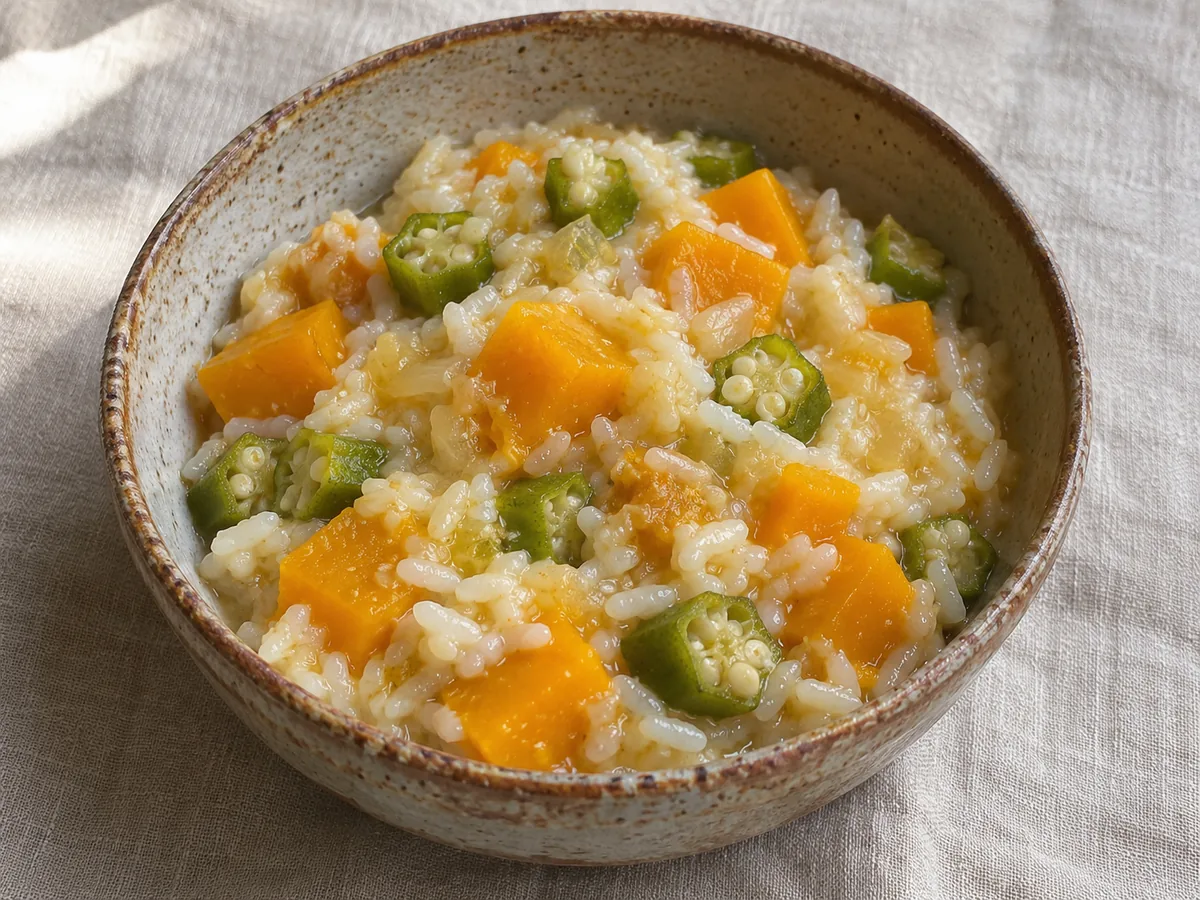
Tender white rice, butternut squash cubes and okra rounds in a gently thickened sauce without cream or cheese. A contemporary creation.
Ingredients
- 240 g plain raw white rice, preferably round-grain
- 500 g raw butternut squash flesh without skin or seeds
- 250 g raw okra, weighed after trimming tough ends
- 120 g peeled raw onion
- 10 g peeled raw garlic
- 20 g olive oil
- 900 ml drinking water: 700 ml initially and up to 200 ml as a hot reserve
- 20 g fresh lemon juice
- 3 g salt
Preparation
Prepare 500 g butternut squash as 1.5 cm cubes and 250 g okra as 1 cm rounds; chop 120 g onion and 10 g garlic.
Briefly rinse 240 g dry rice and drain.
Soften onion in 20 g oil for 6 minutes; add garlic for 1 minute, then squash for 4 minutes.
Add rice for 1 minute, then 700 ml water and 3 g salt; simmer partly covered for 10 minutes.
Add okra and continue about 10 minutes; gradually add from the 200 ml hot-water reserve as needed.
Check rice and vegetable tenderness; extend with a little hot water if rice centres remain hard.
Off the heat, fold in 20 g lemon juice, cover and rest 5 minutes.
Loosen with a little hot water if necessary, divide into four and serve hot immediately.
Introduction
This rice's creamy character comes from moist grain cooking and okra texture, not added cream. Squash contributes tender cubes that remain visible. A few may soften further and help bind the dish, but a uniform purée is not intended. Serve hot just after a short rest while liquid still coats the grains.
Use plain white rice, preferably round-grain for this texture, rather than cooked rice or a seasoned precooked mixture. Weigh 240 g dry. Okra should be firm without soft patches, and butternut squash weighed after removing skin and seeds. Adjust water by observing grains: rice that is still hard does not become tender simply because the dish looks thickened.
This recipe is a contemporary creation for Angola à table. It is not presented as an ancient speciality of a particular region. Four portions are calculated without meat, fish or other accompaniment. Planned salt, oil and lemon juice belong to the formula; no additional finish is necessary to obtain a coating sauce.
Cultural context
Rice, squash and okra are combined here in a contemporary editorial proposal. The method claims neither a specific local name nor a proven regional lineage. FAO resources provide an institutional starting point for Angola's agricultural and food context: https://www.fao.org/angola. They do not certify the origin of this particular creamy rice. Using ingredients associated with several cuisines does not establish a national tradition for a new combination.
Tips
Weigh rice dry; 240 g already cooked does not match the recipe.
Keep hot water in reserve to avoid interrupting simmering at each addition.
Add okra after the first ten minutes to retain recognisable rounds.
Check grain cooking rather than only sauce thickness.
Prepare storage containers before the meal if leftovers are expected.
Planning
Wash squash before cutting. Remove skin, seeds and fibres, then weigh 500 g flesh. Cut approximately 1.5 cm cubes: they should become tender during rice cooking without immediately disappearing. Wash and dry okra, trim tough ends without removing all the flesh around seeds, then weigh 250 g. Cut into approximately one-centimetre rounds. Keep the two vegetables separate because they enter the saucepan at different times.
Chop onion and garlic separately. Briefly rinse rice in a sieve and drain; do not soak for this formula. Heat 20 g oil in a wide heavy-based saucepan holding at least three litres. Add 120 g onion and soften for six minutes over medium heat without seeking brown colour. Add garlic for one minute, then squash for four minutes, stirring gently. Cube edges may begin softening without needing to be fully cooked at this stage.
Add 240 g drained rice and stir one minute to distribute. Pour in 700 ml water and 3 g salt. Bring to a simmer, reduce heat and partly cover. Keep the remaining 200 ml water hot in a small saucepan or kettle. Cook ten minutes, gently stirring once or twice from bottom to top to prevent grains sticking. Do not whisk: squash cubes should remain recognisable.
Add okra rounds and stir to distribute. Continue approximately ten minutes at a gentle simmer, partly covered. Gradually add some hot reserve if rice dries before becoming tender. The actual amount needed depends on rice, saucepan width and evaporation. Add small amounts rather than pouring all the liquid in and making soup that would need long reduction.
Check several rice grains cooled on a clean spoon: no dry or crunchy centre should remain. Also check a squash cube and thick okra round. If rice resists, continue in short intervals with a little hot water without letting the bottom dry. The finished dish should move freely in the saucepan with some sauce between grains rather than forming a rigid mass.
Turn off the heat, add 20 g lemon juice and stir gently. Cover and rest five minutes. Rice continues absorbing liquid; if it has become too compact, loosen with a small amount of hot water before dividing. Share grains, okra and squash into four comparable portions. Serve without a long lukewarm holding period.
Serving
Use shallow bowls or bowls prewarmed and emptied of water. Divide okra rounds and squash cubes as carefully as rice. Creaminess does not mean the dish should be liquid like soup: grains hold together while surrounded by a supple sauce. Do not add cheese, butter or cream without identifying a different version and changing the calculation.
Storage
Cooked rice must cool promptly if leftovers are kept. Divide into small shallow portions and refrigerate at no more than 4 °C, ideally within one hour of cooking; never exceed two hours at room temperature. Consume within 24 hours. Reheat only once, only the amount needed, stirring until steaming hot through the centre. A little water prevents sticking. Poorly cooled rice is not made acceptable by later reheating.
Variations
For more distinct grains, stir less often while watching the bottom. For stronger thickening, mash a few squash cubes already included and return them to the rice; no extra quantity is added. Long-grain rice requires reassessing texture and liquid even at the same weight. Replacing okra with another vegetable would remove part of the intended thickening. Variations should be identified accordingly.
Nutrition notes
The calculation uses dry rice, squash and okra by raw usable weight, and all oil, lemon and salt. The generic raw white rice reference represents round-grain rice selected for texture; it does not predict exact cooking behaviour. Water adds no macronutrients but changes portion weight and concentration. Figures are estimates for one quarter of the saucepan without accompaniment or medical promises.
Conclusion
Uniform cubes, okra added in the second stage and a hot-water reserve provide control for tender, supple rice. Thickening should never hide a grain centre that remains hard. Serve after five minutes resting and promptly organise cooling of any leftovers. This contemporary editorial formula is not declared kitchen-tested.
Enjoy your meal
Enjoy your meal!