Chickpea, carrot and ginguba patties
Twelve oven-baked patties made with already cooked, drained chickpeas, softened carrot and unsalted roasted peanuts. Eggs and chickpea flour provide an explicit binder for a tender centre that holds together without deep-frying.
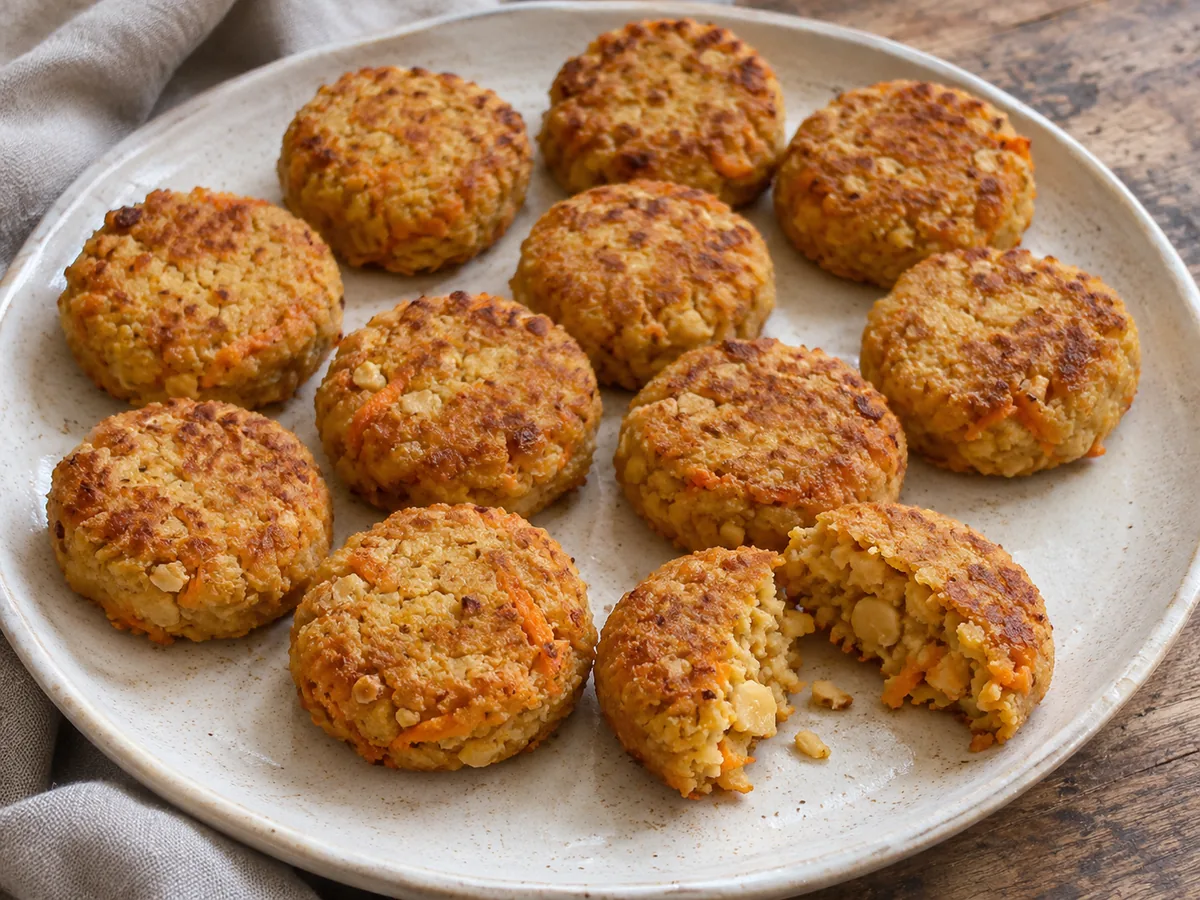
Ingredients
- 500 g already cooked canned chickpeas, rinsed and thoroughly drained, net drained weight
- 200 g peeled raw carrots
- 60 g unsalted roasted peanuts, without shells or loose skins
- 100 g raw shelled eggs, approximately 2 medium eggs, weighed
- 50 g dry chickpea flour
- 8 g peeled garlic
- 20 g olive oil, divided into 5 g and 15 g
- 2 g salt
Preparation
Heat 5 g oil in the pan over medium heat. Add grated carrots and garlic and cook, stirring, for approximately 6 minutes. The shreds should soften without browning strongly and no free water should remain in the pan. Spread on a plate and cool for 10 minutes. Reserve the remaining 15 g oil for the tray and patties.
Mash 500 g drained chickpeas in a large bowl. Crush most into a coarse paste with a fork or short processor pulses; retain some small fragments, but no large whole chickpeas that would split the patties. Fold in finely chopped peanuts and cooled carrot.
Beat 100 g eggs with 2 g salt. Add to the base, then mix in 50 g chickpea flour. Stir until evenly distributed, cover and refrigerate for 20 minutes. This pause lets flour hydrate and improves cohesion. Do not add water to make a pouring batter: the mass must be shapeable.
Preheat the fan oven to 200°C during the end of chilling. Use approximately 5 g of reserved oil to lightly grease the parchment. Divide mixture into twelve comparable heaps, then shape discs approximately 8 cm across and 1.5 cm thick. Firm edges with clean, slightly damp hands; if a patty cracks, press mixture together rather than adding unmeasured flour.
Space patties on a large tray and brush their tops with the remaining 10 g oil. Bake approximately 25–30 minutes. At 15 minutes, carefully turn using a broad spatula; wait a few minutes longer if the base will not yet release. The surface should firm and turn golden without becoming a hard shell.
Check at least 74°C at the centre of a thick patty using a clean probe inserted from the side. Extend baking if necessary until the egg is fully cooked and the centre hot, with no raw wet mixture. Colour alone cannot establish doneness. Allocate three patties per person.
Serve after removing from the oven, allowing brief handling time to prevent burns. Allow approximately 25 minutes preparation, up to 40 minutes cooking and preheating, plus 10 minutes cooling and 20 minutes chilling: approximately 95 minutes overall. Preheating may overlap the end of chilling; the estimate retains a margin for checks.
Introduction
This contemporary creation by Alioune FALL explores chickpeas and ginguba, or peanuts, in an easy shape to share. The recipe makes twelve patties, three per person for four servings. It starts with canned chickpeas that are already cooked:500 g means the contents after draining, not a can weighed with its liquid or a weight of dried seeds. Dry chickpeas cannot be added directly to this mixture. Carrot contributes small soft shreds; brief frying reduces moisture so it will not release water while the patties bake. The ginguba is roasted, unsalted and finely chopped. The aim is neither peanut butter nor a crust of whole peanuts: small fragments should spread through a mashed-chickpea base fine enough to bind together but not so smooth that it becomes sticky purée.
Cultural context
Ginguba here means the peanuts used in the composition. This is a contemporary creation; its oven-baked patty form with egg and flour is not presented as an ancestral Angolan recipe. No specific regional lineage is invented from the choice of this ingredient alone. FAO in Angola, https://www.fao.org/angola , provides an institutional entry point for general agricultural context; it does not document this particular dish. The editorial composition and culinary proposal are by Alioune FALL.
Tips
Dry chickpea surfaces after rinsing: an overly wet mixture spreads instead of holding its shape.
Mash most chickpeas to create a continuous base around the fragments.
Wait until the 20 minutes chilling is finished before judging consistency.
Equal thickness makes cooking more regular; measure the thickest patties especially.
Keep peanuts in small fragments and mention their presence before serving.
Planning
Have a colander, clean cloth or paper towels, a medium-hole grater, a frying pan and a large parchment-lined tray ready. After rinsing, let chickpeas drain, then dry their surfaces without crushing them in the cloth. Surface moisture changes the mixture more than a few grams of carrot, so this step deserves attention. Weigh 500 g at this point. Peanuts must be sold for human consumption, taste fresh and have no rancid smell. Discard spoiled nuts; do not try to hide defects by roasting. As they are already roasted, no roasting time is added here. Chop with a knife or short processor pulses, retaining tiny fragments. Grate carrots and chop garlic. Chickpea flour is weighed dry: it absorbs some moisture and cooks in the oven with the eggs. It is not flour to eat raw; do not taste the mixture before baking. The mixture contains eggs and peanuts, both of which should be mentioned to guests concerned.
Serving
Present the twelve patties on a broad platter without immediately stacking them: trapped steam would soften the surfaces. Their centre remains tender and slightly grainy; they are neither dry biscuits nor falafel made from raw soaked chickpeas. One serving is three similarly sized patties. Calculations exclude sauce and accompaniments. Serve vegetables alongside according to appetite, keeping additions separate so everyone can assemble their plate. Tight tongs may break very hot patties; a flat spatula supports the bases better. Peanut fragments should be noticeable without dominating the mouthful.
Storage
Let leftovers lose their strong steam in a single layer, then place in clean shallow containers. Refrigerate at 4°C or below within 2 hours at room temperature and eat within 48 hours. Reheat only the number needed on a tray in a moderate oven until the centres are thoroughly hot; avoid repeated reheating. If preparing the mixture ahead, keep covered in the refrigerator and bake that same day because it contains raw egg. Do not leave this mixture waiting on the worktop. Flour may continue absorbing moisture in storage, making patties slightly denser without changing their composition.
Variations
The reference formula uses canned chickpeas for reproducible starting weight. Home-cooked chickpeas can be used in an adaptation if fully tender, cooled and weighed after draining; soaking, cooking and cooling must then be allowed for separately. No exact dry equivalent is given because yield varies. Do not automatically replace peanuts with peanut butter: its fat-rich paste and moisture behave differently. Removing eggs or replacing flour also requires revising cohesion and timings. Nutritional values describe only the stated ingredients and weights.
Nutrition notes
Chickpeas and their flour contribute plant protein, carbohydrates and fibre. Peanuts add fats and protein, while eggs contribute both structure and nutrients. The full 20 g oil is included in calculations, including oil for the tray. Estimates use references for drained canned chickpeas and roasted peanuts without added salt; actual salt content can vary by can, even after rinsing. Values refer to three patties, one quarter of the recipe, and guarantee no medical effect. Sodium and salt equivalent should be read as two related but distinct expressions.
Conclusion
Well-drained chickpeas, previously softened carrot and resting the binder make shaping more regular. Oven baking then allows all twelve pieces to cook together with a measured amount of oil. Check the centre rather than seeking excessive browning: the patties benefit from a supple centre in which chickpea, carrot and ginguba remain recognisable.
Enjoy your meal
Enjoy your meal!