Chicken breast fillets stuffed with rice, spinach and ginguba
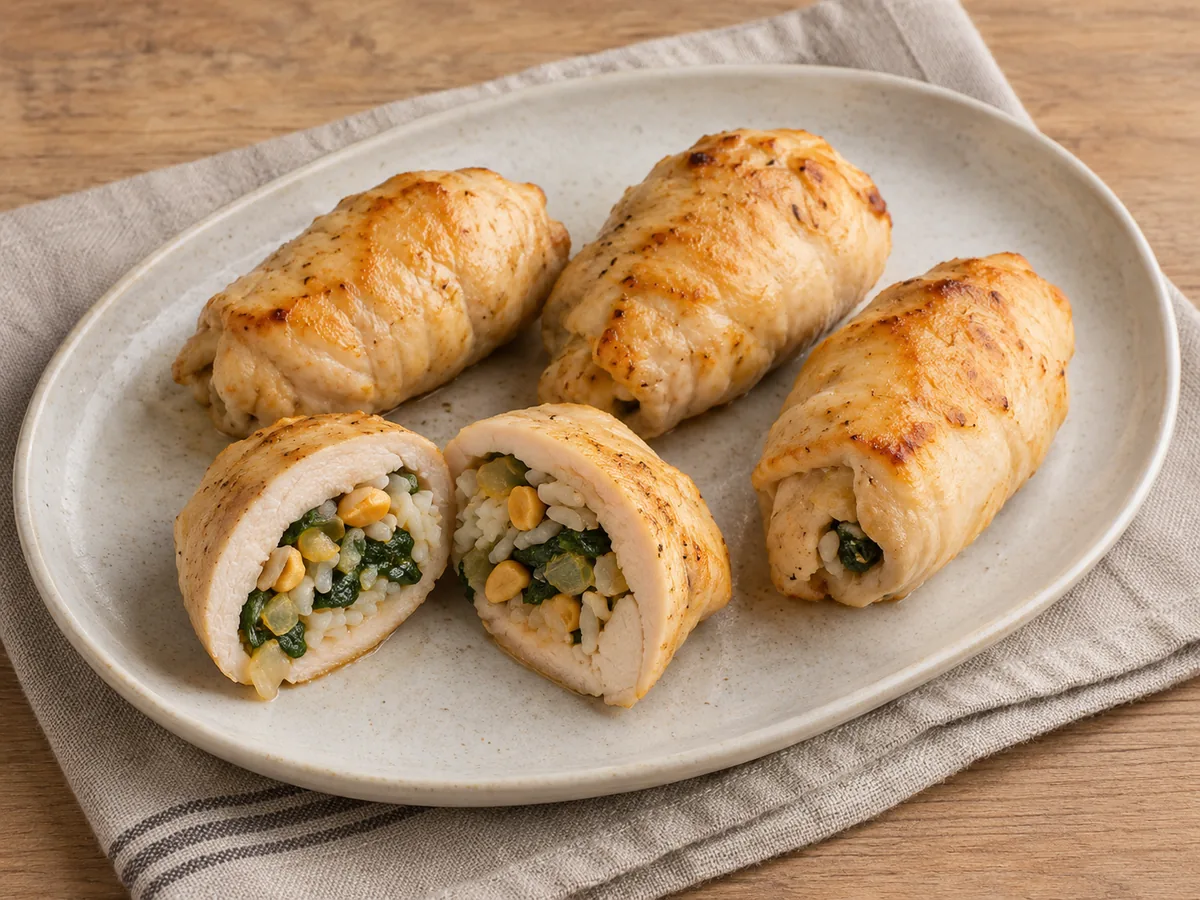
Four boneless fillets rolled around cooked rice, spinach and roasted peanuts, then oven-baked. A contemporary creation for Angola à table.
Ingredients
- 600 g raw skinless boneless chicken breast fillets, approximately 4 fillets of 150 g
- 80 g dried white rice
- 160 ml drinking water for rice, with a small hot reserve if needed
- 200 g fresh raw spinach, trimmed weight
- 100 g peeled raw onion
- 40 g already roasted shelled peanuts without added salt
- 10 g peeled raw garlic
- 20 g olive oil: 10 g for filling and 10 g for roulades
- 100 ml drinking water for the baking dish
- 3 g salt: 1 g for filling and 2 g for fillets
Preparation
Cook 80 g dried rice in 160 ml water for approximately 20 minutes until tender, adjusting water if needed.
Meanwhile soften 100 g onion in 10 g oil for 8 minutes, add 10 g garlic for 1 minute, then 200 g chopped spinach for 4 minutes.
Combine rice, vegetables, 40 g chopped peanuts and 1 g salt. Spread in a shallow dish and cool promptly in the refrigerator for about 20 minutes; aim to refrigerate within an hour.
Butterfly 600 g chicken, approximately 4 fillets of 150 g, on a separate board. Clean hands and utensils.
Preheat oven to 190 °C. Divide all cold filling into four portions inside fillets, roll and tie.
Place seam-side down in a dish; brush with remaining 10 g oil, add remaining 2 g salt and pour 100 ml water into the base.
Bake approximately 45 minutes. Check at least 74 °C at the filling centre AND in meat in several roulades; extend if necessary.
Rest for 5 minutes, remove strings and serve one roulade per portion with its share of juices.
Introduction
This version uses skinless boneless breast fillets rather than a whole bird. Each serving is a small roulade whose centre can be checked, including the filling. Rice must be cooked before assembly: raw grains enclosed in meat would have neither the water nor time needed to soften evenly. Spinach is first wilted in a pan to avoid a pocket of water inside the fillet.
Ginguba, here unsalted roasted peanuts, adds small crunchy pieces to the filling. It neither replaces checking doneness nor conceals overly dry meat. This combination is a contemporary creation for Angola à table without a traditional origin claim. The four portions include all the stated rice and filling, without additional accompaniments in the nutritional calculation.
Cultural context
This proposal combines rice, spinach and ginguba in a fillet roulade, a format chosen for contemporary home cooking. It does not reproduce a documented traditional stuffed bird from a particular Angolan region. The name therefore identifies the cut and technique rather than inventing a local term.
FAO in Angola provides general institutional context: https://www.fao.org/angola. Temperature guidance for poultry and stuffing is available at https://www.foodsafety.gov/food-safety-charts/meat-poultry-charts. These resources illuminate context and safety without certifying the recipe's origin.
Tips
Weigh rice dry and spinach raw and trimmed, not after cooking.
Cool filling in a thin layer and keep raw chicken refrigerated until assembly.
Divide filling before rolling to make servings comparable.
Check filling and meat centres equally; the probe must not stop at the surface.
Count strings when applying and removing them to avoid leaving one on a slice.
Planning
Start with filling before taking chicken out of the refrigerator. Rinse the 80 g rice in a fine sieve. Put it in a small saucepan with 160 ml water, bring to the boil, cover and cook over low heat for approximately twenty minutes depending on the product. Check grains are tender and add a little hot water if necessary. The aim is cooked rice without a pool of free liquid. Do not replace the dry weight with 80 g already cooked rice.
While rice cooks, wash spinach thoroughly, drain and roughly chop. Chop onion and garlic separately. Soften onion in 10 g oil over medium heat for eight minutes, add garlic for one minute and spinach for four minutes, stirring. Let excess water evaporate without scorching leaves. Roughly chop the 40 g peanuts into small pieces rather than fine powder.
Combine rice, vegetables, peanuts and 1 g salt. Immediately spread filling in a thin layer on a clean shallow dish. Once strong steam dissipates, refrigerate to cool quickly; allow about twenty minutes depending on the container, longer if necessary. Aim to refrigerate within an hour of cooking rice. Do not leave it cooling in its saucepan for hours. Filling must be cold before entering poultry and used immediately.
Then prepare the four fillets on a board reserved for raw chicken. Do not rinse them under the tap. Check for small bone fragments, then butterfly with a knife without cutting right through. Gently flatten between two food-contact-safe sheets to an even thickness without tearing. Wash hands and clean utensils after handling. Keep components cold if assembly must be interrupted.
Preheat a conventional oven to 190 °C. Divide all filling into four portions and place in the centre of opened fillets, leaving edges clear. Roll, bringing the sides towards filling, and secure each roulade with kitchen string. If the first is difficult to close, flatten the fillet further without adding meat or abandoning some filling. The result should be a compact roll rather than an overloaded pocket that bursts.
Place roulades seam-side down in a snug baking dish. Brush with the remaining 10 g oil and distribute the reserved 2 g salt. Pour 100 ml water into the base without wetting the top. Bake for approximately forty-five minutes. Check several roulades with a clean probe, aiming for at least 74 °C at the centre of filling and the thickest part of chicken. Neither browning nor the stated time replaces these two checks. Extend in short intervals if needed, protecting the top if browning too much.
Rest for five minutes out of the oven, then remove all strings before serving. Slice with a clean knife and share the pan juices. The stated total includes rice preparation, rapid cooling and this final rest. The filling contains precooked rice reheated in the oven: do not plan another reheating of leftovers afterwards.
Serving
Serve one roulade per person, whole or sliced to reveal filling. Use a clean plate and knife, never equipment left contaminated by raw chicken. Divide cooking juices to limit losses in the baking dish. Rice is already part of the recipe; any extra accompaniment is chosen separately and adds to stated values. Disclose peanuts.
Storage
Preferably make the amount to be served immediately. Because cooked and cooled rice has already been reheated inside the chicken, do not plan a second reheating. If keeping leftovers, cool quickly in small containers, aim to refrigerate within an hour at no more than 4 °C, and eat cold within twenty-four hours. Discard leftovers left at room temperature for a long time. Rice guidance is detailed by the Food Standards Agency: https://www.food.gov.uk/print/pdf/node/4286.
Variations
For finer filling, chop spinach and peanuts more finely without changing quantities. Do not automatically substitute brown rice: precooking, absorption and timing differ. A whole stuffed bird requires another method and checks; it does not replace these four boneless fillets. Omitting peanuts changes texture and composition, which must be reassessed.
Nutrition notes
Fillets are counted raw without skin or bone, and rice is weighed dry before absorbing water. Peanuts and oil contribute fats that remain fully counted even when dispersed through filling and juices. Estimates describe one roulade out of four with all its filling. They are not an analysis of the served dish and carry no health promise.
Conclusion
Correctly cooked and cooled filling, prompt assembly with cold poultry and checks of both centres are decisive. A slice should show cooked meat around tender grains, not serve as proof of doneness on its own. Divide juices and remove ties before eating. This editorial formula is not declared kitchen-tested.
Enjoy your meal
Enjoy your meal!