Baked gilthead seabream with aubergine and ginger
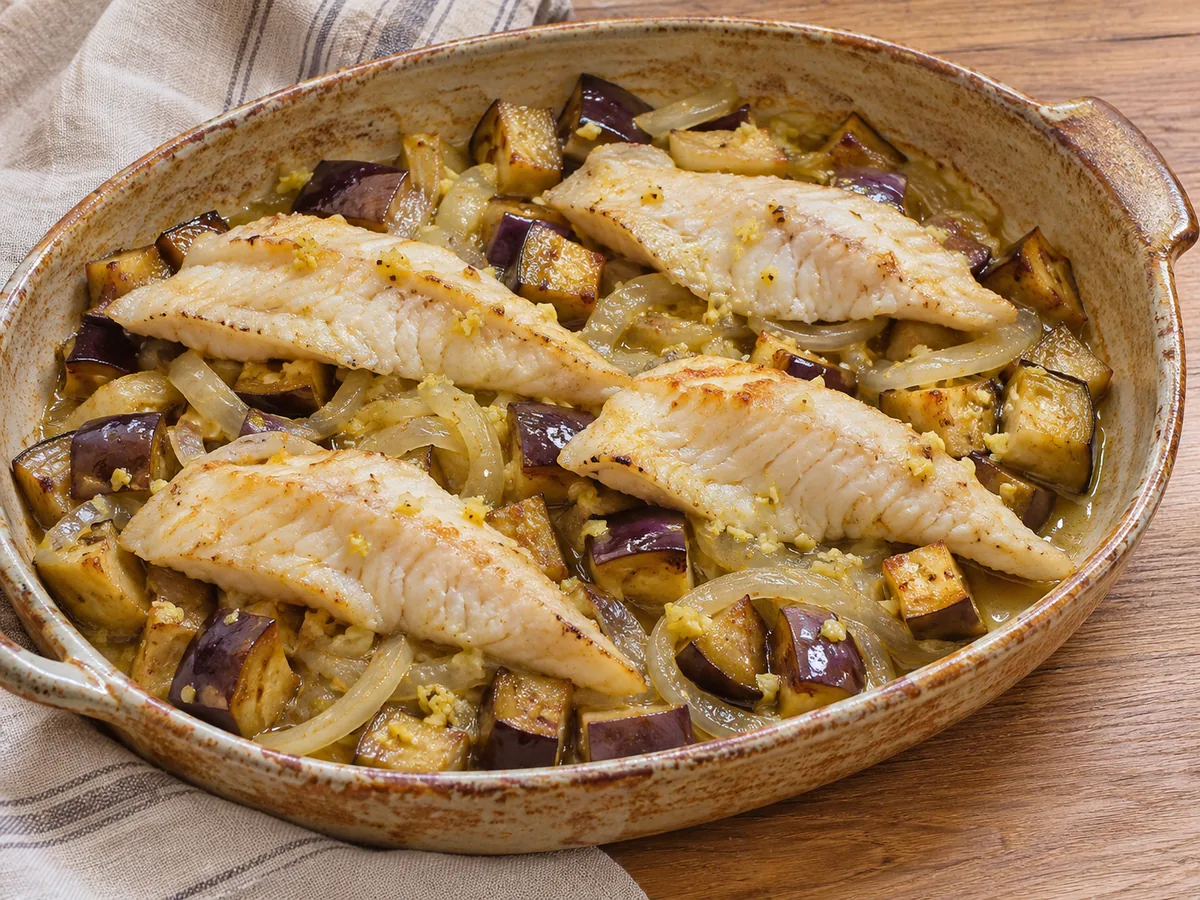
Four portions of gilthead seabream bake over roasted aubergine and an onion-and-ginger base. A contemporary creation for Angola à table.
Ingredients
- 600 g raw farmed gilthead seabream (Sparus aurata) fillets, skinless and boneless, in four portions of approximately 150 g
- 600 g raw aubergine, weighed after removing the stalk, skin retained
- 150 g peeled raw onion
- 20 g peeled fresh ginger
- 30 g olive oil: 20 g for aubergine and 10 g for onion
- 80 ml drinking water
- 30 g freshly squeezed and strained lime juice
- 3 g salt: 1 g for aubergine, 1 g for onion and 1 g for fish
Preparation
Prepare 600 g raw farmed gilthead seabream fillets without skin or bones as four portions; refrigerate.
Preheat oven to 200 °C. Cut 600 g prepared aubergine into 1.5 cm cubes; toss with 20 g oil and 1 g salt.
Roast aubergine for 25–30 minutes, turning once, until tender at the centre.
Meanwhile, soften 150 g onion in 10 g oil for 7 minutes; add 20 g ginger for 30 seconds.
Add 80 ml water and 1 g salt to onion; simmer 3 minutes and retain all the base.
Share the base among tender aubergine, place four fillets in one layer and add 1 g salt.
Bake for 10–15 minutes at 200 °C; check at least 63 °C at the centre with a clean probe.
Out of the oven add 30 g lime juice, rest 2 minutes and divide fish, vegetables and juices into four portions.
Introduction
The seabream goes into the oven only once the aubergine is almost ready. This sequence matters: fish flesh needs much less cooking than vegetable cubes. A small onion-and-ginger base, prepared during the first baking stage, supplies moisture without drowning the aubergine. The aim is tender fish and soft vegetable pieces with some golden faces, rather than a compact gratin or thick sauce.
For clear weights and values, the formula uses six hundred grams of raw farmed gilthead seabream fillets without skin or bones. This is not the weight of four whole fish: heads, innards, skin and skeleton are neither served nor counted. The scientific name Sparus aurata distinguishes this species from other fish sold under similar names. This contemporary preparation does not claim that the product was caught in Angola or corresponds to a traditional national recipe.
Cultural context
This proposal combines fish, aubergine and ginger in a clearly identified contemporary creation. It receives no invented regional name and is not presented as a copy of a historical preparation. The farmed-seabream specification describes the formula's product, not a statement about Angolan fishing.
FAO's Angola representation provides an institutional framework for exploring the country's food and agriculture: https://www.fao.org/angola. It does not validate this recipe. Institutional fillet-temperature guidance is available from FoodSafety.gov: https://www.foodsafety.gov/food-safety-charts/safe-minimum-internal-temperatures. These sources are not a cooking trial of this formula.
Tips
Ask for species and farmed or caught status at purchase instead of inferring composition from the commercial name alone.
Weigh prepared fish flesh without attributing head and skeleton weight to it.
Wait until aubergine is tender before adding fillets.
Share measured oil over vegetables without trying to make every cube shine.
To double quantities, use two dishes and check each fish portion.
Planning
Check the fish label and ask for prepared skinless, boneless fillets. Weigh six hundred edible grams and form four similarly sized portions. Gently run a clean finger over the flesh and remove remaining small bones with tweezers. Keep fillets refrigerated in a covered container until needed. If frozen, thaw in the refrigerator and drain before weighing; this additional wait is not included in the indicative seventy-two minutes.
Preheat a conventional oven to 200 °C. Wash aubergines, remove stalks and weigh six hundred grams with skin. Cut into approximately one-and-a-half-centimetre cubes, not large wedges that would remain firm at the centre. Spread in a wide baking dish approximately thirty by twenty-five centimetres. Toss with twenty grams of oil and one gram of salt to distribute a surface film without adding oil when some cubes look less shiny. Roast for twenty-five to thirty minutes, turning once halfway through.
Meanwhile, thinly slice onion and very finely chop ginger, removing particularly tough fibres. Heat ten grams of oil in a small frying pan and soften onion over medium heat for seven minutes without strong colouring. Add ginger for thirty seconds, then eighty millilitres of water and one gram of salt. Simmer for three minutes to obtain a moist base. It need not reduce to a paste: onion should retain fine strands. Keep all this preparation, including oil and juices.
Check aubergine with a fork before adding fish. Cubes should be soft to the centre; a brown surface around a spongy centre that remains firm is insufficient. If needed, extend their cooking separately for a few minutes. Distribute the ginger-onion base among the cubes, then lay the four seabream portions in one layer. Add the last gram of salt to the fish. Do not bury fillets completely: they should remain accessible for checking and lifting without breaking.
Return to the oven for ten to fifteen minutes, still at 200 °C. Start checking after ten minutes, since actual thickness matters more than fillet length. Insert a clean probe sideways into a fleshy section without touching the dish. Reach at least 63 °C at the centre and check more than one piece if sizes differ. Flesh should become opaque and separate easily. Remove once fish is cooked; do not continue to obtain a crust that would dry the fillets.
Pour over thirty grams of lime juice after removing from the oven, then rest two minutes. Slide a wide spatula beneath each portion and share aubergine, onion and juices between four plates. If a few cubes stick, gently release them with some existing juice rather than additional oil. The stated cooking allowance uses the upper end of both oven stages; onions are prepared during the first stage, not as an additional wait.
Serving
Serve one fish portion per person with one quarter of the aubergine and onion base. Skin was removed before weighing, so there is no skin to subtract when serving. A small bone may nevertheless have escaped preparation; stay attentive when sharing. Juices are part of the recipe and contain some counted oil. Rice, bread or another starch may be served separately but are not included in this entry's values.
Storage
Keep raw fillets between zero and four degrees Celsius and follow the period communicated at purchase. For the cooked dish, promptly divide leftovers into small shallow containers and refrigerate at no more than four degrees Celsius within two hours. Consume within twenty-four hours. Reheat only the amount needed until hot at the centre. Aubergine tolerates reheating better than fish, which becomes firmer; do not repeat cycles. Lime is not a preservation method.
Variations
For softer aubergine, cut some cubes slightly smaller while retaining total weight and checking doneness before adding fish. For a less sharp note, serve some measured lime juice separately; actual consumption may then differ from the calculation. Wild seabream does not necessarily have the same composition as farmed gilthead seabream. A whole fish also changes edible yield and centre-temperature checks; it does not automatically replace six hundred grams of fillets.
Nutrition notes
Seabream contributes protein and some fat, and all added oil is counted. Values use a raw farmed gilthead seabream reference with the stated edible fillet weights, not a whole-fish reference weighed with bones. Aubergine and onion are counted as prepared raw weights. One quarter excludes accompaniments; juice losses and differences between products make figures approximate. Fish is an allergen to disclose.
Conclusion
Giving aubergine time to soften before fish preserves distinct textures. The moist ginger base and final lime remain measured, without correction through large oil additions. Check the centre and serve with juices rather than extending cooking unnecessarily. This editorial creation is not declared kitchen-tested.
Enjoy your meal
Enjoy your meal!