Okra soup with sweet potato and coconut milk
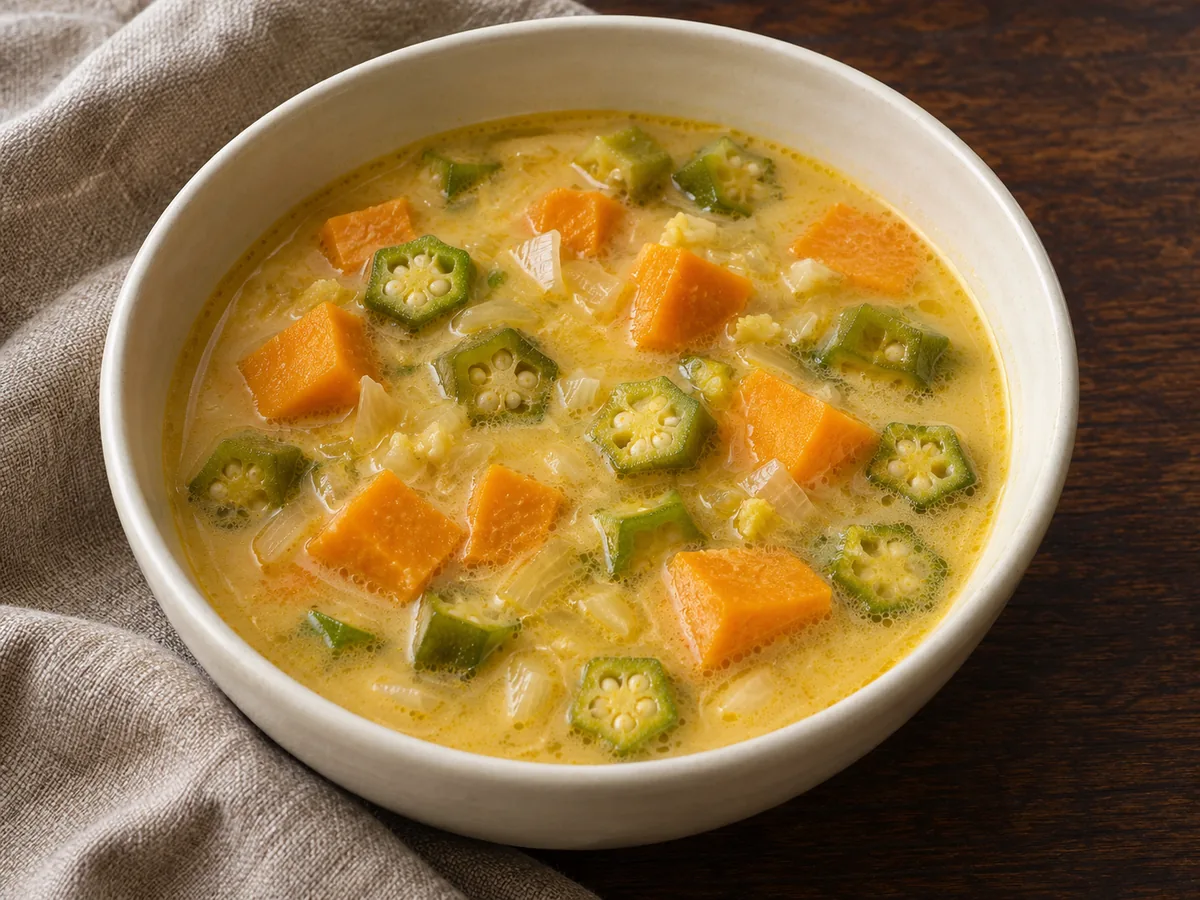
An unblended soup of okra rounds and sweet potato cubes in a light coconut milk broth. A contemporary creation.
Ingredients
- 400 g raw okra, weighed after removing hard stalk ends
- 500 g peeled raw sweet potato
- 250 g unsweetened coconut milk, thoroughly mixed
- 150 g peeled onion
- 10 g peeled garlic
- 10 g peeled fresh ginger
- 20 g olive oil
- 900 ml drinking water, plus a little hot water if needed
- 3 g salt
Preparation
Wash, trim and weigh 400 g raw okra; cut into 1 cm rounds. Peel and weigh 500 g sweet potato, then cut into 1.5 cm cubes.
Soften 150 g chopped onion in 20 g oil for 7 minutes; add 10 g garlic and 10 g ginger for 1 minute.
Add sweet potato, 900 ml water and 3 g salt. Bring to the boil and immediately reduce heat.
Simmer partly covered for 15 minutes; check that large cubes have begun softening and extend if necessary.
Add okra and gently cook for 8 minutes until rounds are tender, stirring carefully.
Homogenise and weigh 250 g unsweetened coconut milk; add and maintain a gentle simmer for 3 minutes.
Rest off heat for 5 minutes, adjust with a little hot water if needed and divide into four portions.
Introduction
Okra gives this soup a slight thickening, while sweet potato remains in small cubes recognisable on the spoon. Coconut milk supplies pale colour and roundness without obscuring the vegetables. The result is neither purée nor thick sauce: pieces sit in liquid that still flows. No added starch is needed because okra and a few softened sweet potato edges already contribute to texture.
This recipe is a contemporary proposal for Angola à table without claiming an identified traditional Angolan soup. It uses trimmed raw okra and peeled raw sweet potato; neither vegetable is precooked. Four portions are planned as soup bowls without accompaniments included in quantities. Choose unsweetened coconut milk, thoroughly mixed before weighing. Much more concentrated coconut cream would change the result and estimates, although a generic nutritional reference may group several products.
Cultural context
The presence of okra, a tuber and coconut does not establish a precise regional origin. This combination and cooking order are contemporary choices for the Angola à table collection. They are described openly without creating a vernacular name or undocumented ancient story.
FAO's representation in Angola provides an institutional starting point on the country's agricultural and food matters: https://www.fao.org/angola. This reference situates general context; it does not attest the soup's history. An explicitly identified creation can explore ingredients without replacing established traditional preparations.
Tips
Cut both vegetables evenly while retaining different sizes appropriate to their cooking order.
Add okra after sweet potato has already begun softening.
Stir with a broad spoon rather than a whisk to preserve pieces.
Mix coconut milk before weighing so neither only water nor only fat is taken.
Taste after resting before adding anything to a recipe whose salt is already measured.
Planning
Prepare all vegetables first rather than leaving the saucepan base heating while cutting. Wash whole okra and dry with a clean cloth. Remove hard stalk ends without taking away much of the pods. Weigh 400 g usable okra and cut rounds approximately one centimetre thick. Rounds should remain thick enough to hold their shape in soup. Discard very fibrous or damaged pods; long cooking does not necessarily turn woody fruit into a pleasant piece.
Wash sweet potatoes before peeling and weigh 500 g flesh. Cut approximately one-and-a-half-centimetre cubes, correcting especially large pieces. Okra enters later, so cubes must begin softening before it arrives. Finely chop onion. Chop garlic and grate ginger, removing very tough fibres. Keep garlic and ginger together in a small dish, separate from onion because their initial cooking is shorter.
Pour twenty grams of oil into a heavy-based saucepan holding at least three litres. Heat over medium heat and add onion. Soften for seven minutes, stirring without seeking dark caramelisation. Add garlic and ginger for one minute. Add sweet potato cubes, stir to coat, then pour in 900 ml water and three grams of salt. Gently scrape the bottom to release light cooking juices, bring to the boil and immediately reduce heat.
Partly cover and simmer for fifteen minutes. Stir once or twice along the bottom without deliberately crushing cubes. Check a large piece with a knife point: it may still resist slightly but should no longer be as hard as at the start. If necessary, cook a few more minutes before adding okra. This check is more useful than mechanically following a time when sweet potato variety or piece size changes.
Add okra rounds and gently stir from bottom to top. Maintain a quiet simmer for eight minutes without fully covering. The liquid becomes slightly thicker; this is expected and does not mean it needs straining. Pierce a thick round to verify tenderness. Avoid beating soup like batter because vegetables would break and the preparation would lose its pieces. If liquid has become insufficient, gradually add a little hot water.
Thoroughly mix coconut milk in its container, then weigh 250 g. Pour into the saucepan and gently simmer for three minutes until hot throughout. Do not boil vigorously in pursuit of a smooth surface: neither vegetables nor coconut milk require that treatment. Turn off heat and rest five minutes. Then taste a spoonful containing liquid and vegetables. Soup may thicken slightly as it rests; loosen with hot water rather than an unmeasured drizzle of oil or second quantity of coconut milk.
Serving
Share cubes and rounds between four bowls first, then add liquid. This prevents a first serving that is mainly creamy liquid and a final one consisting almost entirely of vegetables. The soup should remain fluid enough to ladle and well-filled enough to offer several textures. Serve hot rather than scalding. No additional chilli, lemon, bread or cereal belongs to the formula or calculation; offer any such additions separately.
Storage
Promptly divide leftovers between small shallow containers and refrigerate at no more than 4 °C within two hours of cooking. Consume within 48 hours. Do not wait for a large saucepan to cool completely on the table. Reheat only the amount needed until uniformly hot, stirring gently. Okra continues thickening soup as it rests; add a little drinking water when reheating without treating dilution as a way to extend storage.
Variations
For broth with less coconut, reduce milk from the start and replace its volume with water; this variation requires recalculation. For a thicker soup, mash a few of the specified sweet potato cubes against the pan wall without blending everything. Another leafy vegetable cannot automatically replace okra, which behaves differently in liquid. Adaptations are not represented as tested versions yielding exactly the same result.
Nutrition notes
Sweet potato contributes particularly to carbohydrates and okra to fibre, while coconut milk and oil contribute fat. All quantities are counted, including twenty grams of oil and ingredients' known intrinsic salt. Okra and sweet potato are weighed raw, assuming four equal portions. Water alters concentration but not the whole saucepan's total. These estimates exclude accompaniments and make no medical promise.
Conclusion
The main guide is tenderness of both vegetables, achieved by introducing them at different times. Keep visible rounds and cubes, then add coconut milk near the end to heat everything without excessive agitation. A short rest and careful distribution of pieces give four consistent bowls. This editorial formula is not represented as kitchen-tested.
Enjoy your meal
Enjoy your meal!