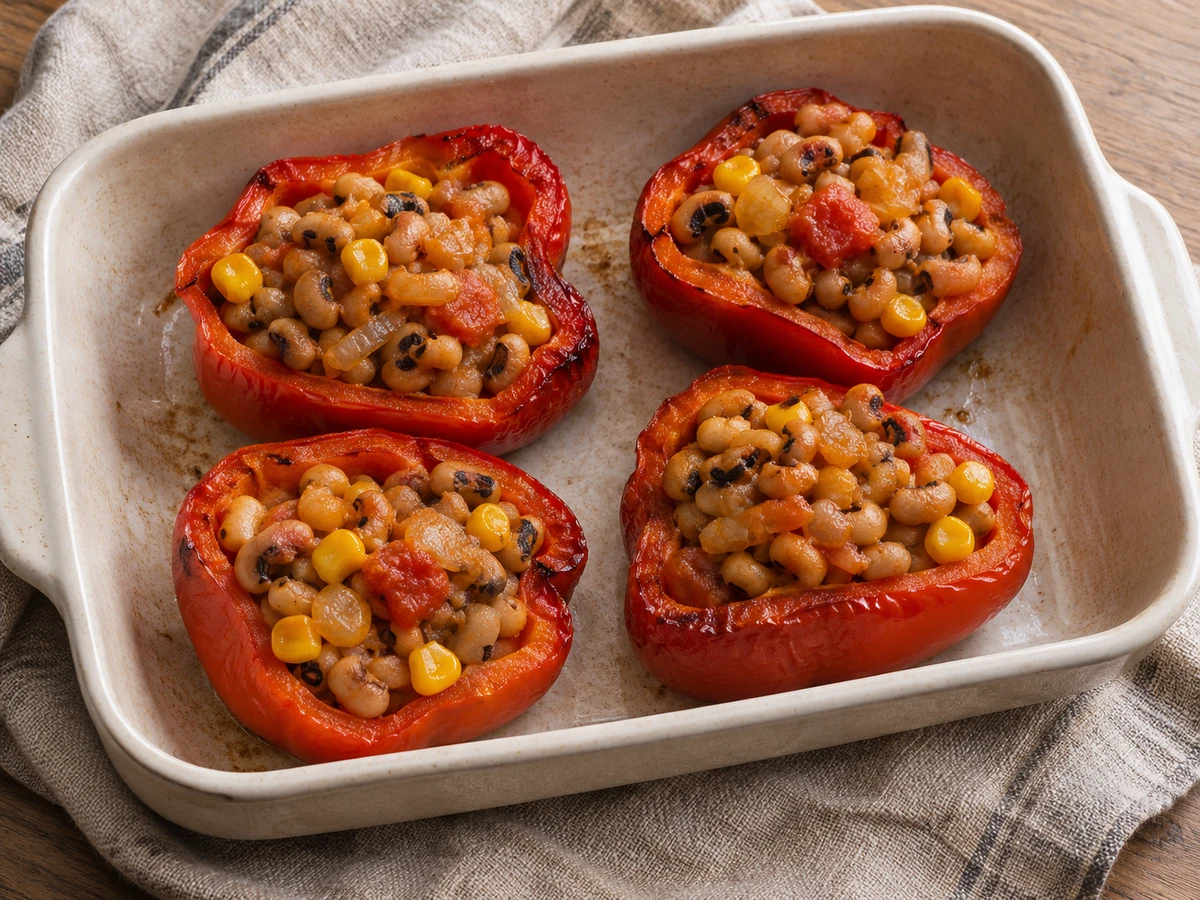
Peppers stuffed with black-eyed peas and sweetcorn
Roasted red pepper halves filled with cooked black-eyed peas, sweetcorn and a tomato mixture. A contemporary creation without meat or cheese.
Ingredients
- 800 g prepared raw red peppers, approximately 4 large peppers, stems and seeds removed
- 500 g black-eyed peas already boiled without added salt, well drained
- 200 g canned sweetcorn, drained weight
- 300 g raw tomatoes with their juice
- 150 g peeled onion
- 10 g peeled garlic
- 25 g olive oil, 10 g for peppers and 15 g for filling
- 3 g salt
- 50 ml drinking water for the bottom of the dish
Preparation
Halve red peppers lengthwise, remove stems and seeds and weigh 800 g prepared halves.
Preheat oven to 200 °C; brush eight halves with 10 g oil, put 50 ml water in the dish bottom and prebake for 15 minutes.
Drain 500 g peas already cooked without added salt and 200 g sweetcorn; chop 150 g onion and 10 g garlic and dice 300 g tomatoes.
Soften onion in 15 g oil for 6 minutes, add garlic for 1 minute, then tomatoes and 3 g salt for 8 minutes.
Mash 100 g peas and fold in with the remaining 400 g and corn; heat for 5 minutes.
Divide all filling between eight halves and bake for another 25–30 minutes.
Check tender peppers and filling at least 74 °C at the centre. Rest for 5 minutes and serve two halves per person.
Introduction
The pepper is an edible container for a filling of whole grains. Black-eyed peas retain their small dark eye, sweetcorn adds yellow touches and tomato brings everything together without becoming an abundant sauce. The filling needs no egg: a small proportion of the peas is mashed to hold the ingredients while the remainder stays recognisable. The result should lift on a wide spatula without the pepper becoming a fragile skin.
This recipe is a contemporary creation in the Angola à table collection. It does not claim to reproduce a traditional preparation with a local name. The peas are used already cooked and drained; prior cooking from dried seeds is excluded from the stated times. Four large peppers make eight halves, two per person. Nutritional values include vegetables, all filling and all oil, without additional accompaniments.
Cultural context
Black-eyed peas are chosen for their structure and visual contrast with corn. This stuffed-pepper form is a contemporary editorial proposal; the presence of pulses and maize in various African food systems does not prove this combination's Angolan origin.
The FAO representation offers institutional access to the country's agricultural and food context: https://www.fao.org/angola. For composition, the pea reference is USDA FoodData Central 173759: mature seeds boiled without salt, with sodium reported. This choice avoids treating missing sodium as zero.
Tips
Weigh peppers after removing inedible parts.
Use peas that are already tender, not merely soaked.
Reduce tomato before filling peppers to limit free water.
Share filling in several rounds to avoid overloading the first halves.
To scale up, use several uncrowded dishes rather than stacked peppers.
Planning
Wash the whole peppers, then cut lengthwise in half. Remove stems, seeds and thick membranes without piercing the walls. Weigh 800 g usable halves; the purchased weight will therefore be higher. Choose wide, fairly uniform peppers rather than very long, narrow ones. Arrange in a baking dish large enough to avoid overlapping. If a half rocks, support it against its neighbour without cutting its base, since an opening would allow juices to escape.
Preheat a conventional oven to 200 °C. Brush ten grams of oil over the inside surfaces and rims of the eight halves. Pour fifty millilitres of water into the bottom of the dish, not into the peppers. Bake empty shells for fifteen minutes. This precooking starts softening them before the filling arrives. They should remain manageable; blackened skin completely detached from the flesh is not the aim.
Meanwhile, thoroughly drain the peas and weigh 500 g cooked. Taste a grain cooled on a clean spoon: its centre should be tender. A still-hard pea will not necessarily finish cooking in the relatively dry filling. Drain sweetcorn separately and weigh 200 g. Finely chop onion and garlic. Dice tomatoes, retaining all their juice. Do not add salted stock: the tomatoes' water is enough to start the filling.
Heat the remaining fifteen grams of oil in a sauté pan. Soften onion over medium heat for six minutes, add garlic for one minute, then tomatoes and three grams of salt. Cook for eight minutes, stirring, until the tomatoes collapse and the mixture is moist without a pool of liquid. Mash approximately 100 g of the allocated peas with a fork, then fold in this mash, the remaining 400 g whole peas and the corn. Heat for five minutes, gently lifting the ingredients.
Remove the dish and fill all eight pepper halves, using all the filling. Begin with modest amounts in each, then top up to create comparable portions. Form a slight dome without pressing hard or leaving large heaps on the edges. Filling capacity depends on the peppers' shape; choose large ones at the start that can each hold approximately one eighth of the mixture. If grains fall into the dish, return them to the filling before cooking finishes.
Bake again for twenty-five to thirty minutes at 200 °C. The walls should yield to the point of a knife and the filling should be hot at its centre. A clean probe can check at least 74 °C in the filling of a pepper in the middle of the dish, particularly if the peas were refrigerated. If the top colours too quickly, loosely cover without compressing the peppers. Rest off the heat for five minutes before lifting the halves with a spatula.
Serving
Lift peppers with a spatula supporting their whole length rather than tongs that could pierce the skin. Allow two halves and a quarter of the filling per portion. Share any loose grains and edible juices left in the dish as well. The filling needs no second sauce. If bread or rice is offered, serve separately: those foods are excluded from the recipe's estimate.
Storage
Refrigerate leftovers in shallow containers at no more than 4 °C within two hours of cooking and consume within forty-eight hours. Reheat only needed portions until the filling is hot throughout. When the peas had been chilled and are reheated by this recipe, eat peppers immediately after cooking and do not plan another cooling and reheating cycle. Do not leave the dish lukewarm on a buffet.
Variations
Yellow peppers may replace red ones, but composition and sweetness differ slightly; this substitution is not included in the stated calculation. For a more cohesive filling, mash a slightly larger proportion of peas without changing their total quantity. Adding cheese or egg changes ingredients, allergens and cooking. For a hotter version, measure chilli separately rather than randomly changing tomato quantities.
Nutrition notes
Peas contribute to protein and fibre, while peppers, tomato and corn contribute to the overall composition. Canned corn supplies intrinsic salt in addition to the three grams added to the pan. Both precooking and filling oil are counted. The calculation estimates one quarter of the preparation rather than analysing a single pepper of arbitrary size.
Conclusion
Precooking shells and limiting free moisture in the filling brings together two components already partly cooked. Then check pepper tenderness and heat at the filling's centre. Sharing all filling and allowing a short rest makes serving consistent. This contemporary creation is not presented as kitchen-tested.
Enjoy your meal
Enjoy your meal!