Oven-baked millet and carrot balls
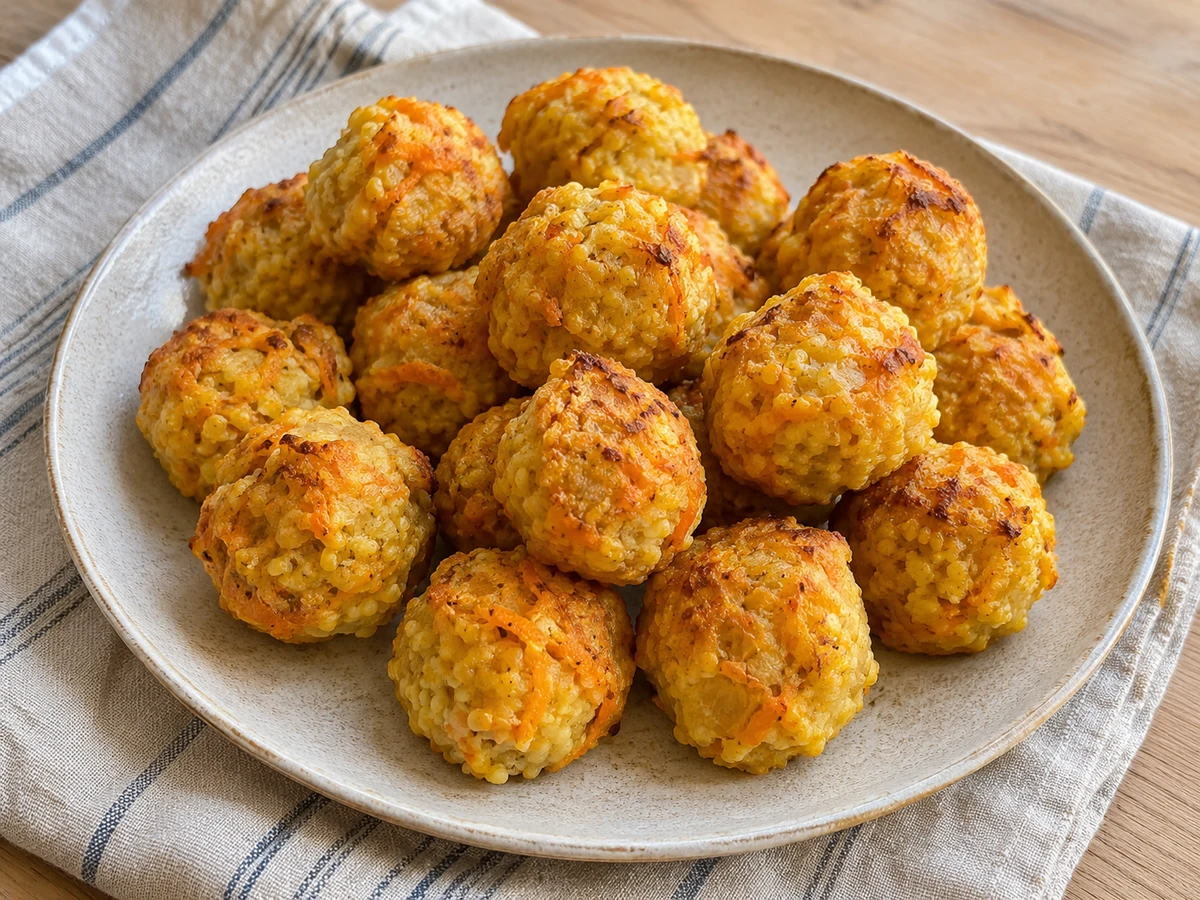
Small balls of cooked whole millet and grated carrot, bound with egg and chickpea flour, then browned in the oven. A contemporary creation for Angola à table.
Ingredients
- 160 g dried whole hulled millet
- 400 ml drinking water to cook millet, with a small hot reserve if needed
- 300 g peeled raw carrots
- 100 g peeled raw onion
- 100 g raw whole egg without shell, approximately 2 eggs to verify by weighing
- 40 g chickpea flour
- 15 g olive oil: 10 g for vegetables and 5 g for brushing
- 3 g salt
Preparation
Rinse 160 g dried whole millet; cook covered in 400 ml water for approximately 20 minutes, adjusting water if needed until tender.
Meanwhile grate 300 g carrots and chop 100 g onion. Soften onion in 10 g oil for 4 minutes, then add carrots for 6 minutes.
Rest millet covered for 5 minutes, separate grains and spread on a clean dish. Cool millet and vegetables to lukewarm for approximately 15 minutes.
Beat and weigh 100 g egg without shell; combine with millet, vegetables and 3 g salt. Fold in 40 g chickpea flour and hydrate for 10 minutes.
Preheat oven to 200 °C. Shape 24 balls approximately 4 cm across on a paper-lined tray and brush with the remaining 5 g oil.
Bake for approximately 25 minutes, turning after 15 minutes. Check at least 74 °C in the centre; extend if necessary.
Rest for 5 minutes and serve 6 balls per portion, with no accompaniment included in the values.
Introduction
These balls keep the small millet grains visible instead of hiding them in a purée. Carrot supplies tender shreds and orange colour, while egg and chickpea flour provide binding. Oven cooking uses a measured amount of oil without deep-frying. The intended result is lightly golden outside and tender in the centre, not a hard crust around dry dough.
This is a contemporary creation for the Angola à table collection, without claiming to reproduce a traditional national preparation. Use whole hulled millet intended for cooking as grains: millet flour, couscous or a precooked cereal would behave differently. The recipe yields twenty-four small balls, six per serving. Sauce or salad served alongside is outside the nutritional calculation.
Cultural context
Millets comprise different cereals and should not be reduced to one commercial product. FAO provides institutional resources about them: https://www.fao.org/millets-2023/en. This documentation explains a food group; it does not make these balls an ancient recipe or a documented Angolan speciality.
In this collection, combining millet, carrot and chickpea flour is a contemporary choice. National context can be consulted through FAO in Angola: https://www.fao.org/angola. The descriptive name avoids inventing a local term or historical origin that has not been verified.
Tips
Weigh millet dry before cooking; cooked weight varies with absorbed water.
Cool grains to lukewarm before egg for even binding.
Observe the ten-minute rest after flour before judging consistency.
Lightly dampen hands without adding unmeasured shaping oil.
Check a thick ball in the middle of the tray, not only the most golden ones at the edges.
Planning
Put millet in a fine sieve, rinse and drain. Bring the 400 ml water to the boil in a heavy-based saucepan, add millet, cover and lower heat. Cook gently for approximately twenty minutes, allowing for package directions. Grains should be tender in the centre. If water is absorbed too early, add a little hot water and continue in short stages rather than leaving hard grains in the eventual balls.
While it cooks, wash, peel and weigh 300 g carrots. Grate finely enough to obtain short shreds that blend into the mixture. Chop the 100 g onion. Soften onion in 10 g oil over medium heat for four minutes, then add carrots and continue for six minutes, stirring. They should soften and lose some moisture without strong browning. Do not pour in extra oil to speed the process.
Once millet is tender, turn off heat and rest covered for five minutes. Separate grains with a fork, then spread over a clean shallow dish. Spread vegetables on another plate. Let both become lukewarm for approximately fifteen minutes rather than waiting for hours at room temperature. This organisation allows twenty minutes for millet resting and cooling to lukewarm. If preparation is interrupted, refrigerate the ingredients promptly and resume later with a short storage period.
Crack eggs into a clean bowl, beat and weigh exactly 100 g without shell. Do not fold eggs into hot grains, which would coagulate them in patches. Combine lukewarm millet, carrots and onion, weighed eggs and three grams of salt. Add the 40 g chickpea flour and mix until evenly distributed. Leave to hydrate for ten minutes. The mixture should gather without running through the fingers; it remains softer than bread dough.
Preheat a conventional oven to 200 °C and line a large tray with baking paper. Divide the entire mixture into twenty-four comparable pieces. With clean lightly dampened hands, shape approximately four-centimetre balls without compressing so hard that all grains disappear. Space them on the tray. Brush their surfaces with the remaining 5 g oil, scraping the small bowl so most of the oil is not left unused.
Bake for approximately twenty-five minutes, gently turning the balls after fifteen minutes to expose another face. The centre should be set without wet egg mixture. Use a clean probe to check at least 74 °C in the centre of a large ball in the middle of the tray. Extend in short intervals if necessary. Rest five minutes before lifting because they firm slightly after leaving the oven. The stated forty-five minutes of cooking assumes vegetables are prepared while millet cooks.
Serving
Serve six balls per person, hot or lukewarm just after cooking. Move with a spatula rather than pinching while fragile. Their texture is not that of a breaded fried croquette: grains and carrot should remain perceptible. Sauce may be served separately, but pouring it over the whole batch changes the formula and can soften the golden surfaces.
Storage
Cool remaining balls promptly in a shallow container and refrigerate at no more than 4 °C within two hours of cooking, sooner in hot conditions. Consume within twenty-four hours. Reheat only the required amount once, to 74 °C in the centre. Do not leave mixture containing raw egg waiting on the worktop. Domestic cooling and hygiene principles are outlined by Anses: https://www.anses.fr/fr/content/en-cuisine-le-meilleur-ingredient-c-est-l-hygiene.
Variations
For a more rustic texture, leave some carrot shreds slightly longer without increasing their mass or moisture. Another flour may absorb differently from chickpea flour: do not automatically substitute gram for gram. Omitting egg requires a new binding formula and does not guarantee stability. Larger balls require reassessing cooking time and temperature checks.
Nutrition notes
Millet is counted dry before absorbing water, while carrots and onion are weighed raw and prepared. Egg and flour contribute protein and binding, and all oil is included. Values cover six balls out of twenty-four without sauce. The recipe contains egg and chickpea, to disclose according to diners' allergies; estimates carry no therapeutic promise.
Conclusion
Tender grains, mixture cooled to lukewarm before egg and regularly sized balls are the main guides. Resting the flour helps shaping, and checking the centre complements observing colour. Dividing the entire mixture into twenty-four units makes portions more consistent. This editorial formula is not declared kitchen-tested.
Enjoy your meal
Enjoy your meal!