Papaya roasted with lime and ginger
Ripe but firm papaya wedges are roasted with a light coating of lime, ginger and sugar, then served with all their juices.
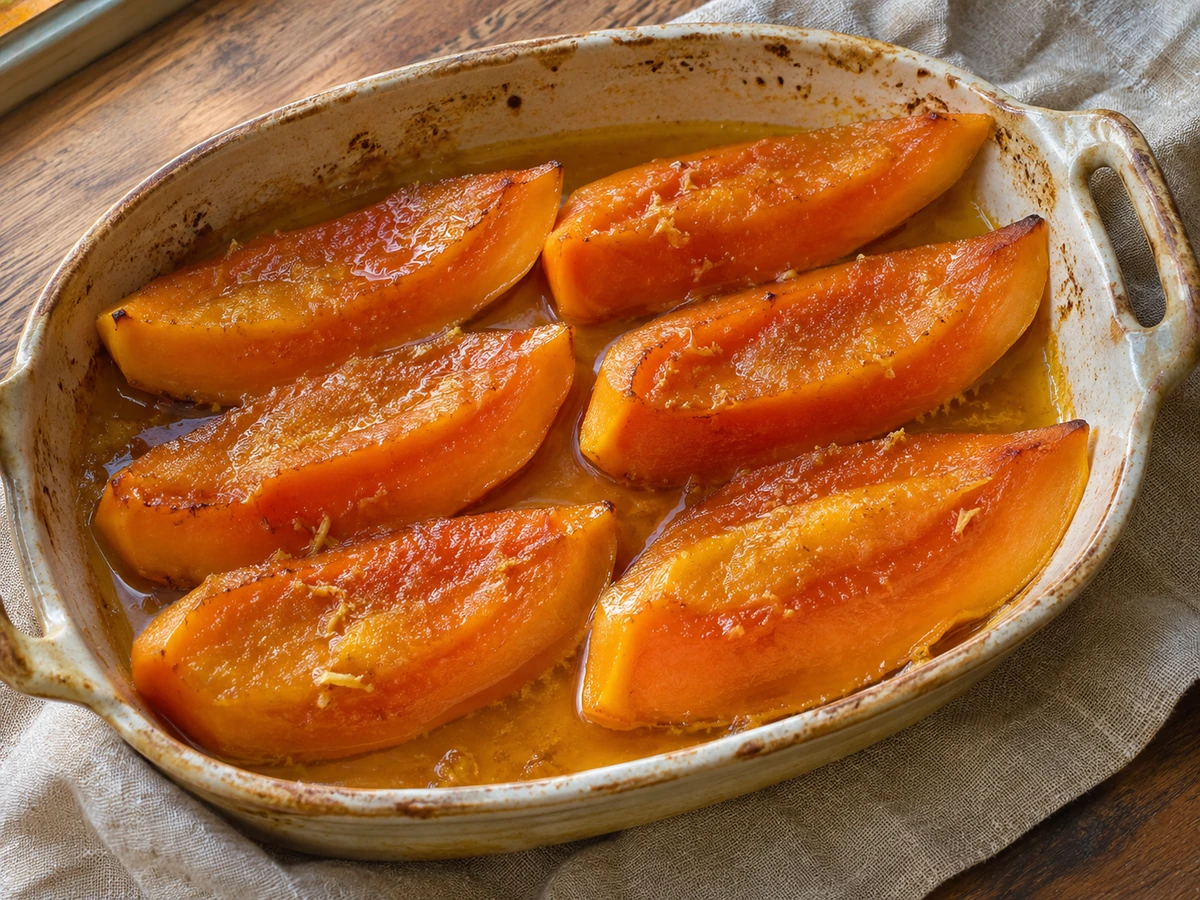
Ingredients
- 800 g ripe but firm papaya flesh, without skin or seeds
- 25 g pure lime juice, divided into 15 g before cooking and 10 g afterwards
- 10 g peeled fresh ginger, very finely grated
- 15 g white sugar
- 10 g olive oil
- 1 g salt
Preparation
Wash, peel and deseed papaya; weigh 800 g firm flesh and cut into approximately eight wedges 2 cm thick.
Preheat a conventional oven to 190 °C and prepare a shallow dish allowing a single layer.
Weigh 25 g lime juice; separately reserve 15 g for cooking and 10 g for finishing.
Mix 15 g juice with 10 g finely grated ginger, 15 g sugar, 10 g oil and 1 g salt; coat the wedges, scraping out the bowl.
Roast 25–30 minutes; baste halfway through and check thick parts for tenderness without seeking dark browning.
Out of the oven, add the reserved 10 g juice, baste gently and rest 10 minutes.
Divide fruit and all dish juices into four servings; serve warm. Approximate total: 60 minutes including resting.
Introduction
Papaya changes texture in the oven: its surface dries slightly while the centre becomes more tender. Choose ripe but still firm fruit to keep wedges that can be lifted, rather than flesh that is already almost liquid. Lime is used in two stages, some before cooking and the rest after the dish leaves the oven. Ginger is very finely grated to flavour the coating without leaving long fibres to chew.
This contemporary creation for Angola à table proposes another way to serve fruit without claiming a traditional Angolan recipe. The 800 g means only peeled, deseeded flesh. The purchased whole fruit's weight is therefore different and depends on size. Four servings of two wedges are intended, including all dish juices; no ice cream, cream or garnish is included. Allow about twenty minutes preparation, thirty cooking and ten resting, or sixty minutes before serving warm.
Cultural context
Roasting papaya with lime and ginger is a contemporary editorial proposal here. The name describes ingredients and technique; no ancient story or regional designation is invented. A fruit's presence in a country is not enough to certify that a precise method is traditional there.
FAO's representation provides an institutional resource for exploring Angola's agricultural and food context: https://www.fao.org/angola. It does not validate this dessert formula. General domestic hygiene recommendations are available from Anses: https://www.anses.fr/fr/content/en-cuisine-le-meilleur-ingredient-c-est-l-hygiene.
Tips
Weigh 800 g after removing skin and seeds.
Separate cooking and finishing juice before starting to stay within the planned 25 g.
Finely grate ginger instead of leaving thick strips.
Use all the coating but do not additionally oil the dish.
Watch small pieces and sugared edges, which colour before thick centres.
Planning
Choose papaya whose flesh yields a little to gentle pressure but has neither large soft areas nor a fermented smell. Skin colour varies between fruits and cannot determine ripeness alone. Wash the whole fruit before placing on a clean board. Halve lengthways, remove seeds with a spoon, then carefully remove skin. Weigh 800 g usable flesh after removing any damaged areas. Do not make up the weight with seeds or skin.
Cut approximately eight long wedges of similar mass, around 100 g each, about 2 cm thick at their thickest point. If the fruit's shape creates smaller pieces, group them to make a comparable serving rather than leaving them to burn in a corner. Even pieces allow their tenderness to be compared during cooking. Very green papaya is unsuitable for this sweet formula: it would need a different method, not merely five additional oven minutes.
Preheat a conventional oven to 190 °C. Choose a shallow dish wide enough to hold the wedges in one layer without crowding. A deep dish retains more steam and gives a poached texture; an enormous tray may dry the juices before the flesh becomes tender. Do not grease the dish separately: all planned fat is the ten grams of oil used in the coating. Keep a small spatula or brush ready to distribute this mixture without adding oil by eye.
Wash the lime before squeezing. Strain and weigh 25 g juice, dividing between two containers: 15 g for cooking and 10 g for finishing. Peel and finely grate ten grams of ginger. Mix 15 g juice with 15 g sugar, 10 g oil, ginger and one gram of salt. Stir until the sugar is thoroughly moistened; complete dissolution is unnecessary. Spread over the wedges, scraping out the bowl, then turn gently to coat their different surfaces.
Roast for twenty-five to thirty minutes in the middle of the oven. Halfway through, baste wedges with their juices and rotate the dish if one side browns faster. Lightly golden edges are sufficient: seeking a very dark crust could dry the flesh or burn the sugar. Pierce the thick part with a clean knife tip; it should yield without collapsing. Remove smaller pieces already tender if necessary. Timings are guides and adapt to actual ripeness, which greatly changes papaya's behaviour.
Take out the dish using suitable protection and pour the reserved 10 g lime juice over the still-hot fruit. If the wedges are fragile, stir only the liquid around them and baste. Rest for ten minutes for warm serving. This rest must not become a long wait on the worktop. Divide two wedges or equivalent mass per person, sharing all juices. Do not drain fruit in a sieve: sugar, ginger and some oil would then remain outside the calculated servings.
Serving
Serve on slightly deep dessert plates to retain juices. Lift each wedge from underneath with a spatula instead of repeatedly piercing it. Two wedges make a serving when all eight are comparable; otherwise distribute their mass as equally as possible. The dessert stands alone in this formula. A spoonful of yoghurt or ice cream can be added separately according to diners' wishes, but it is excluded from the roasted papaya's values.
Storage
To keep leftovers, promptly place in a shallow container with juices and refrigerate at no more than 4 °C within two hours of leaving the oven. Consume within twenty-four hours. Fruit may be eaten cold; its texture will be softer than at first serving. Reheat only the quantity needed, once, if warm fruit is preferred. Lime does not replace refrigeration, and cooked fruit is not a shelf-stable preserve.
Variations
For a softer result, choose slightly riper papaya and check cooking earlier rather than changing all quantities. For a milder aroma, reduce ginger from the outset. Replacing sugar with syrup changes both water and sugars; it is not an automatic equal-mass substitution. Papaya blended before cooking would no longer make roasted wedges and would need another container, timing and presentation.
Nutrition notes
The calculation uses raw edible papaya weight rather than whole fruit weight. The 25 g juice, ginger, sugar, all oil and salt are included. Cooking juices are shared across all four portions; discarding them would make the estimate less directly applicable. Brands, variety and ripeness change actual fruit composition, while evaporation changes final weight. Values are indicative, without a medical promise, and exclude accompaniments.
Conclusion
Even wedges, a measured coating and monitored cooking define this preparation. Sharing juices matters as much as sharing fruit. Adding the second lime portion out of the oven preserves a clear finish, and ten minutes resting allows warm serving. This contemporary creation is offered as a formula to cook; it is not declared kitchen-tested.
Enjoy your meal
Enjoy your meal!