Sorghum with aubergines and ginguba
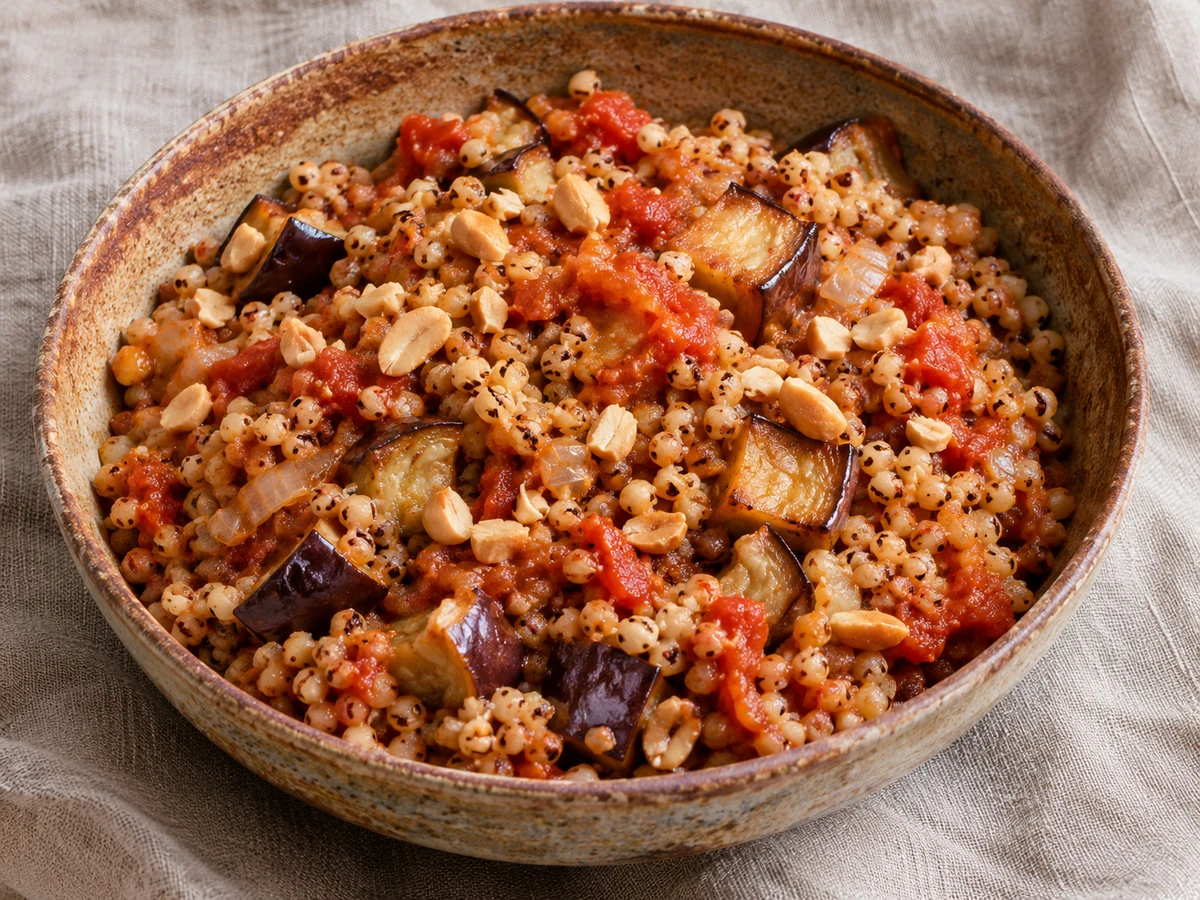
Hot whole sorghum with roasted aubergines, a short tomato and onion sauce and roasted peanuts. A contemporary creation for Angola à table.
Ingredients
- 200 g dried food-grade whole sorghum
- 700 ml drinking water for soaking, to discard
- 900 ml drinking water for sorghum, plus hot water if needed
- 600 g raw aubergines, weighed after removing stalks
- 300 g raw tomatoes with their juice
- 150 g peeled raw onion
- 10 g peeled raw garlic
- 60 g roasted unsalted shelled peanuts
- 25 g olive oil: 15 g for aubergines and 10 g for sauce
- 150 ml drinking water for sauce
- 20 g fresh lime juice
- 3 g salt: 1 g for sorghum and 2 g for sauce
Preparation
Sort and rinse 200 g sorghum; soak for 8 hours in 700 ml water in the refrigerator at no more than 4 °C.
Discard soaking water; rinse and cook sorghum in 900 ml water with 1 g salt at a gentle simmer for 50–60 minutes or until tender.
Preheat the oven to 200 °C; cut 600 g aubergine into 2 cm cubes and coat with 15 g oil.
Roast aubergines for 25–30 minutes, turning halfway; check their centres.
Soften 150 g onion in 10 g oil for 8 minutes; add 10 g garlic for 1 minute, then 300 g tomatoes and 2 g salt for 10 minutes.
Add 150 ml water and 20 g crushed peanuts; fold in aubergines and simmer 5 minutes.
Drain tender sorghum, rest 5 minutes, fold in and gently reheat for about 5 minutes if needed.
Off the heat, add 20 g lime juice; divide into four and distribute the reserved 40 g chopped peanuts.
Introduction
This dish uses sorghum as a grain to chew rather than flour for thickening. Aubergines are roasted separately so they become tender without absorbing all the oil of a pan-fry. They then join a short tomato sauce that coats grains without turning them into porridge. Ginguba, here in the form of chopped roasted peanuts, provides textural contrast. A small part may be crushed into the sauce, but visible fragments remain.
Choose firm, smooth-skinned aubergines and food-grade whole sorghum whose packaging specifies cooking as grains. Sorghum intended for sowing, flour and puffed grains are unsuitable. The planned soak requires starting eight hours ahead, ideally the day before. The indicative total of 580 minutes includes those 480 minutes, 25 minutes preparation and a warm cooking phase of approximately 75 minutes, with grain, vegetables and sauce cooked in parallel.
The recipe is explicitly a contemporary creation for Angola à table. The presence of peanuts, tomato or sorghum does not establish that this combination belongs to a particular regional tradition. The name therefore describes the actual composition proposed without claiming to reproduce an ancient speciality or national dish.
Cultural context
The name ginguba refers here to peanuts used in a contemporary composition, not proof of the dish's antiquity. Sorghum is treated as a whole grain; no particular local variety is claimed without documentation. FAO's representation in Angola is an institutional resource for contextualising the country's agricultural and food issues: https://www.fao.org/angola. It does not certify this specific recipe's origin. This distinction allows exploration of new ways of cooking without confusing editorial creation and documented traditional preparation.
Tips
Start soaking the day before to avoid rushing the other stages.
Do not keep adding oil as aubergines absorb it; the planned quantity suffices for this oven cooking.
Check sorghum and aubergines separately for tenderness before combining.
Use unsalted peanuts because the 3 g salt are already distributed in the recipe.
Tell diners peanuts are present, including the crushed fraction hidden in the sauce.
Planning
Sort and rinse 200 g sorghum. Cover with 700 ml water in a clean container, close and soak for eight hours in the refrigerator at no more than 4 °C. Discard this water, rinse again and put grains in a saucepan with 900 ml fresh water and 1 g salt. Bring to the boil, reduce and simmer partly covered for 50–60 minutes. Keep grains under liquid, adding hot water if needed. Taste several cooled grains: their outer layer may remain noticeable but centres must be tender. Extend in ten-minute intervals if the product requires it.
While sorghum cooks, preheat a conventional oven to 200 °C. Wash aubergines, remove stalks and weigh 600 g usable aubergine, skin included. Cut into approximately two-centimetre cubes. Much smaller cubes dry quickly, whereas large wedges would be difficult to distribute with grains. Toss with the planned 15 g oil and spread on a large baking-paper-lined tray. Do not add another quantity of oil to make every cube shiny: aubergine rapidly absorbs fat before softening.
Roast cubes for 25–30 minutes, turning halfway with a spatula. Skin should remain identifiable and flesh become tender. Check a thick cube from the centre of the tray rather than relying only on coloured edges. Extend a few minutes if necessary. Keep aubergines on the clean tray while awaiting sauce; they will be reheated in it and should not sit for hours at room temperature.
Chop onion and garlic separately. Wash tomatoes and dice finely, retaining juice. In a wide sauté pan, soften 150 g onion in the remaining 10 g oil for approximately eight minutes over medium heat. Add garlic for one minute, then tomatoes and the reserved 2 g salt. Cook ten minutes, stirring, to obtain a softened base, then add 150 ml water. Gently scrape the bottom to return cooking juices to the sauce without letting everything dry and stick.
Coarsely chop peanuts with a knife on a stable board. Check that they are already roasted and unsalted. Crush about 20 g with the back of a spoon and mix into the sauce to give a little body; keep the remaining 40 g in fragments for serving. Add roasted aubergines and simmer five minutes. The sauce should remain mobile enough to distribute, without forming a soup around the vegetables.
When sorghum is tender, drain and rest for five minutes. Fold it hot into the sauté pan with two spoons and gently reheat for approximately five minutes if needed. Off the heat, add 20 g lime juice. Divide the whole preparation into four portions and distribute reserved peanut fragments. If components have not finished together, keep the wait brief; do not needlessly prolong cooking grains in sauce to compensate for aubergines that are still firm.
Serving
Serve hot in shallow bowls, with visible aubergine cubes among grains. Divide vegetables before completing each portion with sorghum so that all the aubergine does not go to the first diners. Distribute peanut fragments after portioning to preserve crunch on each plate. The dish is calculated without meat, fish, bread or extra sauce; any such accompaniments remain separate.
Storage
Promptly divide leftovers between several shallow containers and refrigerate at no more than 4 °C within two hours of cooking. Consume within 48 hours. If possible, store peanut fragments intended for a later portion separately and dry. Reheat only the amount needed until hot in the centre, adding a little water to loosen sauce. Poorly cooled sorghum does not become acceptable simply because it is subsequently reheated.
Variations
For more contrast, leave all peanuts as fragments rather than crushing 20 g; sauce will be less thickened without changing quantities. Reduce lime if tomatoes are very acidic, noting that the exact formula changes slightly. Replacing sorghum with millet or rice requires a new cooking method and calculation. A peanut-free version must be identified accordingly; its flavour, allergens and composition no longer match those stated.
Nutrition notes
Nutrition is estimated from sorghum dry before soaking, vegetables by raw usable weight, already roasted peanuts, and all oil, lime and salt. Sorghum contributes carbohydrate, fibre and some protein, while peanuts and oil contribute fat. Possible cooking or soaking losses are not measured. Four comparable servings require sharing grains, vegetables and peanuts evenly. No health promise is attached to these values.
Conclusion
Cooking grains until tender, roasting aubergines without excessive oil and combining components only when ready gives the best control over texture. Sauce connects ingredients without having to disguise sorghum that is still hard. Add lime off the heat and keep part of the ginguba for the final crunch. This contemporary editorial formula is not declared kitchen-tested.
Enjoy your meal
Enjoy your meal!