Sweet potatoes topped with spinach and eggs
Roasted sweet potato halves carry a spinach, onion and beaten-egg topping, baked until completely set. A contemporary creation.
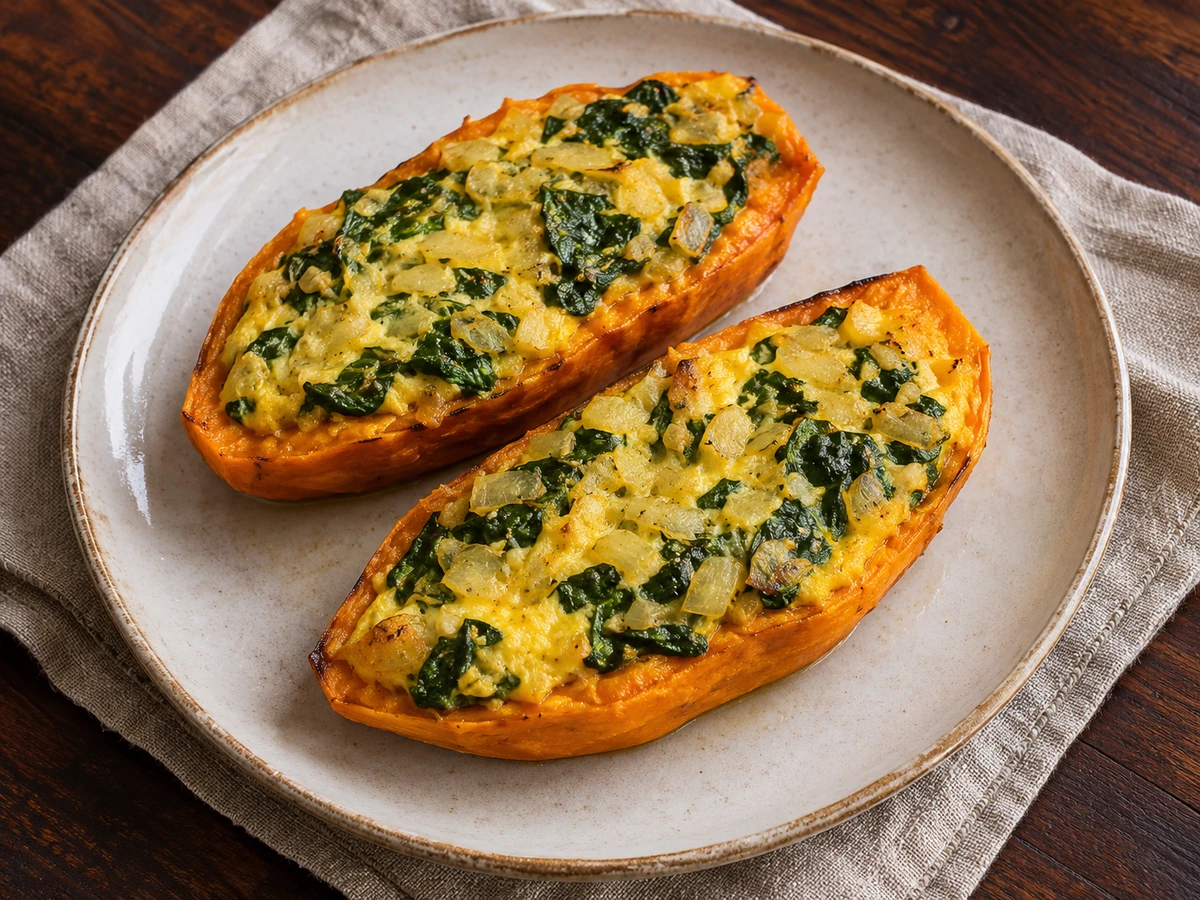
Ingredients
- 1,200 g peeled raw sweet potato, approximately 4 similarly sized pieces
- 300 g raw spinach, usable weight
- 200 g raw eggs without shells, approximately 4 medium eggs, verified by weighing
- 100 g peeled onion
- 6 g peeled garlic
- 20 g olive oil: 10 g for sweet potatoes and 10 g for topping
- 3 g salt
Preparation
Preheat oven to 200 °C. Peel and weigh 1,200 g sweet potatoes; cut four pieces lengthways into eight halves.
Brush with 10 g oil and roast for 35–45 minutes until completely tender in the centre.
During roasting, soften 100 g onion in the remaining 10 g oil for 7 minutes; add 6 g garlic for 30 seconds.
Add 300 g prepared spinach and cook for 4–6 minutes until almost all free water disappears. Cool to lukewarm for 5 minutes.
Beat 200 g eggs without shells with 3 g salt and mix with lukewarm spinach.
Gently press hollows in tender potatoes without removing flesh; divide topping between eight halves.
Bake at 200 °C for 12–18 minutes until fully set and at least 74 °C in the topping's centre.
Rest for 5 minutes and serve two halves per portion.
Introduction
This preparation uses sweet potato as an edible support rather than a purée. Its roasted flesh stays whole beneath a green and golden topping bound with beaten egg. It does not involve cracking a whole egg over each half: a weighed amount of egg is mixed with spinach and divided between eight sweet potato halves. This allows four portions to be shared consistently without depending on the size of a yolk or the depth of one hollow.
The recipe is a contemporary creation for Angola à table, without claiming an Angolan traditional speciality. Choose four similarly sized sweet potatoes and weigh 1,200 g after peeling, approximately 300 g usable flesh per tuber. Peeling is part of this formula: the skin is neither served nor included in the values. Spinach is weighed raw, washed and thoroughly drained. Eggs are weighed without shells; four medium eggs are only a guide to obtaining the required 200 g.
Cultural context
Sweet potato and leafy vegetables allow many preparations, but topping them with an egg mixture in this way is a contemporary proposal. It is not given an invented traditional Angolan identity. The Angola à table collection can thus offer clearly identified creations while reserving historical accounts for genuinely documented preparations.
For the country's agricultural and food context, consult the institutional FAO representation in Angola: https://www.fao.org/angola. This resource does not attest the recipe above or its cooking method. It supplies general context distinct from the editorial work combining sweet potato, spinach and eggs here.
Tips
Weigh eggs without shells instead of relying only on their number.
Evaporate free water from spinach to avoid soaking the potatoes.
Allow vegetables to become lukewarm before adding beaten egg.
Make hollows by pressing without discarding flesh or changing consumed weight.
Check the topping's centre with a clean probe, not colour alone.
Planning
Preheat a conventional oven to 200 °C and line a tray with baking paper. Wash sweet potatoes before peeling and weigh 1,200 g flesh. Cut each lengthways into two, making eight halves as similar as possible. If one piece is markedly larger, choose another potato instead of making a very thick half that stays firm while the others are cooked. Put cut faces upward and brush with the ten grams of oil allocated to the potatoes.
Roast for thirty-five to forty-five minutes. A knife tip should reach the centre without meeting hard resistance. The surface may become lightly golden, but that is not the sole guide: check a particularly thick half. Turn the tray halfway through if the oven heats unevenly. Do not add oil to speed softening. Size and variety explain timing differences; if potatoes are not tender, extend their first cooking before adding topping.
Meanwhile, thoroughly wash spinach in several changes of water if needed, removing damaged parts and large tough stems. Weigh 300 g usable leaves, drain and roughly chop. Finely chop onion and garlic separately. Heat the remaining ten grams of oil in a large frying pan, soften onion over medium heat for seven minutes, then add garlic for thirty seconds. Add spinach in two or three batches and cook for four to six minutes, stirring, until wilted and free water has almost disappeared.
Spread the topping on a clean plate and cool to lukewarm for five minutes. This happens while the potatoes cook and is no reason to remove them from the oven too early. Do not pour eggs into still-piping-hot spinach: they would coagulate in patches before being divided. Crack eggs into a clean bowl, weigh 200 g without shells and briefly beat. Add three grams of salt and combine with lukewarm spinach, including all onion and oil remaining in the pan.
Once potatoes are tender, remove the tray while keeping the oven at 200 °C. With the back of a small spoon, gently press down the centre flesh to create a wide, shallow hollow. Do not remove flesh: the entire planned weight remains edible within the half. Retain an edge to hold topping and work without piercing the base. Divide the egg mixture between all eight halves in alternating small spoonfuls so that the first do not receive all the liquid and the last only spinach.
Return to the oven for twelve to eighteen minutes until eggs are set throughout. With a clean probe, check a temperature of at least 74 °C at the centre of a thick topping; extend in short intervals if necessary. A golden surface is insufficient if liquid egg remains beneath. Rest outside the oven for five minutes before moving the halves with a broad spatula. Serve two halves per person, keeping flesh and topping together.
Serving
Use a spatula wide enough to support the entire half. Roasted flesh is tender and may break if held only at one end. Put two halves on each plate and divide any small topping fragments left on the tray. The recipe already includes potato, vegetables and egg; neither cheese nor sauce is needed to bind the components. An accompaniment offered separately is not included in the calculations.
Storage
Cool leftovers promptly in shallow containers, avoiding stacking halves while hot. Refrigerate at no more than 4 °C within two hours of cooking and consume within 48 hours. Reheat only required portions until uniformly hot at the topping's centre. Do not merely brown the surface of a half still cold inside. Unused raw eggs must not be poured back into an already-cooked preparation.
Variations
For a finer topping, chop spinach smaller after cooking without increasing its quantity or adding cream. Drier sweet potato flesh may require a gentler press to make a hollow; do not turn it all into purée. If eggs are omitted, the topping no longer binds in the same way and estimates require recalculation. These changes are adaptations of the formula and are not claimed to produce an identically tested result.
Nutrition notes
Sweet potatoes contribute particularly to carbohydrates and the plate's volume; eggs and spinach contribute notably to protein. All oil is counted, including oil brushed onto potato faces. Vegetable quantities are prepared raw weights and eggs are weighed without shells. Values assume four portions of two halves without added sauce or accompaniment and remain composition estimates with no claimed medical effect.
Conclusion
The first cooking must fully tenderise sweet potatoes before the eggs enter the oven. A topping with little free water, cooled before mixing and shared evenly, avoids differences between portions. Finish until fully set, check the centre and allow the short planned rest. This editorial creation is offered to cook; it is not represented as kitchen-tested.
Enjoy your meal
Enjoy your meal!