Green lentil balls with sweetcorn and tomato
Oven-baked lentil and sweetcorn balls bound with egg and wheat flour, served with a separate tomato sauce. A contemporary creation.
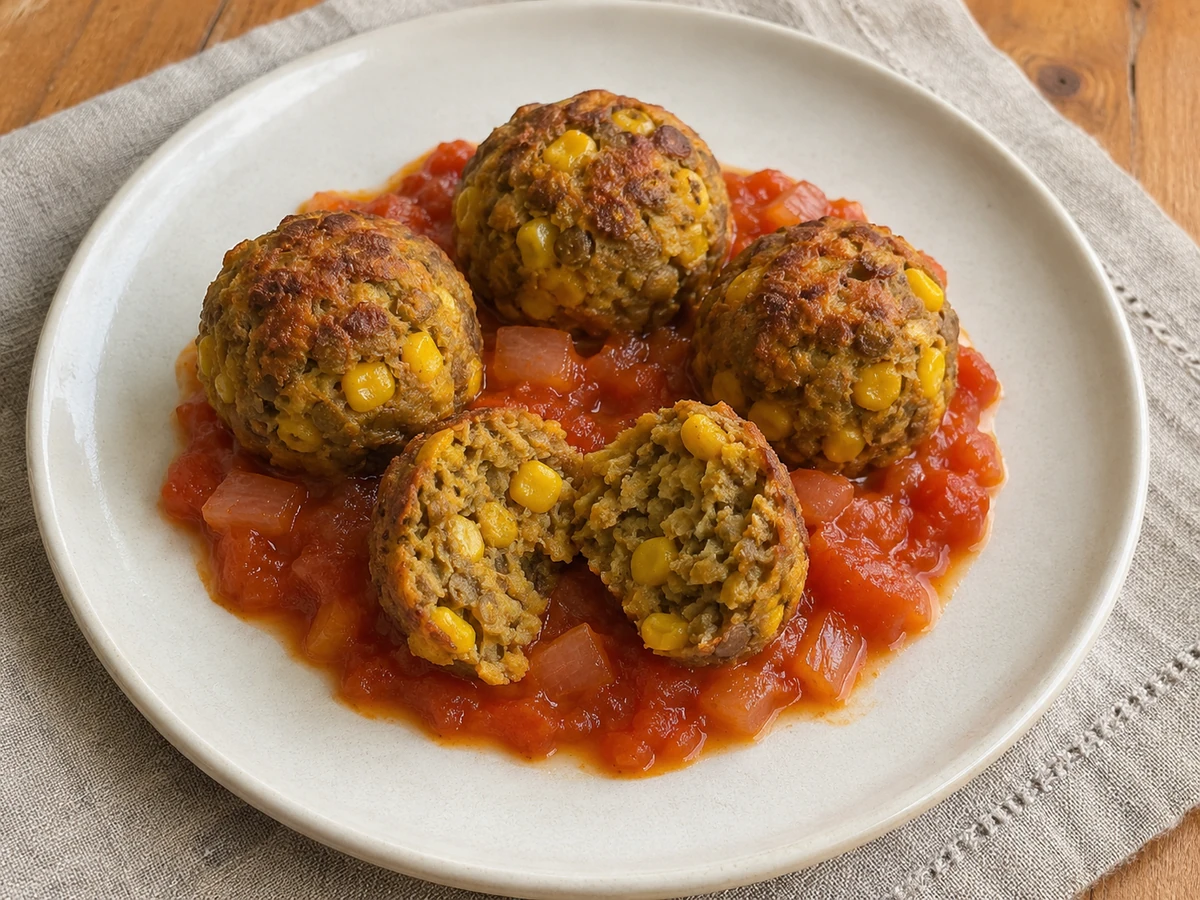
Ingredients
- 500 g green lentils already boiled without added salt, well drained
- 200 g canned sweetcorn, drained weight
- 160 g peeled onion, 80 g for balls and 80 g for sauce
- 100 g raw egg without shell, approximately 2 eggs checked by weighing
- 60 g T65 wheat flour
- 500 g raw tomatoes with their juice
- 10 g peeled garlic
- 30 g olive oil, 10 g for balls, 10 g for sauce and 10 g for brushing
- 150 ml drinking water for sauce
- 3 g salt, 2 g for balls and 1 g for sauce
Preparation
Drain and weigh 500 g green lentils already cooked without added salt and 200 g drained canned sweetcorn.
Soften 80 g onion in 10 g oil for 6 minutes; cool to lukewarm for 10 minutes. Preheat oven to 200 °C.
Mash 350 g lentils and add the remaining 150 g, corn, onion, 2 g salt, 100 g shelled egg and 60 g T65 flour.
Rest for 10 minutes to hydrate, then shape sixteen approximately 4 cm balls; brush with 10 g oil.
Bake 15 minutes, turn and continue for 10–15 minutes. Check at least 74 °C at the centre and extend in 3-minute intervals if needed.
For sauce, cook the remaining 80 g onion in 10 g oil for 5 minutes and garlic for 1 minute; add tomatoes, 150 ml water and 1 g salt.
Simmer sauce for 20 minutes. Serve four balls per person with one quarter of the sauce.
Introduction
These balls aim for a recognisable pulse texture rather than an imitation of meat. Some lentils are mashed to form a soft base, while the remainder and the corn kernels retain texture. Egg and a measured amount of flour bind everything. Baking avoids deep-frying and allows the thirty grams of oil to be counted precisely across mixture, sauce and surface.
The recipe makes sixteen balls: four per person with a quarter of the sauce. Lentils are weighed already cooked and drained; cooking dried grains beforehand is not included in the stated times. This proposal belongs to the contemporary creations of Angola à table. It does not borrow a traditional Angolan preparation's name or present lentils and corn in this shape as a historically documented combination.
Cultural context
Lentils, sweetcorn and tomato are assembled here as a contemporary form of oven-baked balls. The reference to Angola identifies the collection's setting and is not evidence of national provenance for this mixture. Clearly naming ingredients and technique is preferable to giving the dish an invented local name.
FAO provides an institutional starting point for Angola's agricultural and food context: https://www.fao.org/angola. That context does not validate this particular recipe. General food-handling and cooling advice can be found at the French Ministry of Agriculture: https://agriculture.gouv.fr/cuisine-domicile-les-bons-gestes-dhygiene.
Tips
Weigh lentils after draining; never replace this weight with the same dry weight.
Chop onion finely enough to avoid large weak points.
Let onion cool to lukewarm and flour hydrate before judging consistency.
Use a wide spatula to turn balls rather than squeezing them with tongs.
Measure brushing oil in a small dish to distribute all the allocated quantity.
Planning
Check the lentils first. They must be tender at the centre but not sitting in cooking water. Drain in a sieve for at least ten minutes, then weigh 500 g. If prepared ahead, use lentils that were cooled promptly and stored correctly in the refrigerator. A salted can does not exactly match the no-added-salt lentil reference used for calculation. Drain sweetcorn separately and weigh 200 g; its intrinsic salt is included in the estimate.
Finely chop the 160 g onion, then divide into two 80 g piles. Soften the first half in ten grams of oil over medium heat for six minutes. Cool to lukewarm for ten minutes on a clean shallow plate. Onion that remains very hot would start setting the egg during mixing. Meanwhile wash and dice the tomatoes, keeping their juice, and chop garlic. Line a baking tray with baking paper and preheat a conventional oven to 200 °C.
Mash approximately 350 g lentils with a fork in a large bowl without aiming for a perfectly smooth cream. Add the remaining 150 g lentils, corn, lukewarm onion and two grams of salt. Break eggs separately, beat and weigh exactly 100 g without shell before adding. Fold in sixty grams T65 flour with a spatula. Rest for ten minutes to hydrate the flour. Do not taste the raw mixture: it contains uncooked egg and flour.
The mixture should form a ball with two spoons or clean, slightly damp hands. It remains softer than a minced-meat ball. Divide the entire mixture into sixteen comparable parts, without adding flour whenever uncertain. If excessively soft, refrigerate for fifteen minutes to firm before resuming shaping rather than adding unmeasured binder. This extra rest extends the total time and does not replace correct initial draining. Shape approximately four-centimetre balls on the tray.
Brush surfaces with the allocated ten grams of oil, sharing it across all sixteen balls. Bake for fifteen minutes, carefully turn with a spatula and continue for ten to fifteen minutes. The surface should be lightly coloured and the centre set. Use a clean probe to check at least 74 °C in the centre of one of the largest balls. If insufficiently hot or still very pasty, extend baking in three-minute intervals. A browned exterior is not a measurement of interior cooking.
Prepare sauce while the balls bake. Soften the reserved 80 g onion in ten grams of oil for five minutes; add garlic for one minute. Add 500 g tomatoes and their juice, 150 ml water and the remaining gram of salt. Simmer partly covered for twenty minutes, stirring. Crush a few tomato pieces with the spoon if needed without straining or discarding juices. If sauce reduces too far, add a little water. Keep sauce and balls separate until serving so the balls retain their structure.
Serving
Put a quarter of the sauce on each plate first, then arrange four balls without stirring them in it for long. This preserves the contrast between the slightly dry surface and tender centre. A ball may be cut at serving to show corn kernels and lentil structure. Extra accompaniments are possible but are excluded from the stated values. The dish contains wheat and egg; inform diners concerned by these allergens.
Storage
Cool leftovers quickly in a single layer in shallow containers and refrigerate at no more than 4 °C within two hours of cooking. Keep sauce separate and consume everything within forty-eight hours. Reheat only the portions needed until the centres of the balls and all the sauce are hot. If the starting lentils had already been chilled and then reheated in this recipe, consume immediately and do not plan another cooling and reheating cycle.
Variations
For a more uniform texture, mash a few more lentils while maintaining the total 500 g. For more rustic balls, keep more whole, but check they hold together before filling the entire tray. Another flour does not necessarily absorb water in the same way. Removing the egg without developing another binder does not produce a reliable vegan version. Such changes require reformulation and a new nutritional estimate.
Nutrition notes
Lentils and egg, and to a lesser extent flour and corn, contribute to protein. Fibre is estimated from weighed ingredients without attributing a therapeutic effect to the dish. Canned corn contributes intrinsic salt in addition to the three grams added. All oil, all sauce and sixteen balls are included in the calculation for four equal portions. Unequal balls or sauce left in the pan alter the amount actually eaten.
Conclusion
Structure depends above all on draining the lentils, partly mashing them and allowing flour to hydrate. Checking the centre is more useful than deep browning. Keeping sauce separate until plating preserves a slightly firm surface. This editorial creation is a formula to cook, without claiming a practical kitchen trial has already taken place.
Enjoy your meal
Enjoy your meal!