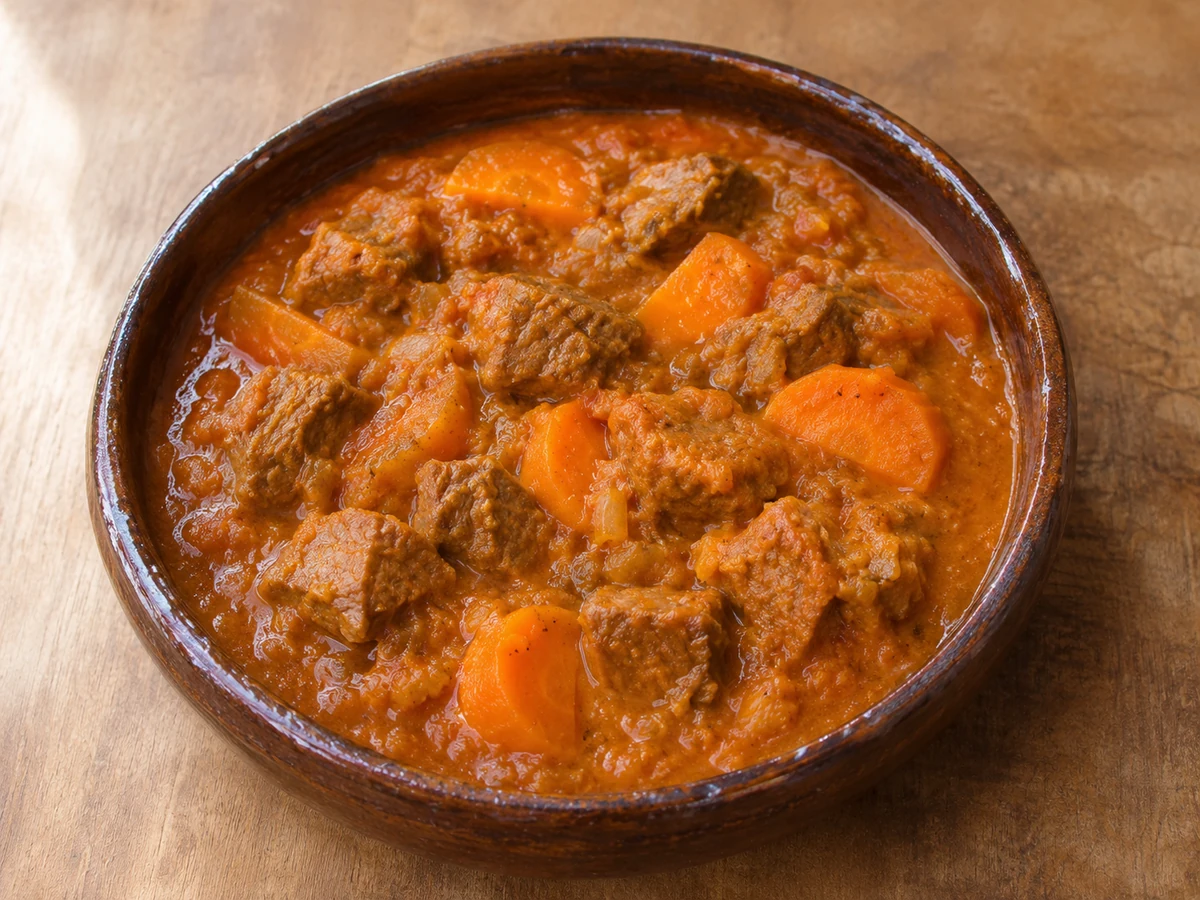
Kid goat stew with carrots and ginguba
A version using boneless kid meat, gently simmered with carrots, tomato and a thickening of unsalted roasted peanuts. A contemporary creation for Angola à table.
Ingredients
- 600 g raw boneless kid meat, inedible parts removed, in 3 cm cubes
- 600 g raw carrots, weight after peeling and trimming
- 300 g raw tomatoes
- 150 g peeled raw onion
- 60 g already roasted shelled peanuts without added salt
- 10 g peeled raw garlic
- 10 g peeled fresh ginger
- 15 g olive oil
- 800 ml drinking water, with a hot reserve if needed
- 3 g salt
Preparation
Prepare 600 g carrots in 1.5 cm half-rounds, 300 g diced tomatoes, 150 g onion, 10 g garlic and 10 g ginger, chopped or grated.
Finely grind 60 g unsalted roasted peanuts without adding fat.
Prepare 600 g raw boneless kid meat in 3 cm cubes on a separate board; clean hands and utensils.
Sear meat in two batches in 15 g oil for 8 minutes in total, then reserve. Soften onion for 6 minutes, add garlic and ginger for 1 minute, then tomatoes with their juice for 5 minutes.
Return meat and juices; add a total of 800 ml water and 3 g salt. Simmer covered for approximately 65 minutes until tenderness begins; extend before the next stage if needed.
Add carrots and cook partly covered for 25 minutes. Loosen ground peanuts with liquid taken from the casserole, fold in and simmer another 10 minutes, stirring.
Check meat and carrots are tender, adjust sauce with hot water, rest off the heat for 5 minutes and divide into four portions.
Introduction
This stew is formulated with kid, meaning a young goat, to specify the meat actually cooked and the nutritional reference used. The stated weight means boneless meat with inedible parts removed. Shoulder prepared by a butcher is suitable; a bone-in piece cannot replace it gram for gram. Gentle cooking should soften the fibres before carrots are added, helping them retain a recognisable shape.
Ginguba here means peanuts. They are used roasted without added salt, then finely ground to give the sauce body. They form neither a crust nor a garnish of whole peanuts. This combination is a contemporary creation for the Angola à table collection, not a transcription of a documented heritage recipe. The quantities make four portions without funge, rice or other accompaniments in the calculation.
Cultural context
The term ginguba is used for peanuts in the Angolan context. Angola's agricultural census documentation distributed by FAO explicitly links ginguba and amendoim: https://www.fao.org/fileadmin/templates/ess/ess_test_folder/World_Census_Agriculture/WCA_2020/WCA_2020_new_doc/ANG_REP4_POR_2019_2020.pdf. This lexical reference does not establish the age of the present stew or its belonging to a particular region.
The choice of boneless kid meat, carrot quantity and thickening sequence are contemporary editorial decisions. For general national agricultural context, also consult https://www.fao.org/angola. These institutional references help distinguish documented context from the proposed cooking formula.
Tips
Weigh only edible boneless meat and keep cubes uniform.
Add carrots once the meat has begun softening, not at the start.
Loosen peanuts before adding them to limit dry clumps.
Stir more frequently after thickening and lower the heat if sauce catches.
Keep hot water available; a wider casserole evaporates more in the same time.
Planning
First prepare vegetables and peanuts. Wash and peel carrots, trim the ends and weigh 600 g usable carrot. Cut thick half-rounds about one and a half centimetres thick; large carrots can be quartered lengthways before slicing. Wash tomatoes and dice, retaining juice. Chop onion and garlic separately, then grate ginger without leaving long tough fibres.
Grind the 60 g unsalted roasted peanuts in short pulses in a clean small processor. Stop at a fine, slightly oily meal; a perfectly smooth paste is unnecessary. Do not add oil to help processing. If the machine heats or particles cling to the sides, stop, scrape with a spatula and briefly resume. Reserve all the ground peanuts in a bowl: losses left in the machine would make the calculation less representative.
Prepare kid meat on a board separate from the clean vegetables. Check for bone fragments and remove large inedible tendons before weighing 600 g. Pat dry with disposable paper if the surface is very wet and cut even three-centimetre cubes. Do not rinse meat under running water. Clean hands, board and utensils after handling. Keep the meat refrigerated until searing.
Heat the 15 g oil in a three-to-four-litre casserole. Sear meat in two batches for eight minutes in total, turning to colour a few surfaces without burning the bottom. Reserve on a plate that must be washed before use for the finished food. Put onion in the casserole and soften for six minutes. If needed, add a small spoonful of measured water to release the juices, then add garlic and ginger for one minute. Fold in tomatoes with their juice and cook for five minutes.
Return the meat with the juices on its plate. Add a total of 800 ml water and three grams of salt. Bring to a simmer, cover and cook gently for approximately sixty-five minutes. The liquid should simmer calmly, not bubble vigorously. Halfway through, check the base remains moist and add a little hot water if needed. Towards the end, test a cube with a fork: the meat should begin yielding without completely falling apart. If still very firm, extend this stage before adding carrots.
Add carrots and cook for twenty-five minutes, partly covered. Loosen the ground peanuts with two small ladlefuls of hot liquid taken from the casserole, then return this mixture to the stew. Simmer for another ten minutes, stirring regularly along the bottom because the thickened sauce can catch. Check meat and carrot tenderness; extend cooking if needed. The sauce should lightly coat, not become a compact paste. Adjust with hot water, then rest off the heat for five minutes. The two-hour cooking time is a guide including searing and sauce stages; the animal's age and the cut may require longer.
Serving
Serve in shallow bowls to keep sauce around the pieces. Divide meat into four comparable shares before distributing carrots and peanut-thickened sauce. A ladleful taken only from the surface may give uneven portions because meat often settles. An accompaniment is possible, but its quantities and nutrients add to the stated values. Clearly inform diners that the dish contains peanuts.
Storage
After the meal, promptly divide the stew into small shallow containers. Refrigerate at no more than 4 °C within two hours of cooking, sooner in very hot conditions, and consume within forty-eight hours. Do not leave the entire casserole cooling on the table. Reheat only the needed portion until hot throughout, stirring; 74 °C is a suitable guide for reheating. Loosen sauce with a little water without adding a new amount of peanuts.
Variations
Adult goat meat can require significantly longer and have a different composition; results and values must not be considered identical to this kid version. For a finer sauce, grind peanuts a little longer without increasing their amount. Replacing carrots with another vegetable requires reassessing its cooking time. A peanut-free version is a different formula whose thickening and values must be recalculated.
Nutrition notes
Kid meat contributes mainly to protein, while carrots and tomatoes contribute to carbohydrates and fibre per portion. Peanuts add particularly fats and must be counted even when they disperse completely in sauce. All oil is included. Values cover one quarter of the complete preparation without accompaniments; reducing liquid mainly changes concentration. They are neither an analysis of the dish actually served nor a therapeutic claim.
Conclusion
The intended result depends on patience before adding carrots and more attentive heat after adding peanuts. Look for meat that yields to a fork, tender carrots and sauce that remains supple rather than mechanically applying a time. Dividing pieces before liquid makes portions more even. This editorial creation is not represented as kitchen-tested.
Enjoy your meal
Enjoy your meal!