Mackerel braised with tomato and ginger
Pieces of mackerel fillet cook gently in a tomato sauce with onion and ginger. A contemporary creation for Angola à table.
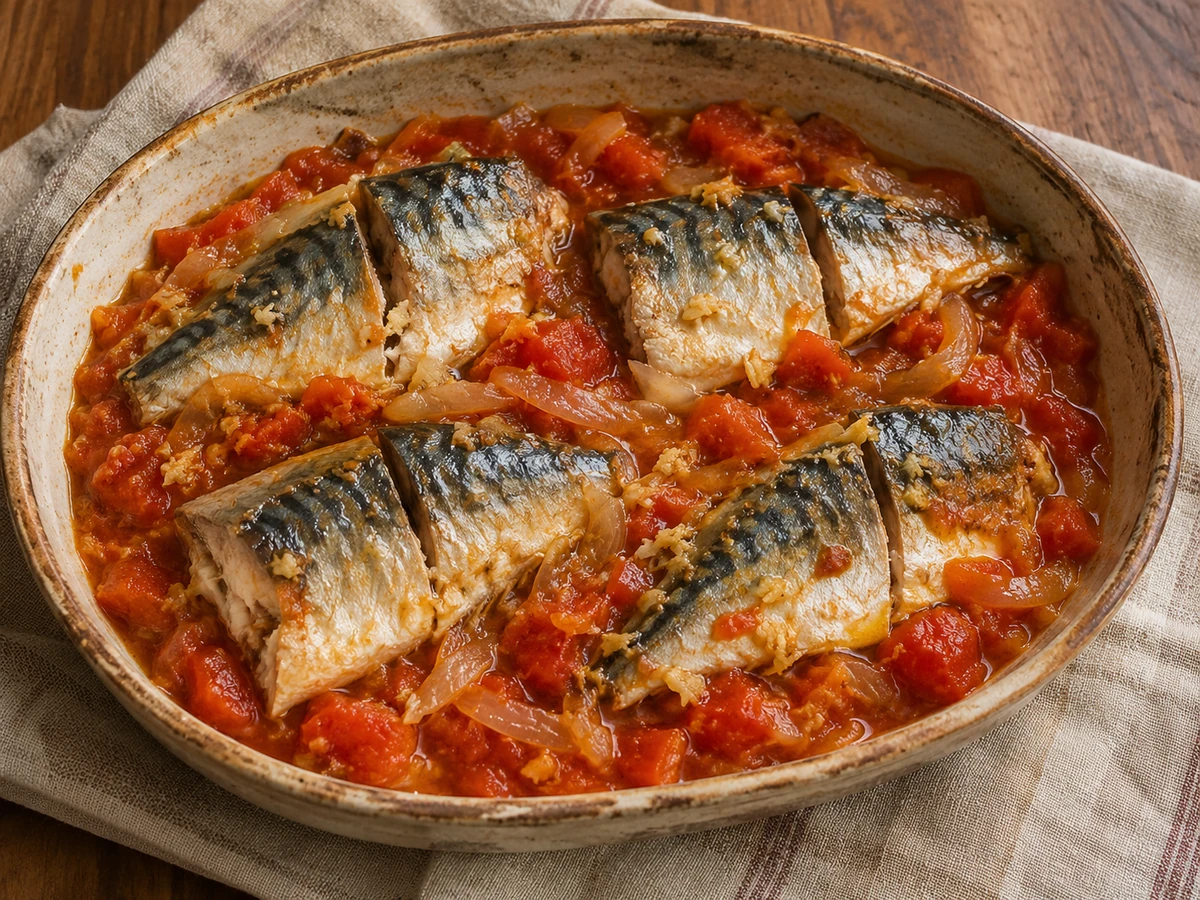
Ingredients
- 600 g raw common Atlantic mackerel fillets, skin on, pin bones removed, edible weight
- 600 g raw tomatoes
- 180 g peeled onion
- 15 g peeled fresh ginger
- 10 g peeled garlic
- 15 g olive oil
- 150 ml drinking water
- 2 g salt
Preparation
Prepare 600 g edible raw fillets, remove any bones found and cut into eight pieces; keep chilled.
Dice 600 g tomatoes; chop 180 g onion, 15 g ginger and 10 g garlic.
Soften the onion in 15 g oil for 7–8 minutes; add garlic and ginger for 1 minute.
Add tomatoes, juice, 150 ml water and 2 g salt; simmer partly covered for 12–15 minutes.
Arrange mackerel in one layer, skin side up; cover and cook gently for 8–12 minutes.
Verify at least 63 °C at the centre of the thickest part with a clean probe; remove thinner pieces as soon as cooked.
Share two pieces and one quarter of the sauce per person; serve hot, with no accompaniment included in the calculation.
Introduction
Mackerel has a sufficiently assertive flesh to remain noticeable in a tomato sauce. This recipe does not try to hide it beneath a thick crust or make it disappear in a long-stirred stew. The fillets go into a sauce that is already nearly finished, then cook gently in a single layer. Ginger adds a clear aroma, while onion softens the tomato's natural acidity. The skin stays on to help the pieces hold together during serving.
The formula uses common Atlantic mackerel sold as raw fillets, not smoked, salted or canned fish. The 600 g refers to edible fillet weight after removing any bones found, without head or skeleton. This distinction matters for cooking as well as the nutritional estimate. Four servings are intended, with no rice, bread, funge or other accompaniment included. The combination belongs to a contemporary collection inspired by Angola; it is not presented as a documented traditional speciality.
Cultural context
This proposal brings together a strongly flavoured fish, tomato sauce and fresh aromatics in a contemporary cooking approach. Here, braising describes short covered cooking in a moist base; it does not imply a long stay in the oven. Neither that technique nor ginger's presence establishes an ancient Angolan origin for this precise combination.
The country's food and agricultural context can be explored through FAO's representation in Angola: https://www.fao.org/angola. This institutional source does not certify the recipe. Handling advice and the fish temperature reference can be consulted with the FDA: https://www.fda.gov/food/buy-store-serve-safe-food/selecting-and-serving-fresh-and-frozen-seafood-safely. An editorial recipe should distinguish these documentary references from its own culinary proposal.
Tips
Prepare the sauce before taking fillets out of the refrigerator.
Keep eight comparable pieces instead of multiplying small fragments.
Use a wide sauté pan; stacking causes uneven cooking.
Insert the probe from the side of a thick piece to reach its centre without touching the hot pan bottom.
For larger quantities, choose two pans instead of doubling the depth of fish.
Planning
Buy the fish from a professional supplier and transport it promptly under chilled conditions. Keep in the coldest part of the refrigerator, at no more than 4 °C, until cooking. If frozen, thaw the fillets in the refrigerator in a covered container following the packaging, then drain and weigh; this waiting time is not included in the stated sixty minutes. Do not thaw on the worktop. The cold chain is especially important for mackerel: subsequent cooking cannot correct every consequence of poor storage.
Wash and medium-dice the tomatoes, retaining their juice. Chop the onion finely enough to soften while the sauce base cooks. Grate or very finely chop the ginger, removing coarse fibres that would remain long in the mouth. Chop the garlic separately. Prepare the vegetables before the fish and use a separate board, or thoroughly clean equipment between operations. A spoon used for the sauce must not handle raw fillets and then go directly onto serving plates.
Run your fingers gently over each fillet to find remaining bones and remove them with clean tweezers. Check the central line as well. Cut the fillets into eight comparable pieces, two per person, rather than fragile small cubes. Pat lightly with disposable paper and return to the refrigerator while the sauce cooks. Do not salt the fish separately: the two grams are intended for the whole dish. Choose a covered sauté pan about 28 cm wide, large enough to accommodate the pieces without stacking.
Heat fifteen grams of oil over medium heat. Add the onion and soften for seven to eight minutes, stirring. It should become translucent, with a few lightly golden edges, without deep browning. Add garlic and ginger for one minute, followed by tomatoes, all their juice, water and two grams of salt. Stir, scraping up the light cooking juices from the bottom. Simmer partly covered for twelve to fifteen minutes until the sauce still flows but has no large firm tomato pieces. If it dries before that stage, add a little hot water, never an extra unmeasured quantity of oil.
Arrange the mackerel pieces in the sauce, skin side up. Press slightly so the underside contacts the liquid. Cover and maintain a gentle simmer for eight to twelve minutes, depending on thickness. Avoid repeatedly turning the pieces; spooning a little sauce over them is sufficient. Check the thickest part with a clean probe: it must reach at least 63 °C. The flesh becomes opaque and separates into flakes, but this visual sign supplements the measurement rather than replacing it when thickness varies.
If some pieces are thinner, lift them out with a broad spatula once cooked and briefly keep in a covered dish while the rest finish. Do not cook everything for another ten minutes merely to thicken watery sauce. Instead, remove all cooked pieces, reduce only the sauce, then return the fish off the heat to coat it. Separating the operations preserves its texture better. Check once more that no visible bones have come loose before dividing into four servings.
Serving
Warm the plates slightly, then dry before serving. Lift pieces with a broad spatula rather than a fork that would tear the skin. Allow two pieces per serving, balancing their size as well, and divide the sauce with its onions. An accompaniment may be offered separately, but its composition adds to that of the recipe. Ask everyone to remain alert for bones: even after careful checking, a fillet should never be declared absolutely bone-free.
Storage
The best result is obtained by serving immediately. To keep leftovers, promptly divide them into small shallow containers and refrigerate at no more than 4 °C within two hours of cooking. Consume within twenty-four hours. Reheat only the amount needed, once, until thoroughly hot, protecting the pieces with sauce. Do not use reheating to artificially prolong storage. Discard a portion that has spent too long at room temperature.
Variations
For a smoother sauce, crush some tomatoes before introducing the fish, without blending the fillets afterwards. Reduce ginger at the outset if its aroma seems too prominent; sugar is not needed to correct it. Another oily fish would require reassessing timings and nutritional values. Smoked, salted or canned mackerel does not replace these raw fillets gram for gram: salt, water content and cooking would differ. Every adaptation becomes a different formulation.
Nutrition notes
Mackerel provides an important share of this preparation's protein and fat. Tomatoes and onion are counted with their retained juices, as is all added oil. The calculation concerns one quarter of the dish, not 100 g fish alone. It includes the ingredients' intrinsic salt and the two grams added to the sauce. Evaporation changes serving weight but does not automatically remove nutrients from the pan. These estimates are neither an analysis of the cooked dish nor a health promise.
Conclusion
Practical success depends on advancing the sauce sufficiently before adding the fish and cooking the fillets gently. Checking the pieces' centres avoids relying on surface colour alone. Dividing fish and sauce separately then helps create four more consistent servings. This contemporary formula is offered as a precise basis for cooking; it is not represented as kitchen-tested.
Enjoy your meal
Enjoy your meal!