Hake simmered with peppers and okra
Four portions of hake gently poached in a tomato and red pepper sauce with already cooked okra. A contemporary creation for Angola à table.
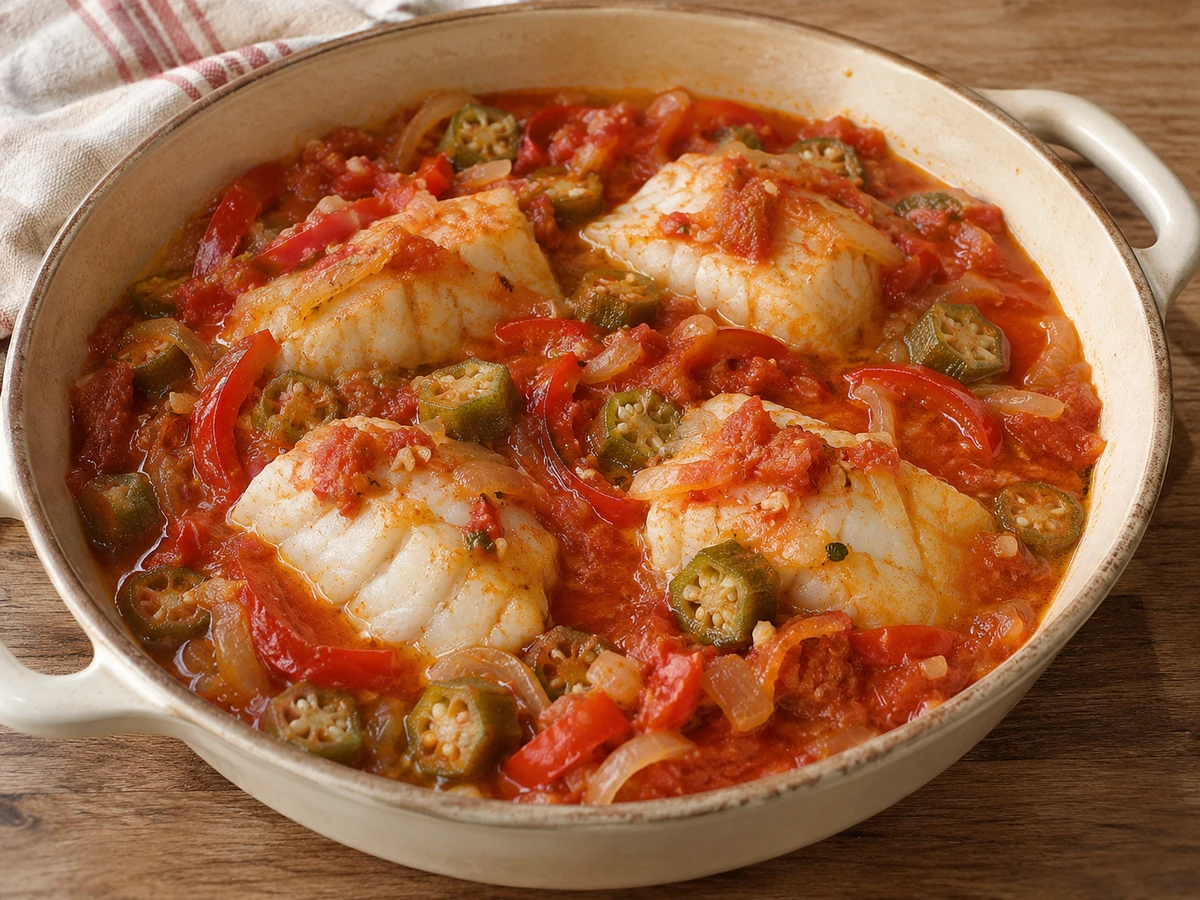
Ingredients
- 600 g raw skinless, boneless hake fillet, divided into four portions of approximately 150 g
- 350 g raw red pepper, weighed after removing stalk and seeds
- 300 g okra already steamed without salt, cooked drained weight
- 400 g raw tomato
- 150 g peeled raw onion
- 10 g peeled raw garlic
- 25 g olive oil
- 150 ml drinking water
- 3 g salt
Preparation
Prepare 600 g raw skinless, boneless hake fillet as four portions; keep chilled.
Weigh 300 g okra already steamed without salt and drained, then cut into 1.5 cm sections.
Cut 350 g red pepper into strips, dice 400 g tomato, thinly slice 150 g onion and finely chop 10 g garlic.
Soften onion in 25 g oil for 6 minutes. Add pepper for 8 minutes, then garlic for 1 minute.
Add tomatoes and juice, 150 ml water and 3 g salt. Simmer partly covered for 10 minutes and check pepper tenderness.
Fold in okra, lay in hake and cover. Gently cook for 8–12 minutes without stirring the fillets.
Check at least 63 °C at the centre of several portions with a clean probe, then divide fish, vegetables and sauce into four servings.
Introduction
Hake has delicate flesh that breaks apart if the pan is stirred vigorously. This recipe first builds a sufficiently cooked sauce, then lays the fish in it for a final gentle cooking stage. Pepper provides soft strips and okra adds a light thickening effect. The result is neither a watery soup nor a vegetable purée: the sauce should accompany each fish portion without completely hiding its shape.
This proposal belongs to the contemporary section of Angola à table. It has no invented regional name and does not claim to reproduce an established traditional recipe. Choosing hake allows a precise formulation rather than the simple word 'fish', which would leave thickness and composition entirely variable. The quantities yield four portions of one hundred and fifty grams of raw flesh each, with vegetables equally shared. Rice or other starchy accompaniments served alongside are not included in the formula.
Cultural context
The combination of fish, okra and vegetable sauce serves a contemporary editorial creation here. It is not sufficient to identify a specific Angolan recipe or assign it a traditional name. Choosing skinless fillets and precooked okra makes operations and weights explicit, while producing a preparation different from a whole-fish dish.
The national food context can be explored through FAO's Angola resources: https://www.fao.org/angola. This source does not attest to the formula. Institutional temperature guidance for fish fillets is available from FoodSafety.gov: https://www.foodsafety.gov/food-safety-charts/safe-minimum-internal-temperatures. Distinguishing a safety reference from evidence of origin avoids presenting a creation as a documented tradition.
Tips
Choose hake portions of similar thickness rather than four pieces equal in length but very different at the centre.
Weigh pepper after cleaning and okra after its prior cooking and draining.
Finish softening the peppers before adding delicate flesh.
Clean the probe before checking another food and avoid touching the pan base.
Increase cooking area or use two pans when doubling quantities, without stacking the portions.
Planning
Buy clearly identified hake fillet and ask for the bones to be removed. Nevertheless, check the flesh with clean fingers and remove any bones found. Weigh six hundred edible grams without skin, then divide into four portions of similar thickness, approximately two to three centimetres. Keep the fish refrigerated while preparing the vegetables. If frozen, thaw in a covered container in the refrigerator and drain; thawing time is not included in the stated sixty minutes.
The recipe starts with three hundred grams of okra already steamed without salt, then drained. Prior okra cooking is therefore not included in the stated time. When starting with raw pods, cook them separately until tender, then weigh the required cooked amount. Do not replace three hundred cooked grams with the same raw weight without considering preparation losses. Cut the cooked pods into approximately one-and-a-half-centimetre sections; they join the pan late so they do not disintegrate.
Wash peppers and tomatoes before cutting. Remove pepper stalks, seeds and thick white ribs, then weigh three hundred and fifty grams of usable flesh. Cut into one-centimetre strips. Dice tomatoes and retain their juice. Thinly slice the onion and finely chop garlic separately. Choose a broad lidded sauté pan approximately twenty-eight centimetres in diameter so the four hake portions fit without stacking.
Heat twenty-five grams of oil over medium heat. Add the onion and cook for six minutes, stirring without pronounced browning. Add pepper strips for eight minutes, then garlic for one minute. Pour in tomatoes and their juice, one hundred and fifty millilitres of water and three grams of salt. Simmer partly covered for ten minutes. Peppers should already be soft before the fish is added. If the sauce remains very watery, reduce uncovered for a few minutes; if it catches, add a little hot water.
Gently fold in the cooked okra, then lay the four hake portions on the sauce and press them in slightly. Cover and maintain a gentle simmer for eight to twelve minutes. Do not boil vigorously or stir with a spoon between the fillets. Instead, carefully move the pan in small motions if necessary. Check the centres with a clean probe: reach at least sixty-three degrees Celsius. Test several pieces, particularly the thickest. Serve once the flesh is opaque, cooked and separates easily, without extending cooking to obtain browning that is not intended.
Serving
Lift each portion with a wide spatula rather than a fork pushed into the middle of the flesh. Then distribute peppers, okra and sauce, reaching down to the bottom so that no plate is almost without vegetables. Serve hot with a sauce that still flows. Rice or a cereal paste may be added at the table in its own quantity; it is not included in this entry's nutritional values. Check for possible small bones when sharing.
Storage
Keep raw hake chilled between zero and four degrees Celsius and follow the period communicated at purchase. Already cooked okra must have been rapidly cooled and refrigerated covered before use. For leftovers of the finished dish, divide into shallow containers and refrigerate within two hours of cooking. Consume within twenty-four hours and reheat only the amount needed until hot at the centre. Do not leave the sauté pan cooling throughout an evening. Tomato sauce does not make fish safe to store at room temperature.
Variations
For a finer sauce, cut pepper into narrower strips while keeping its weight and checking tenderness before adding fish. For less pronounced thickening, leave some okra pods whole rather than cutting them into many small rounds; do not add unplanned starch. Another white fish requires reassessing thickness, time and the nutritional reference. Removing okra produces a different preparation that should no longer have exactly the same name.
Nutrition notes
Hake contributes mainly to the portion's protein, while oil provides some fat. Pepper, tomato, onion and okra are counted in the stated conditions: fish and the first vegetables are weighed raw, already cooked okra is weighed cooked. The generic cooked-okra reference represents steaming; this approximation is noted in the calculation. All salt and oil are included. The values per quarter remain estimates without health promises; fish is an allergen.
Conclusion
A sauce ready before the fish, portions without overlap and a centre-temperature check provide the essential guides for this preparation. Okra does not need prolonged recooking because it joins the pan already tender. Keeping fillets intact during serving makes sharing clearer. This contemporary recipe is an editorial formula and is not declared kitchen-tested.
Enjoy your meal
Enjoy your meal!