Baked sardines with onions and lime
Opened sardine fillets baked on soft onions and finished with lime juice. A contemporary creation for Angola à table.
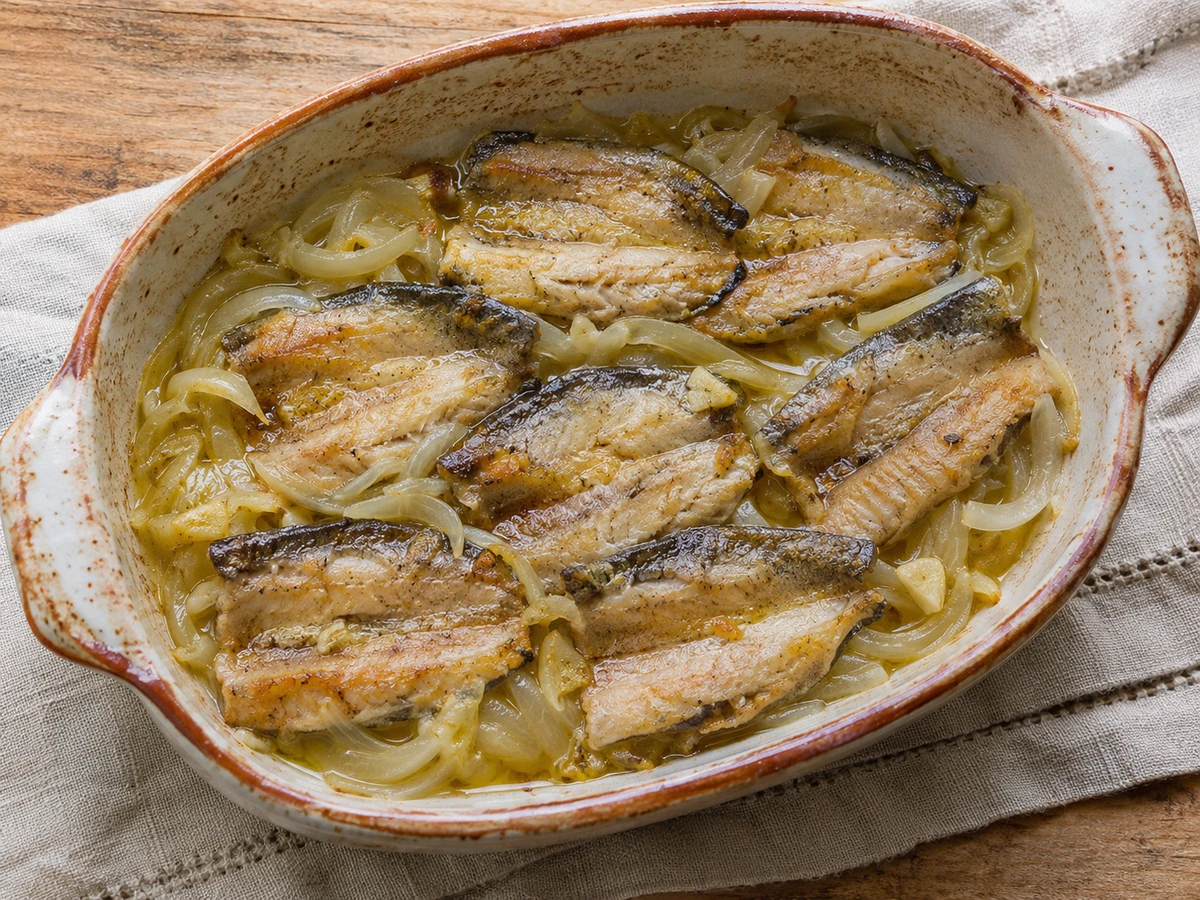
Ingredients
- 600 g raw butterflied sardine fillets, skin on, without heads or central backbone, edible weight
- 400 g peeled raw onion
- 10 g peeled raw garlic
- 25 g olive oil: 15 g for the onions and 10 g for the fillets
- 40 g freshly squeezed, strained lime juice
- 60 ml drinking water
- 2 g salt: 1 g for the onions and 1 g for the sardines
Preparation
Prepare and weigh 600 g edible raw fillets; remove remaining bones and keep the sardines refrigerated.
Preheat the oven to 190 °C. Thinly slice 400 g onion and finely chop 10 g garlic.
Mix onions and garlic in the dish with 15 g oil, 60 ml water and 1 g salt. Cover and bake 25 minutes; extend by 5 minutes if needed to soften the onions.
Arrange the fillets in one layer, skin against the onions. Spread 10 g oil and 1 g salt over them.
Bake uncovered for 10–15 minutes; check at least 63 °C in the thick flesh with a clean probe.
Out of the oven, add 40 g lime juice. Rest 2 minutes, divide fish and onions into four portions and serve.
Introduction
Sardines bring flavourful flesh that needs a short cooking time, whereas onions need longer to soften. The method therefore separates the two stages: first the onion bed, then the fillets join it in the same dish. Lime finishes the preparation out of the oven. This arrangement keeps the ingredients recognisable without reducing the fish to flakes or leaving crunchy onion beneath flesh that has already dried out.
This is a contemporary creation for the Angola à table collection, not a regional recipe with an established origin. Baking takes the place of cooking over embers here; it should not be presented as the exact equivalent of grilled fish. The four portions are calculated from six hundred grams of edible raw fillets, with skin but without heads, innards or central backbone. The purchase weight of whole sardines will be greater and depends on the preparation carried out by the fishmonger.
Cultural context
This entry offers a contemporary interpretation of fish with onion and citrus within a collection devoted to Angola. It does not give a local name to an invented formula or claim to summarise the practices of the country's fishing communities. Choosing opened fillets makes edible weighing and family sharing easier, but is an editorial and practical choice.
FAO's representation in Angola provides context for the country's agricultural and food questions: https://www.fao.org/angola. It does not certify this recipe. The institutional reference used for fish cooking guidance is FoodSafety.gov: https://www.foodsafety.gov/food-safety-charts/safe-minimum-internal-temperatures. These references document contexts or precautions; they do not establish a traditional origin for the dish.
Tips
Weigh fillets after preparation, not whole sardines with heads and innards.
Check onion tenderness before adding the fish; extend their cooking separately when necessary.
Keep sardines in a single layer to reduce differences in cooking.
Strain seeds from the lime juice and keep it separate until the dish leaves the oven.
When doubling quantities, use two dishes rather than a thick overlapping layer and check each dish.
Planning
Ask for sardines opened into butterfly fillets, then keep them chilled until the last moment. If frozen, thaw in a covered container in the refrigerator and drain before weighing. Do not thaw them on the worktop. Gently pat the surface with kitchen paper. Run a clean finger along the flesh to locate remaining bones and remove them with dedicated tweezers. Removing the backbone does not guarantee that every small bone is absent; remain attentive when serving, particularly to children.
Preheat a conventional oven to 190 °C. Use a baking dish approximately thirty by twenty centimetres, wide enough to hold the fillets in a single layer. Peel the onions before weighing four hundred grams. Cut into half rings two to three millimetres thick and separate the layers with your fingers. Finely chop the garlic rather than leaving large pieces that could burn. Measure oil, salt, water and juice separately so that several uncounted seasonings are not added along the way.
Place onions and garlic in the dish, add fifteen grams of oil, sixty millilitres of water and one gram of salt. Mix to moisten the slices, then cover with an ovenproof lid or baking parchment protected by aluminium foil. Bake for twenty-five minutes. Remove the cover carefully to avoid steam, stir and check a thick onion slice. It should bend easily under a fork. If it still clearly resists, cook covered for another five minutes before adding the fish.
Take the fillets out of the refrigerator only once the onion bed is ready. Spread the onions across the bottom and lay the sardines skin against the vegetables, flesh upwards. Avoid overlapping piles, which would cook less evenly. Spread the remaining ten grams of oil in a thin film and add the last gram of salt. Return to the oven uncovered for ten to fifteen minutes. The time depends on thickness, initial fish temperature and the dish used; begin checking after ten minutes.
Insert a clean probe sideways into the fleshy part of a fillet without touching the hot base. Check for at least sixty-three degrees Celsius at the centre, testing several places if the fillets differ in size. The flesh should be opaque and separate easily. A brown surface alone does not measure doneness. Once the fish is cooked, remove the dish and pour over forty grams of lime juice. Rest for two minutes, then lift the fillets with a wide spatula to serve without breaking them.
Serving
Allow one hundred and fifty grams of raw fillets per person when sharing the preparation, rather than insisting on an identical number of sardines of different sizes. Then divide the onions and cooking juices between the four plates. The liquid contains some of the oil included in the formula; leaving it all behind would make the actual plate differ from the calculation. Plain rice, vegetables or bread may be served separately but are not included in the stated values. Tell diners that small bones may remain.
Storage
Keep raw fish in the cold part of the refrigerator, between zero and four degrees Celsius, and cook within the period stated at purchase. For cooked leftovers, promptly divide into small containers, cover and refrigerate within two hours of cooking. Consume within twenty-four hours. Reheat only the amount needed until hot throughout. Sardines become drier when cooked a second time; do not use repeated reheating to try to prolong storage. Lime does not replace refrigeration.
Variations
For a more rustic presentation, retain complete onion rings while keeping the same thinness and weight. For subtler acidity, serve part of the measured juice separately instead of adding extra to the dish; the amount actually consumed may differ from the calculation. Another small fish is not automatically an identical substitute: its fat content, bones and thickness alter the result. Canned sardines are already cooked and often salted; they do not follow this method designed for raw fillets.
Nutrition notes
Sardines provide an important share of this preparation's protein and fat. Onions and lime juice are counted according to the stated weights, as are the twenty-five grams of oil and two grams of added salt. Values are estimated for one quarter of the recipe, without accompaniments. The food reference describes raw sardine; differences in size, season and lost cooking juices make the actual plate variable. Fish is an allergen that should be disclosed.
Conclusion
The decisive step is giving the onions a head start, then monitoring brief but complete cooking of the sardines. Lime juice is added at the end as a measured finish. Sharing fillets, vegetables and juices evenly makes the four portions more comparable. This editorial formula is not represented as kitchen-tested.
Enjoy your meal
Enjoy your meal!