Sorghum salad with papaya and cucumber
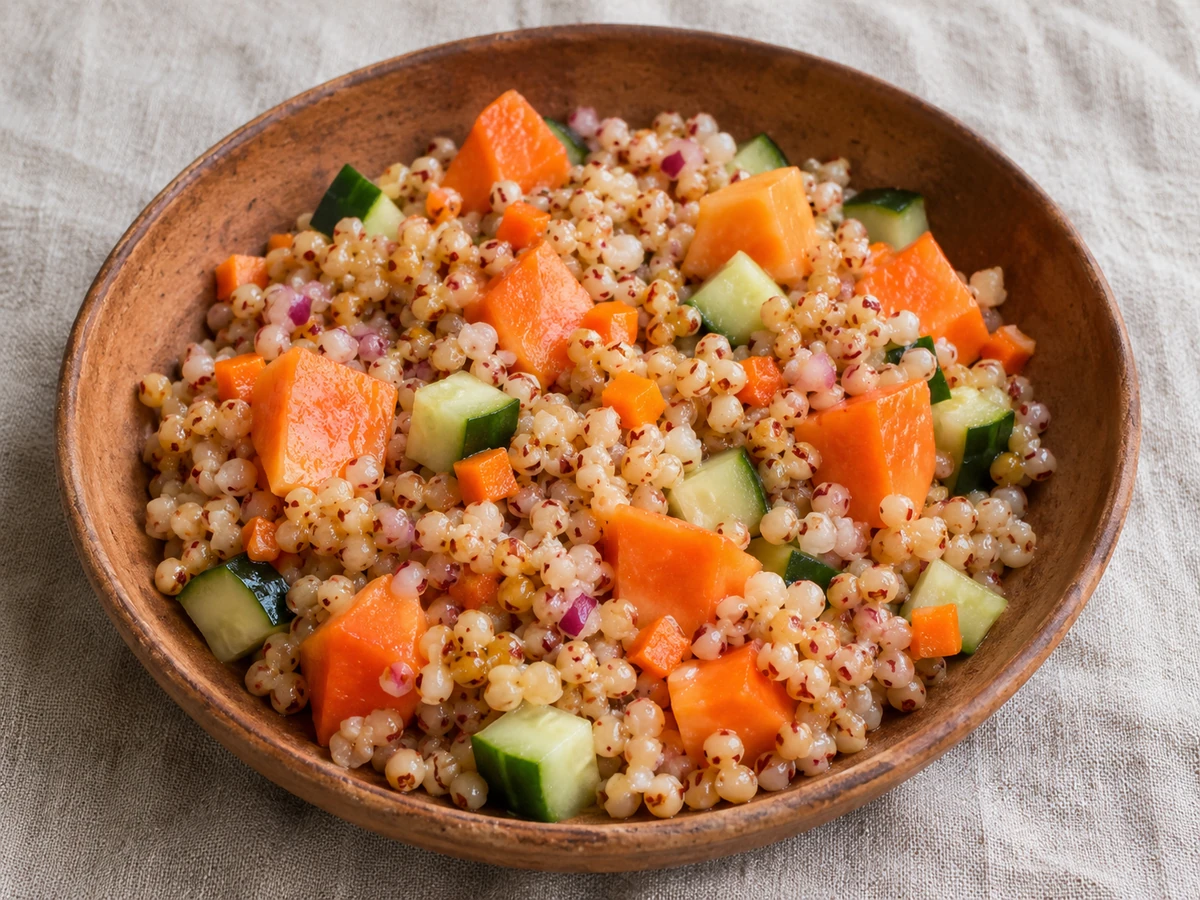
Tender yet distinct whole sorghum grains, firm ripe papaya and cucumber with carrot, red onion, lime and ginger. A contemporary creation.
Ingredients
- 180 g dried food-grade whole sorghum for cooking as grains
- 700 ml drinking water for soaking, to be discarded
- 900 ml drinking water for cooking, plus a little hot water if needed
- 300 g firm ripe papaya flesh, without skin or seeds
- 300 g washed raw cucumber, usable weight with skin
- 100 g peeled raw carrot
- 60 g peeled red onion
- 5 g peeled fresh ginger
- 30 g freshly squeezed lime juice
- 20 g olive oil
- 2 g salt
Preparation
Sort and rinse 180 g sorghum; cover with 700 ml water and soak for 8 hours in the refrigerator at no more than 4 °C.
Discard soaking water, rinse and put grains in 900 ml fresh water.
Bring to the boil, then simmer partly covered for 50–60 minutes; add hot water and extend cooking if centres remain hard.
Drain tender sorghum, rest 5 minutes, separate grains and spread in a shallow dish.
Chill promptly, aiming to refrigerate within an hour of cooking and never exceeding 2 hours at room temperature; allow approximately 45 minutes cooling.
Prepare 300 g diced papaya, 300 g diced cucumber, 100 g very finely diced carrot, 60 g chopped onion and 5 g grated ginger.
Mix 30 g lime juice, 20 g oil, 2 g salt and ginger; fold into cold sorghum.
Add vegetables, then papaya gently; divide into four portions and serve chilled.
Introduction
Whole sorghum gives this salad a firmer chew than white rice. Its small round grains must be cooked through and cooled before receiving pieces of papaya and cucumber. The intended contrast combines a tender but recognisable grain, soft fruit and crunchy vegetables. This is not cooled porridge: sorghum reduced to a paste, or flour, does not suit this method.
Choose ripe papaya whose flesh still holds its shape when cut. Very soft flesh would blend into the dressing instead of making distinct cubes. Cucumber is used with its skin if pleasant, after thorough washing. Carrot is cut smaller so it does not dominate each mouthful. Ginger remains a subtle note in lime dressing, with no added chilli. The four portions are generous starters or side dishes.
Preparation includes an eight-hour refrigerated soak. Start the day before or early in the morning, then allow for cooking and cooling. The indicative total of 620 minutes includes 480 minutes soaking, 25 minutes preparation, an estimated 70-minute cooking phase and 45 minutes cooling. Grain age and the manufacturer's instructions may require an actual extension.
Cultural context
This salad is a contemporary creation for Angola à table and claims no precise national tradition. Sorghum is used as whole grains for texture; it is not confused with millet or identified as a particular local variety without evidence. FAO provides institutional resources on the diversity of cereals covered by the International Year of Millets, including sorghum: https://www.fao.org/millets-2023/en. Angola's agricultural context can be approached through https://www.fao.org/angola. These references illuminate ingredients and an environment, not the origin of this papaya combination.
Tips
Check that grains are food-grade and follow any particular package instructions.
Weigh 180 g dry sorghum before soaking; swollen weight is not interchangeable.
Taste several grains to judge cooking rather than relying only on the volume of water absorbed.
Cool in a wide dish; a hot mass left in a deep bowl cools more slowly.
Cut papaya with a sharp blade and fold it in after vegetables to preserve its edges.
Planning
Check the sorghum packaging: it must contain whole food-grade grains, not garden seed, flour or puffed sorghum. Spread the 180 g on a plate and remove any debris. Rinse in a fine sieve. Place in a clean container with 700 ml soaking water, cover and keep for eight hours in the refrigerator at no more than 4 °C. Soaking is part of this cooking formula; it is neither a promise to remove particular substances nor a preservation method.
After eight hours, discard soaking water and rinse the grains. Put in a saucepan with 900 ml fresh water. Bring to the boil, reduce the heat and simmer with the lid ajar for 50–60 minutes. Keep grains covered with liquid, adding a little hot water if the level becomes insufficient. Check tenderness by tasting several grains cooled on a clean spoon. The skin may remain noticeable, but the centre must no longer be hard. If necessary, extend in ten-minute intervals according to the product rather than accepting a raw centre because the timer has sounded.
Thoroughly drain tender grains in a sieve, then rest for five minutes to release surface liquid. Separate with a fork and immediately spread in a thin layer on a clean dish. Refrigerate promptly once vigorous steam has dissipated, aiming for less than one hour after cooking ends; never exceed two hours at room temperature. Allow approximately 45 minutes cooling in a shallow dish. Time depends on volume and refrigeration; grains must be cooled before assembly.
Wash papaya before cutting. Open it, remove seeds and cavity fibres, then peel. Weigh 300 g flesh and cut into approximately 1.5 cm cubes with a clean knife. Wash and dry cucumber, trim ends and weigh 300 g usable cucumber. If the centre has large seeds and is very watery, remove it before weighing, then make up the weight with another piece. Dice into one-centimetre pieces. Do not draw out water using extra salt.
Peel the carrot, weigh 100 g and cut very small dice, approximately 4 mm; they remain raw, so large pieces would be difficult to share in a spoonful of sorghum. Finely chop 60 g red onion. Grate 5 g ginger, removing tough fibres. Mix lime juice, oil, salt and ginger in a bowl. Pour over cold sorghum and separate grains with two spoons. Add carrot, onion and cucumber, then fold in papaya last to avoid crushing it. Distribute fruit and grains into four equal portions.
Serving
Serve in four shallow bowls or on a wide platter, avoiding leaving all the fruit on top. Gently toss once more before dividing if dressing has settled at the bottom. Sorghum retains a pleasant resistance to the bite, but that must not be confused with an undercooked centre. An additional accompaniment may be served separately without describing it as included in the stated values.
Storage
Keep salad covered in the refrigerator at no more than 4 °C and consume within 24 hours. For advance preparation, keep papaya pieces separately and add close to serving. Cooked sorghum must have been cooled promptly before storage. Lime alone does not prevent microbial development. Take out only the quantity needed and do not keep until the next day a dish left at room temperature for more than two hours.
Variations
Particularly juicy papaya may be briefly drained before weighing its 300 g flesh, without squeezing it. For less onion flavour, reduce the initial quantity. Another grain cannot automatically replace sorghum using identical water volumes and times: millet, rice and couscous behave differently. Ginger may be omitted, but this changes the stated aromatic formula. Any substantial substitution requires recalculating nutrition.
Nutrition notes
The calculation uses sorghum dry before soaking, fruit and vegetables by raw usable weight, and all the oil and salt. Absorbed water increases cooked weight without adding macronutrients. Sorghum contributes particularly to carbohydrate and some protein and fibre; fruit and vegetables contribute to the overall composition. Four portions should receive comparable quantities of grains and garnish. The values remain approximate and do not describe a medical effect.
Conclusion
Grains cooked through, drained well and then cooled form this salad's foundation. Papaya is added only after dressing the sorghum and vegetables to preserve its shape. Organising soaking the day before avoids rushing cooking on the day of the meal. Keep chilled until serving. This contemporary editorial formula is not declared kitchen-tested.
Enjoy your meal
Enjoy your meal!