Millet salad with orange, cucumber and ginguba
Cooled millet grains, orange pieces, crunchy cucumber and roasted peanuts brought together in a contemporary salad.
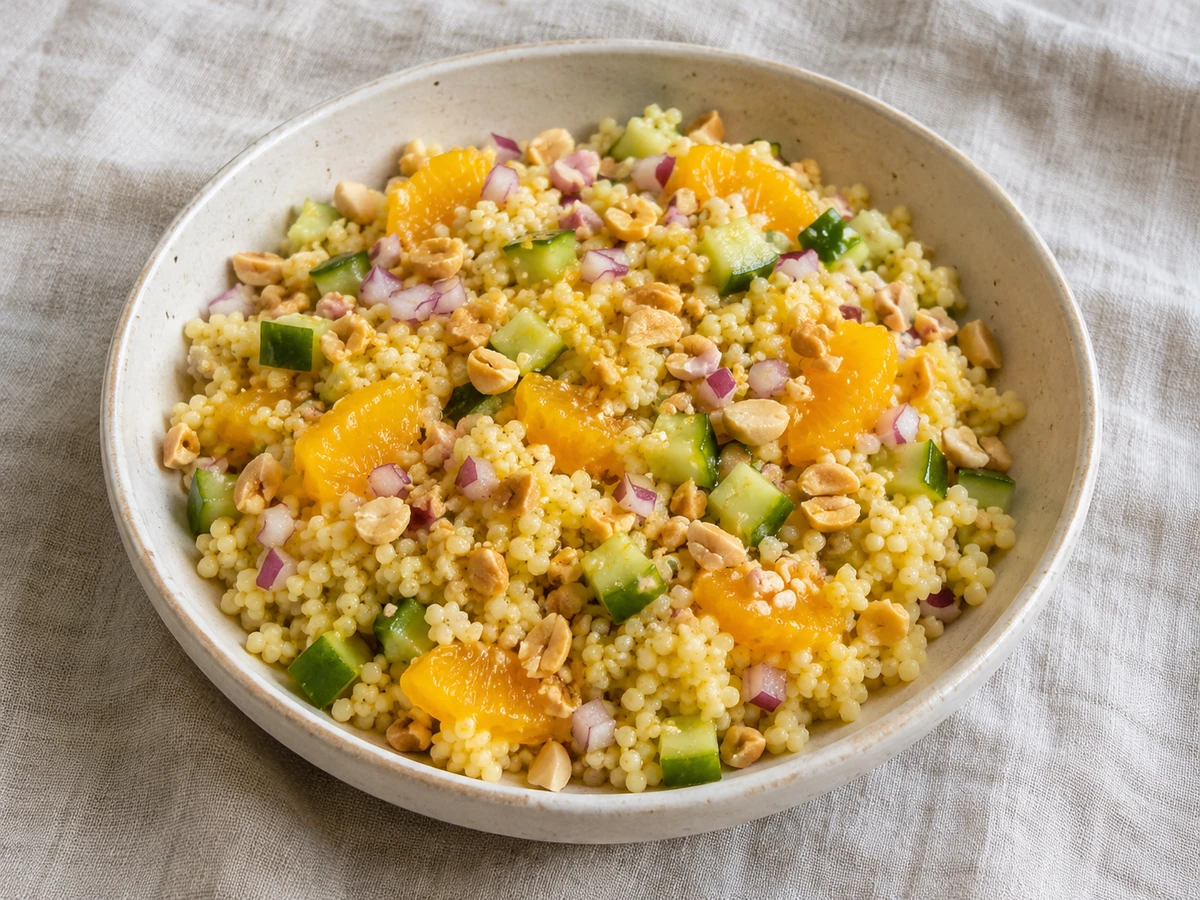
Ingredients
- 160 g dried hulled millet for cooking as grains
- 400 ml drinking water for cooking, with a small reserve if needed
- 300 g orange flesh without peel or seeds, including collected juice
- 300 g washed cucumber, usable weight with skin
- 60 g peeled red onion
- 40 g dry-roasted unsalted shelled peanuts
- 20 g olive oil
- 2 g salt
Preparation
Rinse 160 g dried millet and cook in 400 ml water over low heat, covered, for 15–20 minutes, adjusting water if needed.
Check tenderness, rest for 5 minutes and separate grains with a fork.
Spread in a clean shallow dish and chill promptly: aim to refrigerate within an hour and never exceed 2 hours at room temperature.
Prepare 300 g orange flesh and its juice; reserve about 2 tablespoons of that juice for dressing.
Dice 300 g cucumber and finely chop 60 g red onion. Roughly chop 40 g roasted unsalted peanuts.
Mix 20 g oil, 2 g salt and reserved juice; fold into cold millet with cucumber, onion and orange.
Add peanuts at the last moment, gently fold and divide into four equal portions.
Introduction
Millet gives this salad small, tender grains, orange adds juice and cucumber provides a fresh crunch. Roasted peanuts, referred to as ginguba in the Angolan context, add a firmer texture without becoming a sauce. The aim is an airy salad with distinguishable grains and evenly distributed fruit, without a pool of liquid at the bottom. Cooling the millet is therefore part of the preparation, not an indefinite wait on the worktop.
This recipe is a contemporary creation for Angola à table. It does not claim to reproduce a traditional salad or represent the diversity of millets grown and eaten across Africa. Use food-grade hulled millet sold for cooking as whole grains; flour, precooked semolina or a cereal mixture would require a different method. The four portions can be generous starters or side dishes. No fish, egg or other protein addition is included in the stated quantities.
Cultural context
The word ginguba refers here to peanuts; it does not make this salad an ancient recipe. The combination with orange, cucumber and millet is a contemporary editorial proposal. Angola's agriculture and cereal uses cannot be reduced to this dish, and a generic commercial millet should not be described without evidence as a specific local variety.
FAO provides institutional resources on millets and their diversity: https://www.fao.org/millets-2023. For national context, see https://www.fao.org/angola. These references illuminate ingredients and a food environment; they do not validate this formula's origin.
Tips
Weigh millet dry; cooked weight varies with water absorption.
Take dressing juice from the orange quantity already weighed.
Dice cucumber after removing any watery centre, then check usable weight.
Use unsalted peanuts to control the two grams of added salt.
Increase the area of the cooling dish when scaling up instead of piling up a hot mass.
Planning
Put the millet in a fine sieve and rinse under drinking water. Drain. Bring 400 ml water to the boil in a small heavy-based saucepan, add the millet, cover and reduce the heat. Cook gently for fifteen to twenty minutes, also following the package instructions. The grain should be tender without turning into paste. If the water is absorbed while the centre remains firm, add a little hot water and continue in short intervals. Do not try to compensate for hard grains with cold dressing.
Turn off the heat and rest with the lid on for five minutes. Separate the grains with a fork without crushing them. Immediately spread the millet in a shallow layer on a clean dish. Once the strong steam has dissipated, refrigerate rather than waiting for hours; aim to refrigerate within one hour of cooking and never exceed two hours at room temperature. Cooling may take thirty to forty-five minutes depending on the depth of the dish and available refrigeration. The total preparation time includes cooling.
Meanwhile, wash the oranges before opening them. Peel and remove seeds and thick white pith. Work over a bowl to collect juice. Weigh 300 g usable flesh and collected juice together. Cut the segments into two or three pieces and set aside about two tablespoons of available juice for the dressing. This comes from the stated 300 g, not extra fruit weight. A very dry orange may simply produce less dressing.
Thoroughly wash and dry the cucumber. Trim the ends and weigh 300 g usable cucumber, retaining the skin if pleasant. If the centre is very watery and contains large seeds, remove it before weighing and make up the weight with another piece. Cut into approximately one-centimetre dice. Do not salt to draw out moisture with additional salt: that changes the formula and softens the intended contrast. Peel and finely chop the red onion to distribute its sharpness without large raw mouthfuls.
Check that the peanuts are already roasted, unsalted and fit to eat. Coarsely chop with a knife on a stable board. The aim is small pieces, not powder that absorbs all the juice. Mix twenty grams of oil with two grams of salt and the reserved juice. Add to the cooled millet, then fold in cucumber, onion and orange with its remaining juice. Gently lift with two spoons. Add the peanuts just before serving and divide into four portions.
Serving
Serve chilled on a wide platter or four plates, distributing orange pieces and peanut fragments as carefully as the millet. Gently toss once more if juice has collected. A grain salad does not need to be compressed in a ring to hold together; a loose presentation better preserves the textures. Do not leave it waiting in sunlight or on a warm buffet; take out only what will be served.
Storage
Keep the salad covered at no more than 4 °C and consume within twenty-four hours. When preparing ahead, keep the peanuts dry and separate and add them when serving to retain crunch. Rapid millet cooling remains necessary even when orange is added later: juice does not replace refrigeration or hygiene. Do not refrigerate for another day a dish that has spent more than two hours at room temperature.
Variations
For less raw-onion flavour, reduce the amount instead of adding sweetener. A sharper orange naturally changes how the dressing tastes; taste before adjusting. Replacing peanuts with another seed changes allergens and nutritional composition. They may be omitted if needed, but the version should then be presented without ginguba and its values recalculated. An automatic substitution with couscous preserves neither the stated ingredient nor method.
Nutrition notes
The calculation covers one quarter of the complete preparation, including oil, orange juice and peanuts. Millet is counted dry, before water absorption. Peanuts contribute particularly to fats and some protein; their small quantity must not be omitted from the calculation. The salad contains peanuts, an allergen to disclose to diners. The figures describe a dietary estimate rather than a medical effect.
Conclusion
Three actions structure this salad: cook millet until tender, cool it quickly in a thin layer and add peanuts at the end. They preserve contrast better than adding many garnishes. Juice should coat the grains without drowning them. Divide the pieces evenly and serve chilled. This editorial creation is offered as a formula to cook and is not declared kitchen-tested.
Enjoy your meal
Enjoy your meal!